• News
  • Film and TV
  • Music
  • Tech
  • Features
  • Celebrity
  • Politics
  • Weird
  • Community
  • Advertise
  • Terms
  • Privacy & Cookies
  • LADbible Group
  • LADbible
  • SPORTbible
  • GAMINGbible
  • Tyla
  • UNILAD Tech
  • FOODbible
  • License Our Content
  • About Us & Contact
  • Jobs
  • Latest
  • Topics A-Z
  • Authors
Facebook
Instagram
X
Threads
TikTok
YouTube
Submit Your Content
Scientists are baffled after finding part of the Sun is actually 'broken'

Home> Technology> Space

Published 14:27 22 Nov 2024 GMT

Scientists are baffled after finding part of the Sun is actually 'broken'

Scientists have explained the significance of the event

Gregory Robinson

Gregory Robinson

google discoverFollow us on Google Discover

The sun is clearly a very important part of our solar system; it radiates light and heat which makes it possible for life on Earth to exist. But did you know a scientists observed a piece of the sun 'break away'?

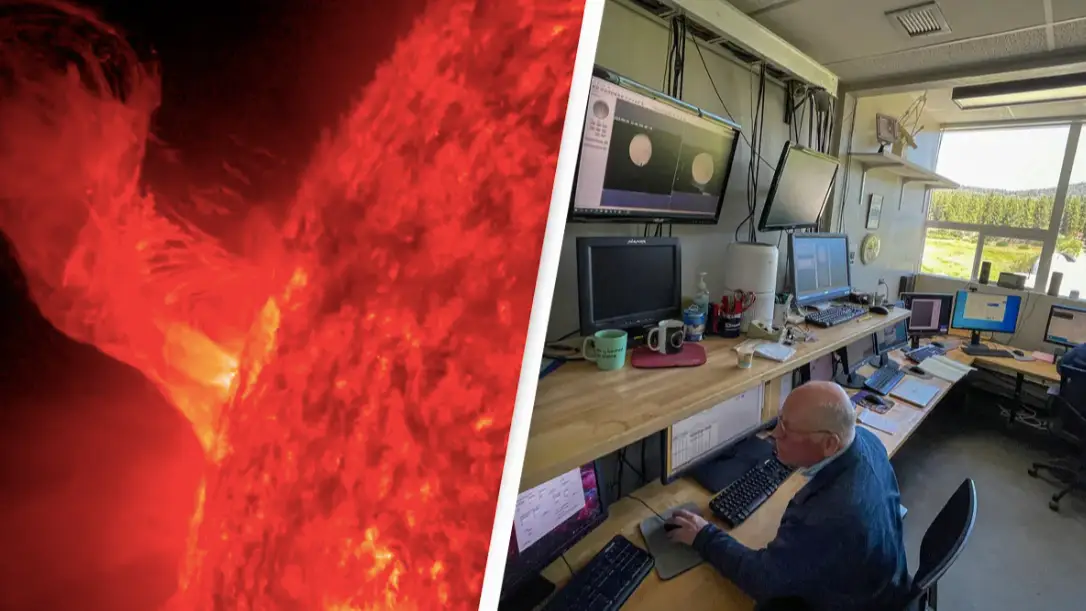
NASA’s James Webb Telescope captured the moment a section of the sun left the surface and was swept up in a polar vortex, and it understandably became a viral moment.

Space weather physicist and research scientist Tamitha Skov, from The Aerospace Corporation in Southern California, shared the news of the event on X as well as as imagery.


Advert

"Talk about Polar Vortex!" she shared. "Material from a northern prominence just broke away from the main filament & is now circulating in a massive polar vortex around the north pole of our Star."

She added: “Implications for understanding the Sun's atmospheric dynamics above 55° here cannot be overstated!”

The event happened on February 2, 2023. A solar prominence is a big, bright feature extending outward from the sun’s surface, NASA explains. They are anchored to the sun’s surface in the photosphere (the sun's outer layer) and extend outwards into the sun’s, ‘hot outer atmosphere, called the corona’.

The ‘red-glowing looped material’ which forms a solar prominence is plasma - a super-hot gas consisting of electrically charged hydrogen and helium.

So, to put it more simply, a large piece of plasma broke away from the sun’s surface and circled around its North Pole. The polar vortex it was swept up in is different to a polar vortex we might experience on Earth.
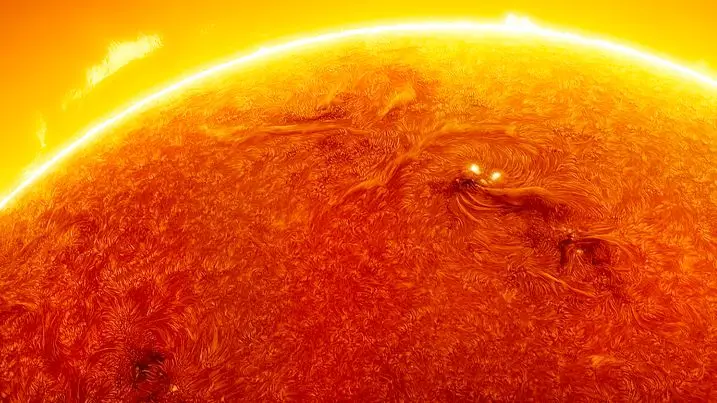
Scientists were very excited by the event (Getty Stock Image)

On our home planet, a polar vortex is a large area of cold air and low pressure that appears in the stratosphere, surrounding both of Earth’s poles, according to the National Weather Service.

Why was this 2023 event on the sun so exciting? Because it’s not always seen.

Scott McIntosh, a solar physicist and deputy director at the National Center for Atmospheric Research in Boulder, Colorado, told Space.com that the prominence mentioned by Skov appears exactly at the 55 degree latitude around the sun’s polar crowns every 11 years.

Scientists say it has something to do with the reversal of the sun’s magnetic field, which happens once every solar cycle, but they don’t know what’s behind it.

"Once every solar cycle, it forms at the 55 degree latitude and it starts to march up to the solar poles," McIntosh said. "It's very curious. There is a big 'why' question around it. Why does it only move toward the pole one time and then disappears and then comes back, magically, three or four years later in exactly the same region?"

Featured Image Credit: NASA/MediaNews Group/Orange County Register via Getty Images

Topics: Space, Science, NASA

Gregory Robinson
Gregory Robinson

Gregory is a journalist for UNILAD. After graduating with a master's degree in journalism, he has worked for both print and online publications and is particularly interested in TV, (pop) music and lifestyle. He loves Madonna, teen dramas from the '90s and prefers tea over coffee.

Advert

Advert

Advert

Choose your content:

5 hours ago
12 hours ago
a day ago
  • (YouTube/NASA Goddard)
    5 hours ago

    Terrifying NASA simulation reveals biggest known black holes and the largest could devour our galaxy

    It's very unlikely Earth will be swallowed whole, though.

    Technology
  • Getty Stock Photo
    12 hours ago

    Amazon returns worker explains what you should 'never ever' do when sending back items

    The insider also revealed the most disgusting item they had seen get returned

    Technology
  • NurPhoto/Getty
    a day ago

    Urgent warning to nearly 2 billion iPhone users over calendar scam you shouldn't click

    iPhone users have reported being unable to stop hackers from flooding their calendars with dangerous scam invites

    Technology
  • Joe Raedle/Getty Images
    a day ago

    NASA engineer explains what actually happens to poop in space as Artemis II mission around Moon launches next week

    Four astronauts will make history as they travel farther than anybody else during the Artemis II mission

    Technology
  • Scientists left baffled after discovering interstellar object hurtling towards our solar system
  • NASA scientists baffled after discovering rock structure on Mars that isn't from there
  • NASA releases closest-ever images to the sun and everyone is asking the same thing
  • Scientists studying NASA’s James Webb Space Telescope discover black hole 300 million times bigger than the sun