unilad homepage
unilad homepage
    • News
      • UK News
      • US News
      • World News
      • Crime
      • Health
      • Money
      • Sport
      • Travel
    • Music
    • Technology
    • Film and TV
      • News
      • DC Comics
      • Disney
      • Marvel
      • Netflix
    • Celebrity
    • Politics
    • Advertise
    • Terms
    • Privacy & Cookies
    • LADbible Group
    • LADbible
    • SPORTbible
    • GAMINGbible
    • Tyla
    • UNILAD Tech
    • FOODbible
    • License Our Content
    • About Us & Contact
    • Jobs
    • Latest
    • Archive
    • Topics A-Z
    • Authors
    Facebook
    Instagram
    X
    Threads
    TikTok
    YouTube
    Submit Your Content
    Extremely powerful cosmic ray hits the Earth and no one knows where it came from

    Home> Technology> Space

    Published 13:26 24 Nov 2023 GMT

    Extremely powerful cosmic ray hits the Earth and no one knows where it came from

    The minuscule particle carries 240+ exa-electron volts of energy, but its source remains unknown

    Rhianna Benson

    Rhianna Benson

    google discoverFollow us on Google Discover
    Featured Image Credit: Osaka Metropolitan University/L - Insight, Kyoto University/Ryuunosuke Takeshige/Teekid/Getty

    Topics: Science, Space

    Rhianna Benson
    Rhianna Benson

    Rhianna is an Entertainment Journalist at LADbible Group, working across LADbible, UNILAD and Tyla. She has a Masters in News Journalism from the University of Salford and a Masters in Ancient History from the University of Edinburgh. She previously worked as a Celebrity Reporter for OK! and New Magazines, and as a TV Writer for Reach PLC.

    X

    @rhiannaBjourno

    Advert

    Advert

    Advert

    Earth and space continue to pose baffling questions and mysterious phenomena to the human race on an almost daily basis.

    And this week, scientists studying our planet's atmosphere made a startling discovery.

    It's very rarely that something 'earth-shattering' appears or occurs within our galaxy without experts being able to pinpoint its cause or origin.

    Advert

    This being said, scientists were left dumbfounded this week when an extremely powerful cosmic ray smacked down into the Earth's atmosphere... with no apparent cause.

    The event has absolutely gobsmacked astrophysicists.

    Despite the minuscule particle carrying in excess of 240 exa-electron volts of energy, experts are finding it nigh on impossible to track the the cosmic ray to an obvious source.

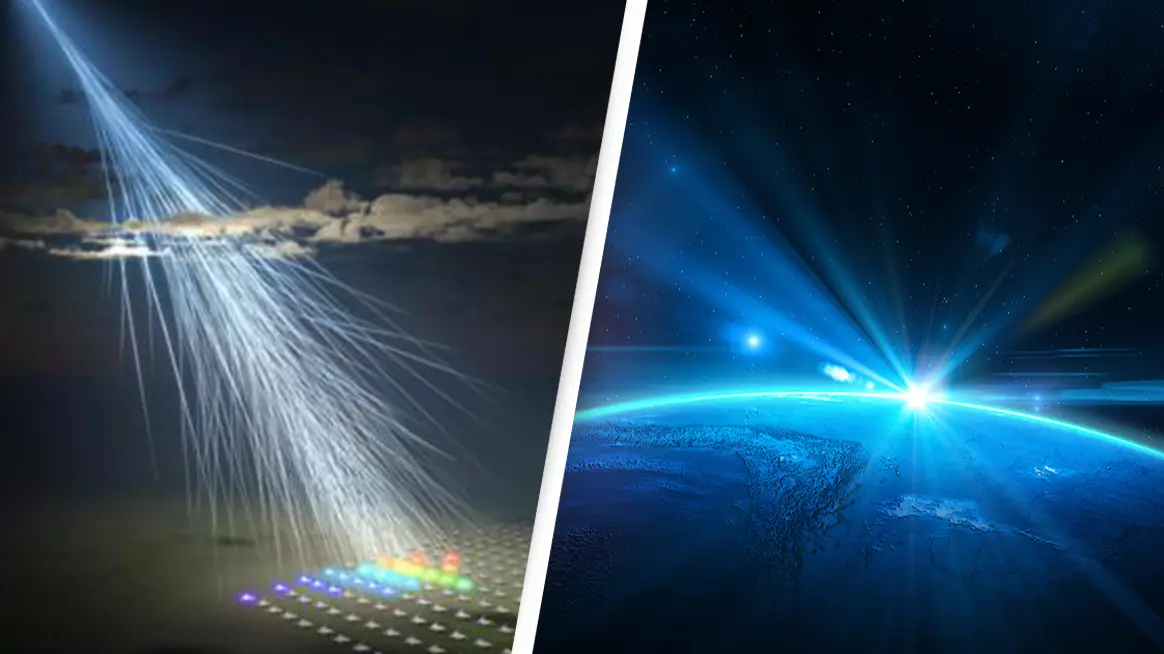
    Earth has been hit by a cosmic ray.
    Getty

    John Matthews - a physicist at the University of Utah - told press this week: "The particles are so high energy, they shouldn't be affected by galactic and extra-galactic magnetic fields.

    "You should be able to point to where they come from in the sky."

    The moment that a cosmic ray his the Earth's atmosphere, it collides with other particules, and in turn, producing a shower of particles, which subsequently fall to Earth.

    Observatories pick up on these shows, and link them to cosmic ray collision.

    Matthews - who is a member of the Telescope Array collaboration that made the discovery - added that the huge number of exa-electron volts of energy makes the ray second only to the mind-blowing 'Oh-My-God' particle.
    The cosmic ray has left scientists baffled.
    Getty/Dr Pixels

    This was detected back in 1991 at a colossal 320 exa-electron volts.

    "But in the case of the Oh-My-God particle and this new particle, you trace its trajectory to its source and there's nothing high energy enough to have produced it," Matthews explained.

    "That's the mystery of this – what the heck is going on?"

    Like much phenomena in the realms of science and space, cosmic rays have always posed complicated conundrum.

    Though scientists have had the ability to detect them - and have done for over a century, they still don't have a full understanding as to how they can be propagated throughout the Universe.

    This is because, unlike light, cosmic rays are not made from radiation.

    The cosmic ray can be caused by a supernova.
    Getty/Yuichiro Chino

    Instead, they're particles - predominantly atomic nuclei - but also sub-nuclear particles, like protons and electrons.

    These do stream through the Universe at close to the speed of light, however, but have much more power than they should have.

    It is common belief amongst experts that these cosmic rays are produced in energetic circumstances - such as in supernovas and stellar collisions.

    Lower-energy cosmic rays can also be produced by less energetic sources, like stars (including the Sun).

    The research team who made the latest cosmic ray discovery have fittingly named the new particle Amaterasu, after the Shinto goddess of the sun.

    Choose your content:

    3 days ago
    6 days ago
    8 days ago
    9 days ago
    • Justin Sullivan/Getty Images
      3 days ago

      OpenAI names 22 industries at risk of job losses as it proposes four day week

      Two new reports suggest AI might be coming for your job - but you could also get a three day weekend

      Technology
    • Kayla Bartkowski/Bloomberg via Getty Images
      6 days ago

      Congressman Tim Burchett claims he has seen UFO footage that ‘defies logic’

      Tim Burchett says he has seen UFO footage that couldn't be man made - and he wants answers from the government

      Technology
    • NASA/JPL-Caltech/MSSS
      8 days ago

      NASA's Curiosity rover makes groundbreaking discovery that suggests Mars can support life

      An expert has claimed the new reveal 'increases the prospect that Mars offered a home for life in the ancient past'

      Technology
    • John Nacion/Variety via Getty Images
      9 days ago

      Bill Nye issues stern warning to Trump over concerns he could 'end NASA'

      Bill Nye the Science Guy revealed that Donald Trump's NASA proposal is a 'huge mistake'

      Technology
    • NASA astronaut on ISS captures cosmic aurora unlike anything you'll see on Earth
    • Asteroid almost hits Earth and experts didn't even notice until hours later
    • NASA telescope made terrifying planet discovery where it rains glass at 4,300 miles per hour
    • Harvard scientist says mysterious object aiming at Earth is 'not natural' after pointing out one major issue