OpenAI names 22 industries at risk of job losses as it proposes four day week

It's been a big month for OpenAI after dropping two major reports, one mapping which jobs are most under threat from Artificial Intelligence, and the other suggesting a sweeping set of policy proposals that calls on, among other things, employers to trial a four day working week with no loss of pay.
The first report, called The AI Jobs Transition Framework, is a detailed breakdown of which industries face the biggest threats from AI job losses.
The second report, called Industrial Policy for the Intelligence Age: Ideas to Keep People First, is a set of huge policy proposals that includes a call on employers to trial a four-day working week and massively increase worker benefits like pensions, healthcare and much more.
All of this while being paid the same wages we get now.
Advert
Here's all you need to know.
Is a four day working week actually possible?
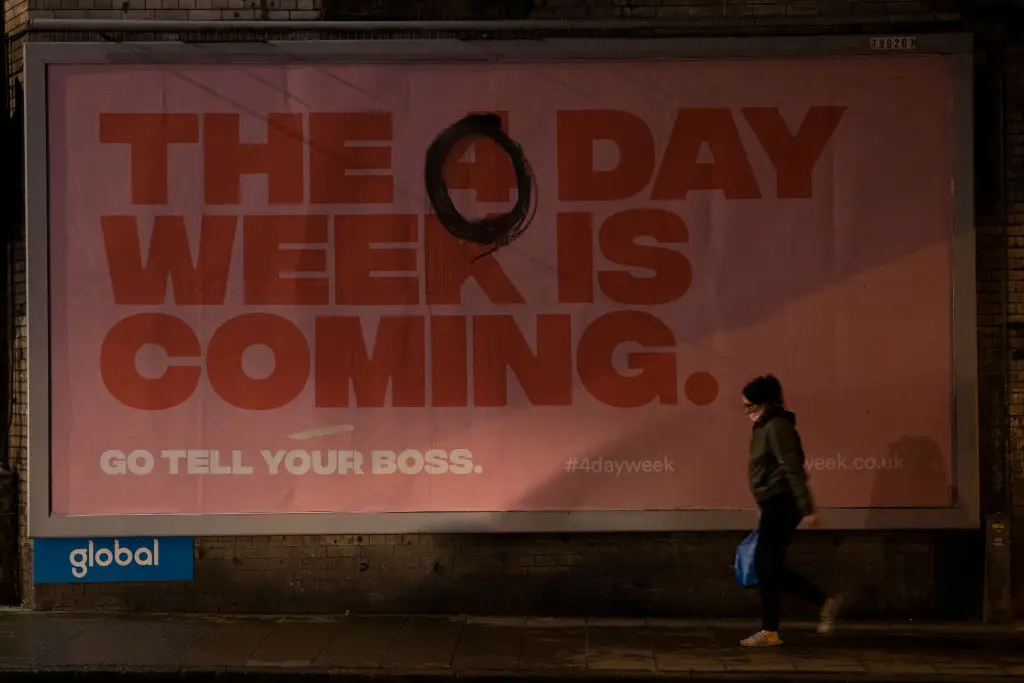
OpenAI is calling on governments to incentivize employers and unions to run 32 hour, four-day workweek pilots with no loss in pay that hold output and service levels constant - with the option to convert those reclaimed hours into a permanent shorter week, bankable paid time off, or both.
The idea suggests that AI productivity gains should actually benefit workers, not just company profits.
OpenAI also suggests firms should be finding durable improvements in workers' benefits as routine workloads decline, including: increasing retirement contributions, covering most healthcare costs and even subsidising childcare.
Not everyone is convinced it's that simple, however.
Speaking to the BBC, Prof Gina Neff of the University of Cambridge Minderoo Centre for Technology and Democracy said the idea of paying workers for efficiency gains from revolutionary tech is not new. But the difference now is that "OpenAI wants other companies to pay workers more while also paying them for subscriptions to their services.
"The ideas in this policy might work, but doing so will take a complete change in political headwinds."
Which jobs are most at risk from AI?
When it comes to its report on AI, authored by OpenAI Chief Economist Ronnie Chatterji, the company analyzed more than 900 occupations covering 153.7 million jobs, 99.7 percent of all US employment, to produce what it calls a clear picture of where AI will hit hardest and soonest.
So does being on the list mean you're losing your job? Not necessarily.
OpenAI splits all roles into four camps. 18 percent of jobs are at a genuine automation risk, 24 percent will see the workforce shrink - even though humans are still needed for key tasks - and 12 percent of jobs could actually grow because of AI; software developers and physical therapists being prime examples, where cheaper and faster output simply creates more demand.
The largest group, making up 46 percent, thankfully won't see much change very soon.
The most revealing section of the report is a chart that maps 22 broad industry groups by two measures: how much AI theoretically could take over their tasks, versus how much AI is actually being used right now.
The gap between those figures, what OpenAI is calling the 'Capability Overhang', is enormous across every single sector.
To put it plainly, AI can already do far more than workers in these industries are currently using it for.
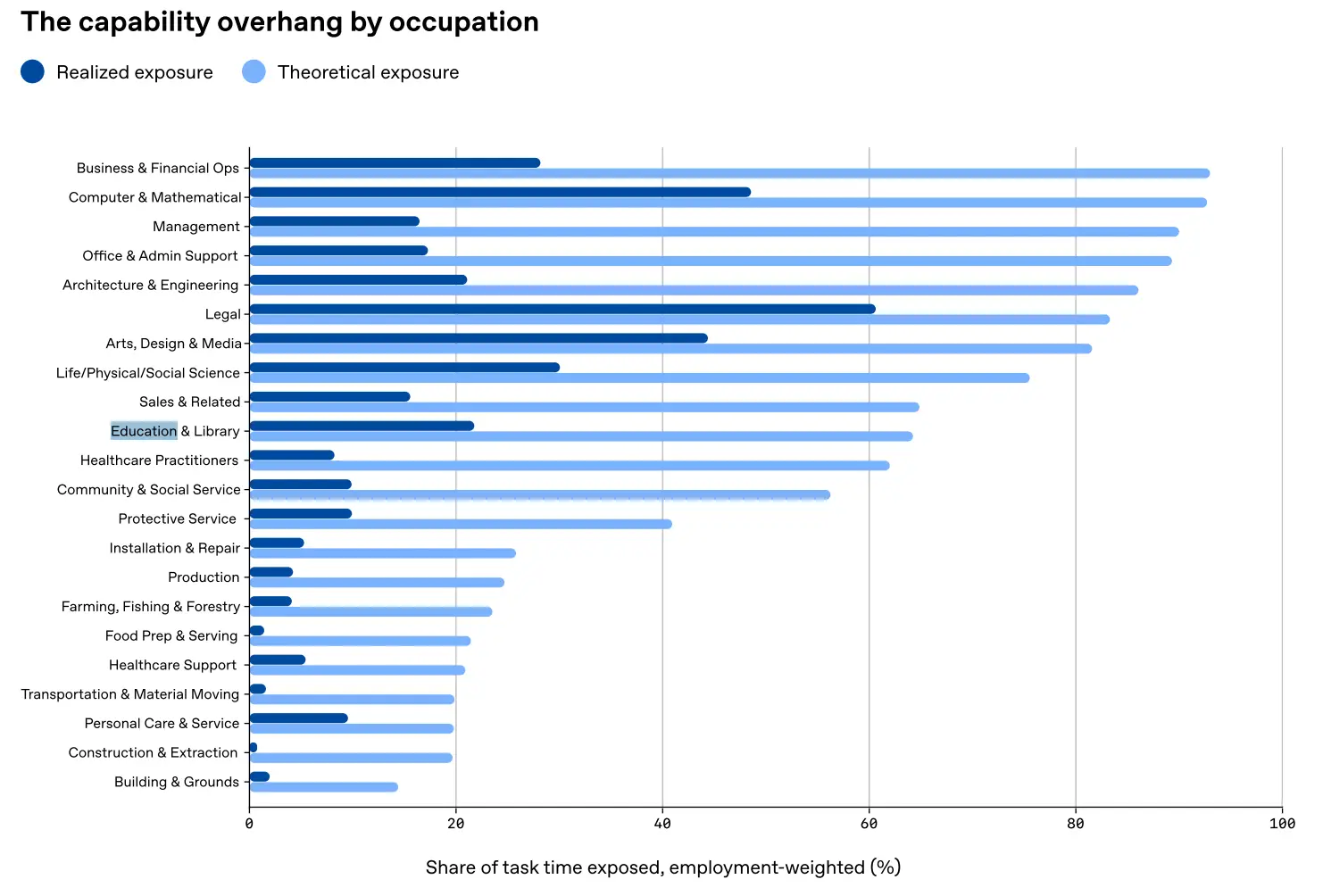
The industries ranked from highest to lowest theoretical AI exposure are:
- Business & Financial Operations
- Computer & Mathematical
- Management
- Office & Admin Support
- Architecture & Engineering
- Legal
- Arts, Design & Media
- Life/Physical/Social Science
- Sales & Related
- Education & Library
- Healthcare Practitioners
- Community & Social Service
- Protective Service
- Installation & Repair
- Production
- Farming/Fishing & Forestry
- Food Prep & Serving, Healthcare Support
- Transportation & Material Moving
- Personal Care & Service
- Construction & Extraction
- Building & Grounds
The sectors where AI is already being used most heavily relative to its potential include:
- Legal
- Arts/Design/Media
- Computer and Mathematical Roles
And finally, the sectors where actual usage is further behind what's theoretically possible, suggesting disruption still may be coming - include:
- Management
- Business and Financial Operations
- Office and Admin Support
Why AI is not all doom and gloom
But apparently, it's not all doom and gloom. OpenAI is arguing that simply measuring how much AI can do a job isn't enough to predict who will actually lose their jobs.
The report states: "Exposure helps us understand where AI has technical capability.
"It cannot, on its own tell us which jobs are most likely to be automated, redesigned, or expanded in the near term."
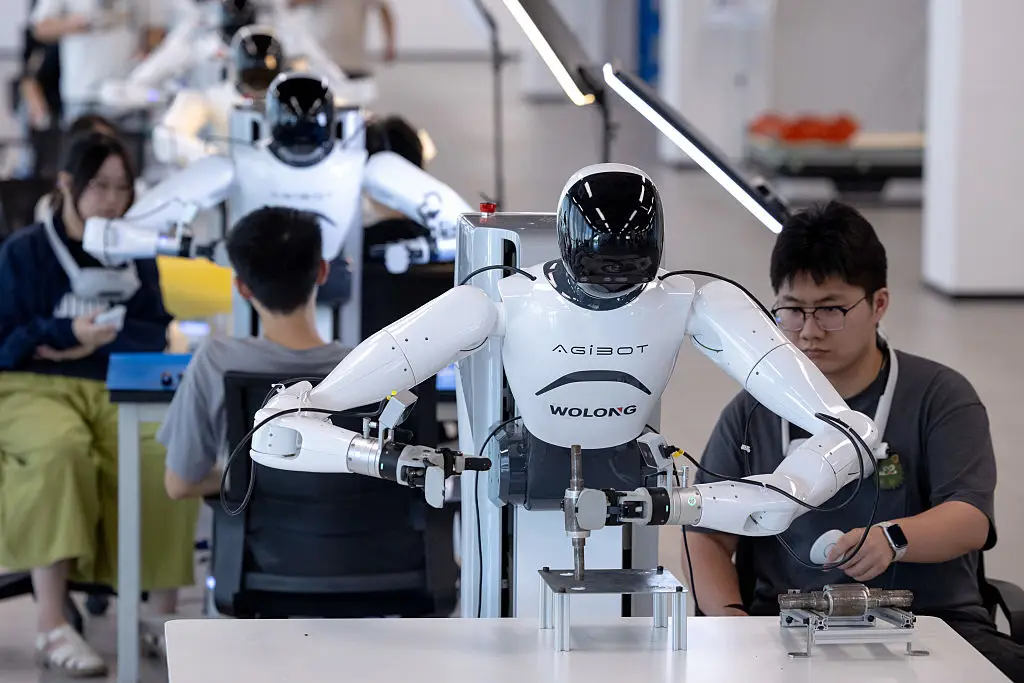
What does the future of work look like?
OpenAI warns that without thoughtful policies, AI could widen inequality by compounding advantages for those already positioned to capture the upside, while communities that begin with fewer resources could fall behind, excluded from new tools, new industries and new opportunities.
They have described the reports as 'the beginning of the broader conversation' rather than having all the answers, suggesting these are the conversations Governments, companies, civil society communities and families need to start having.
Topics: Artificial Intelligence, Technology
 Thomas Bamford