
• News
  • Film and TV
  • Music
  • Tech
  • Features
  • Celebrity
  • Politics
  • Weird
  • Community
  • Advertise
  • Terms
  • Privacy & Cookies
  • LADbible Group
  • LADbible
  • SPORTbible
  • GAMINGbible
  • Tyla
  • UNILAD Tech
  • FOODbible
  • License Our Content
  • About Us & Contact
  • Jobs
  • Latest
  • Topics A-Z
  • Authors
Facebook
Instagram
X
Threads
TikTok
YouTube
Submit Your Content
NASA confirms signs of life on asteroid that could change what we know about space

Home> Technology> NASA

Published 10:46 3 Dec 2025 GMT

NASA confirms signs of life on asteroid that could change what we know about space

The discovery takes us one step closer to finding life beyond Earth

Ellie Kemp

Ellie Kemp

Early signs of life have been detected on asteroid Bennu, revealing further clues about our origin.

Attention might have turned to the mysterious comet 3I/ATLAS in recent months, which NASA reckons is an asteroid, but one Harvard scientist thinks could be an alien probe. I hope you haven't forgotten all about Bennu, though.

The 500-meter-wide comet was once considered the most dangerous of its kind, given a 1-in-2,700 chance of hitting Earth between the years 2175 and 2199.

Back in 2016, the US space agency launched its OSIRIS-REx mission and collected samples from the spinning top-shaped space rock four years later in 2020. Samples from 4.5 billion year old Bennu landed in Utah back in 2023 and scientists have been working hard to analyze them ever since.

Advert
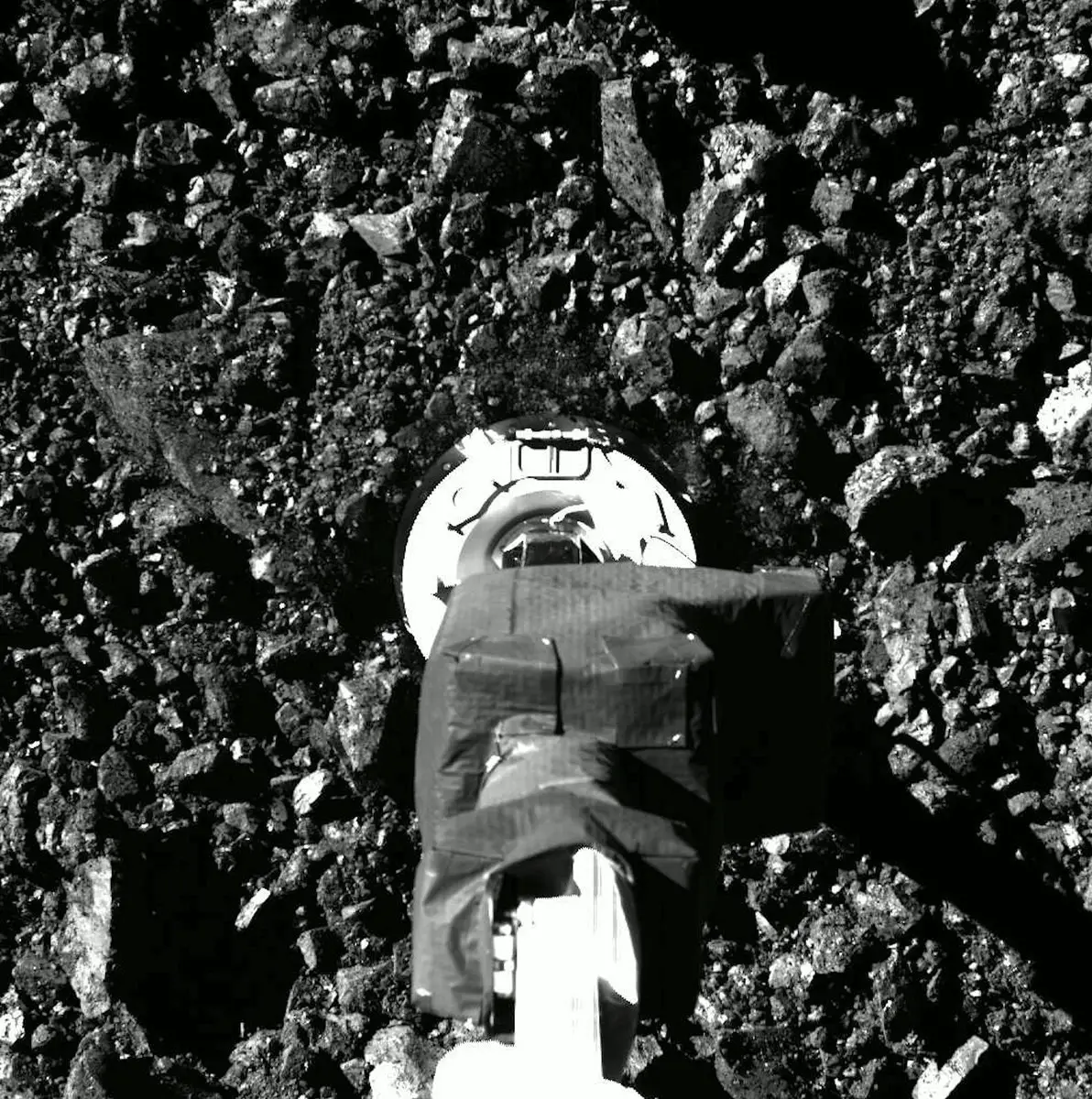
The discovery challenges our understanding of how life on Earth may have begun (NASA)

Turns out, the rock gives us an indication as to how the early solar system may have begun. It also hints as the possibility of life in universes beyond our own, NASA says.

What are the early signs of life on Bennu?

Bennu was found to contain glucose, a six-carbon sugar and an early building block of life. This discovery was the first of its kind in extraterrestrial material.

The latest finding means the asteroid has all the components needed to form RNA, a vital molecule present in all living cells that acts as a messenger for DNA. These components include a five-carbon sugar called ribose, as well as amino acids, nucleobases, carboxylic acids, and phosphates.
A NASA scientist is confident we will find life beyond our own solar system (Fotograzia/NASA/Getty Images)

This shows many building blocks of life were widespread in the early solar system, NASA explains.

Interestingly, the sugar in DNA called deoxyribose was not found, while ribose was, suggesting ribose may have been more common than deoxyribose in early solar system environments.

What does this mean for how life on Earth began?

This supports the RNA world hypothesis, where RNA was likely the first major genetic and catalytic molecule before DNA and proteins.

The presence of glucose implies that an important energy source for life on Earth was already present in early solar system materials and could have been delivered to early Earth by meteorites. This is also known as the panspermia hypothesis.

NASA scientist and OSIRIS-REx Co-Investigator Daniel Glavin said of the breakthrough: "I'm becoming much more optimistic that we may be able to find life beyond Earth, even in our own solar system."


He added that despite all the chemical building blocks to make proteins and nucleic acids were found in the Bennu sample, we still haven't found evidence for life itself in Bennu.

"I think this is going to open up a lot of new areas of research for folks to try to figure out why didn't these building blocks advance to something more complex inside this giant

asteroid parent body," Glavin added.

So, asteroids and meteorites may have seeded early Earth and possibly other world with all the ingredients needed to start life.

Anyone else feeling existential?

Featured Image Credit: NASA/Goddard/University of Arizona

Topics: Earth, Life, NASA, Space, US News

Ellie Kemp
Ellie Kemp

Ellie joined UNILAD in 2024, specialising in SEO and trending content. She moved from Reach PLC where she worked as a senior journalist at the UK’s largest regional news title, the Manchester Evening News. She also covered TV and entertainment for national brands including the Mirror, Star and Express. In her spare time, Ellie enjoys watching true crime documentaries and curating the perfect Spotify playlist.

X

@EllieKempOnline

Advert

Advert

Advert

Choose your content:

4 hours ago
20 hours ago
3 days ago
6 days ago
  • Ring
    4 hours ago

    Ring doorbell Super Bowl commercial branded ‘dystopian’ as they showcase 'terrifying' new feature

    Social media users are calling out the 'Dark Knight dilemma' of Amazon Ring doorbell's 'Search Party' feature

    Technology
  • DESY Science Communication Lab/University of Oregon
    20 hours ago

    Scientists baffled by black hole exuding more energy than the Death Star

    The black hole is expected to reach its peak next year

    Technology
  • Getty Stock Images
    3 days ago

    Experts reveals terrifying reason why astronauts should be banned from making 'space babies'

    The fertility and space experts came together to explore whether in-space pregnancy is safe

    Technology
  • Jim WATSON / AFP via Getty Images
    6 days ago

    NASA postpones Artemis II launch after practice run identifies major issue

    Other NASA missions have faced similar issues in the past

    Technology
  • Why NASA astronauts face ‘significant challenge’ in −410F temperatures as they prepare to fly farther into space than ever before
  • Space agency chief warns city-destroying asteroid could be hurtling towards earth now and we have 'no way to detect it'
  • NASA gives major new update on chances 'city-destroying' asteroid could hit Earth in just seven years
  • NASA postpones Artemis II launch after practice run identifies major issue