unilad homepage
unilad homepage
  • News
    • UK News
    • US News
    • World News
    • Crime
    • Health
    • Money
    • Sport
    • Travel
  • Music
  • Technology
  • Film and TV
    • News
    • DC Comics
    • Disney
    • Marvel
    • Netflix
  • Celebrity
  • Politics
  • Advertise
  • Terms
  • Privacy & Cookies
  • LADbible Group
  • LADbible
  • SPORTbible
  • GAMINGbible
  • Tyla
  • UNILAD Tech
  • FOODbible
  • License Our Content
  • About Us & Contact
  • Jobs
  • Latest
  • Archive
  • Topics A-Z
  • Authors
Facebook
Instagram
X
Threads
TikTok
YouTube
Submit Your Content
Scary simulator shows what could happen in the event of a nuclear disaster
Home>News>World News
Published 12:30 21 Jan 2024 GMT

Scary simulator shows what could happen in the event of a nuclear disaster

A team of researchers uncovered what would happen to the buildings and people surrounding the explosion.

Poppy Bilderbeck

Poppy Bilderbeck

google discoverFollow us on Google Discover
Featured Image Credit: X/@historyinmemes

Topics: Social Media, World News, Twitter, Science

Poppy Bilderbeck
Poppy Bilderbeck

Poppy Bilderbeck is a freelance journalist with words in Daily Express, Cosmopolitan UK, LADbible, UNILAD and Tyla. She is a former Senior Journalist at LADbible Group. She graduated from The University of Manchester in 2021 with a First in English Literature and Drama, where alongside her studies she was Editor-in-Chief of The Tab Manchester. Poppy is most comfortable when chatting about all things mental health, is proving a drama degree is far from useless by watching and reviewing as many TV shows and films as possible.

Advert

Advert

Advert

Researchers have revealed what it would look like if a nuclear explosion occurred.

You may've seen - or heard, if you were in a different room watching Barbie - the sound of an atomic bomb going off in Oppenheimer, but do you know what effect one could have on its surroundings if it went off today?

Well, a team of researchers have harnessed the power of technology to predict what could happen.

Warning: Contains simulation of explosion:

Advert

A team of researchers from the University of Nicosia (UNIC) in Cyprus looked into what would happen in the event of a nuclear explosion, and how it could impact surrounding buildings and people.

Titled Nuclear explosion impact on humans indoors, the paper investigated what would happen if an intercontinental ballistic missile caused an atomic bomb explosion.

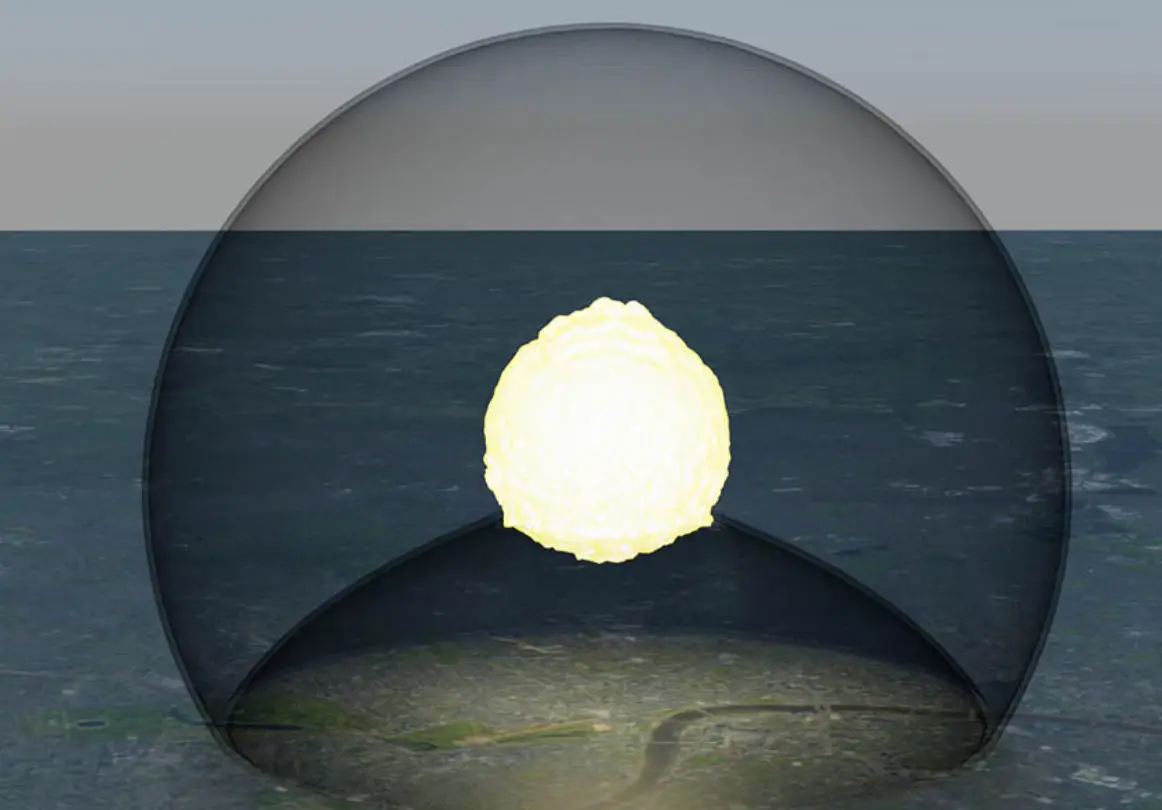
Using advanced computer modeling, the team created two videos showing how such an explosion would alter the temperature of its surroundings, alongside how the sheer force of the air the explosion would generate could impact buildings and people.

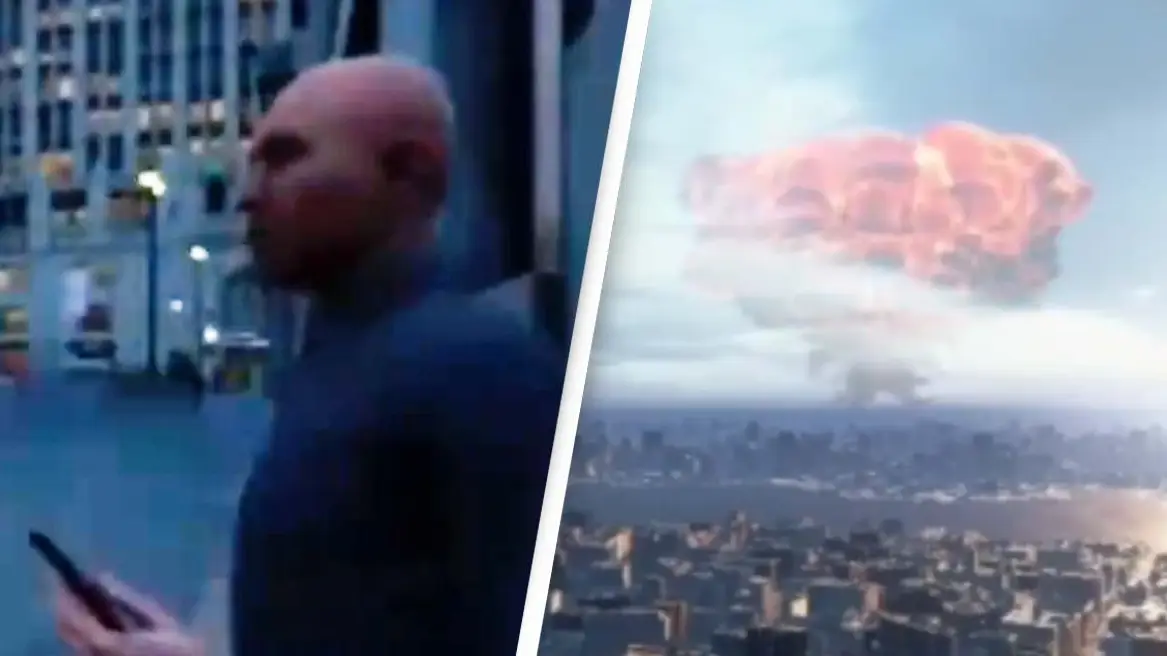
And if you wanted to see a simulation of what it looks like from a person's point of view on the ground, well another video has been shared to X - formerly known as Twitter - by Historic Vids (@historyinmemes), and it's pretty horrifying.
You may've seen it portrayed in Oppenheimer, but what actually happens if a nuclear explosion takes place?

The video - posted to X on Monday (15 January) - shows a man standing at the bottom of a building in a city.

The view then pans up the building until it reaches the roof, the shot looking down over the city.

In the distance, an explosion goes off, clouds of smoke billowing into the air and while it initially doesn't appear to affect its surroundings, out of nowhere, debris suddenly explodes all over the screen.

But what should you do if you - like the man in the video - are on the ground near a building in the event of such an explosion?


Nuclear explosion simulation pic.twitter.com/K1oDXozrt1

— Historic Vids (@historyinmemes) January 15, 2024

Well, the UNIC team's study also looked at how people should react to try and stay as safe as possible.

Lead author Professor Dimitris Drikakis says, as per UNIC's website: "Before our study, the danger to people inside a concrete-reinforced building that withstands the blast wave was unclear. Our study shows that high airspeeds remain a considerable hazard and can still result in severe injuries or even fatalities.”

So, where's the best place to be if an explosion of this magnitude should ever happen?

Well, Dr Ioannis Kokkinakis explains the 'most dangerous critical indoor locations to avoid' consist of 'the windows, the corridors, and the doors'.

The doctor advises: "People should stay away from these locations and immediately take shelter. Even in the front room facing the explosion, one can be safe from the high airspeeds if positioned at the corners of the wall facing the blast."

Choose your content:

3 hours ago
8 hours ago
10 hours ago
  • Dumb Blonde Podcast
    3 hours ago

    Bunnie Xo breaks silence on shocking Jelly Roll divorce and reveals the explosive fight that ended it all

    "File the f***ing divorce papers." The podcaster revealed the exact Mother's Day ultimatum that shattered country music's favorite marriage.

    News
  • Roy Rochlin/Getty Images
    8 hours ago

    Timothée Chalamet, Ben Stiller, and 2 million fans take over Manhattan for historic Knicks Championship Parade

    From Timothée Chalamet high-fiving the barricades to Martha Stewart crashing the team bus, Hollywood turned out for the celebration.

    News
  • Getty Stock Images
    10 hours ago

    Scientists reveal how GLP-1 medications can slash the risk of 4 types of cancer by 50%

    The latest polls report that one in eight Americans have taken a GLP-1 medication

    News
  • Rob Adcock
    10 hours ago

    I went to a World Cup match and spent a fortune - but I’d do it all over again tomorrow

    Rob Adcock has been putting away $25 a month since 2018 for the World Cup

    News
  • Terrifying simulation shows what would happen in the first 20 minutes of nuclear attack and the worst US locations to be in
  • Mind-blowing simulation shows exactly what happens when semen enters your body
  • 'Mutant deer' spotted with terrifying flesh bubbles as fears grow of animal outbreak in the US
  • Before and after photos show key differences of Iran’s nuclear sites after US bombing as expert explains the impact