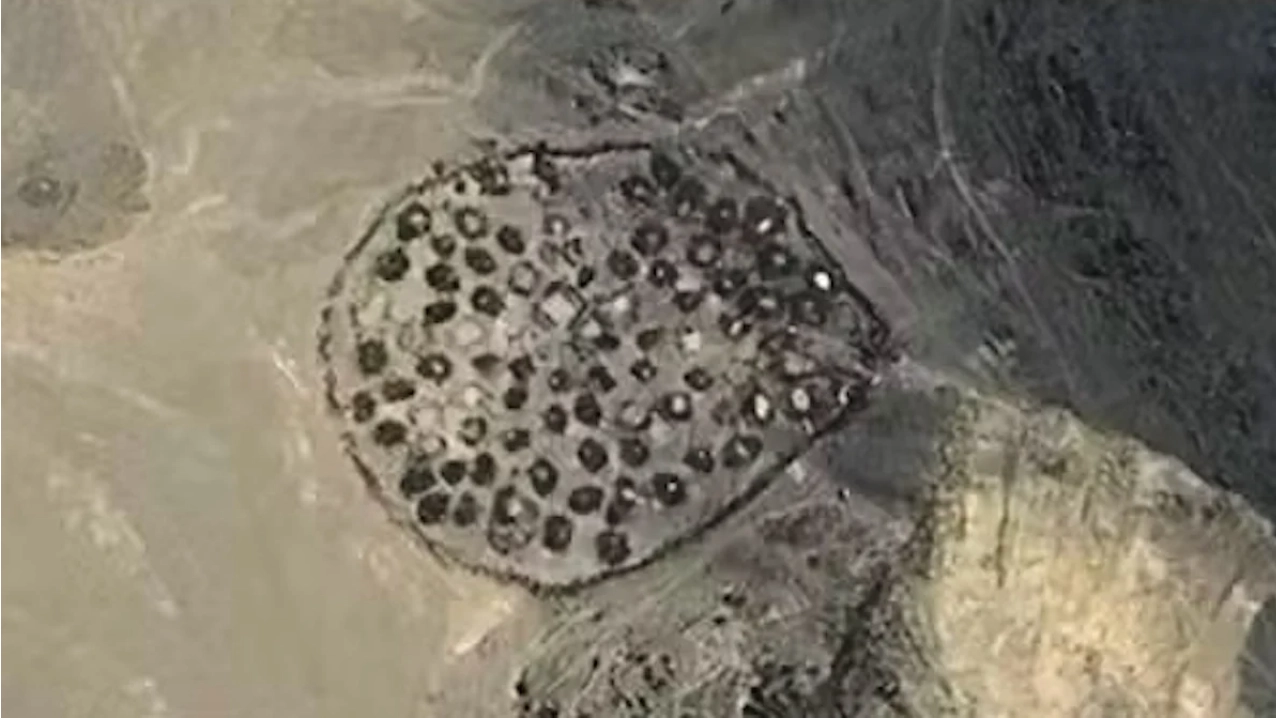
260 mass graves filled with human and animal bones discovered in the desert with chilling recurring feature

Archaeologists have stumbled upon something seriously unsettling buried beneath the sands of Eastern Sudan, and the deeper they looked, the stranger it got.
A team of researchers from Macquarie University, France's HiSoMA research unit, and the Polish Academy of Sciences has discovered 260 previously unknown mass graves scattered across almost 1,000km of the Atbai Desert, east of the Nile River.
And they all share one deeply eerie detail. Each site, known as an "enclosure burial", follows the exact same pattern. A large circular wall, some stretching up to 80 metres in diameter, with the bones of humans and animals carefully arranged inside. But at the centre of each one, is a single, significant person. Everyone else, and everything else, is buried around them.
Advert
We're talking cattle, sheep, and goats interred alongside the dead like some kind of ancient VIP send-off.
The graves are believed to date back to around 4000–3000 BCE, making them roughly 6,000 years old and predating Pharaonic Egypt. Researched found them not by digging, but by using satellite imagery, systematically scanning the desert from above in what has been a years-long remote sensing operation. That's 260 burial sites hiding in plain sight, invisible to the naked eye until now.
What makes the discovery even more striking is the consistency. These weren't isolated, one-off burial practices. The sheer scale and repetition of the pattern points to a shared nomadic culture stretching across a vast swathe of the Sahara, organised, deliberate, and clearly meaningful to the people who built them.
So who were these people burying their dead this way?
Researchers believe they were Saharan desert nomads, herders who lived and died by their livestock. The cattle in particular seem to have held serious cultural significance, something backed up by ancient rock art found in the surrounding area. Owning a large herd in such a harsh, drying environment was likely the ultimate status symbol, researchers compare it to the prehistoric equivalent of parking a Ferrari on your driveway. So naturally, when you died, the herd came with you.
The graves also hint at the early emergence of a social elite. Some sites show a clear hierarchy, with a central "primary" burial surrounded by "secondary" ones, suggesting chiefs or community leaders were being honoured in death in ways ordinary nomads simply weren't.
These people were eventually wiped out, not by war, but by climate. As the once-green Sahara dried out during the end of what scientists call the "African Humid Period," the land could no longer support large cattle herds. The nomads either moved south, fled to the Nile, or simply disappeared. But their graves survived for millennia.
Tragically, that might not be the case for much longer. Unregulated mining in the region is currently destroying many of the sites, monuments that endured 6,000 years of desert heat could vanish within a week.
Topics: Africa, Egypt, Climate Change
 Thomas Bamford