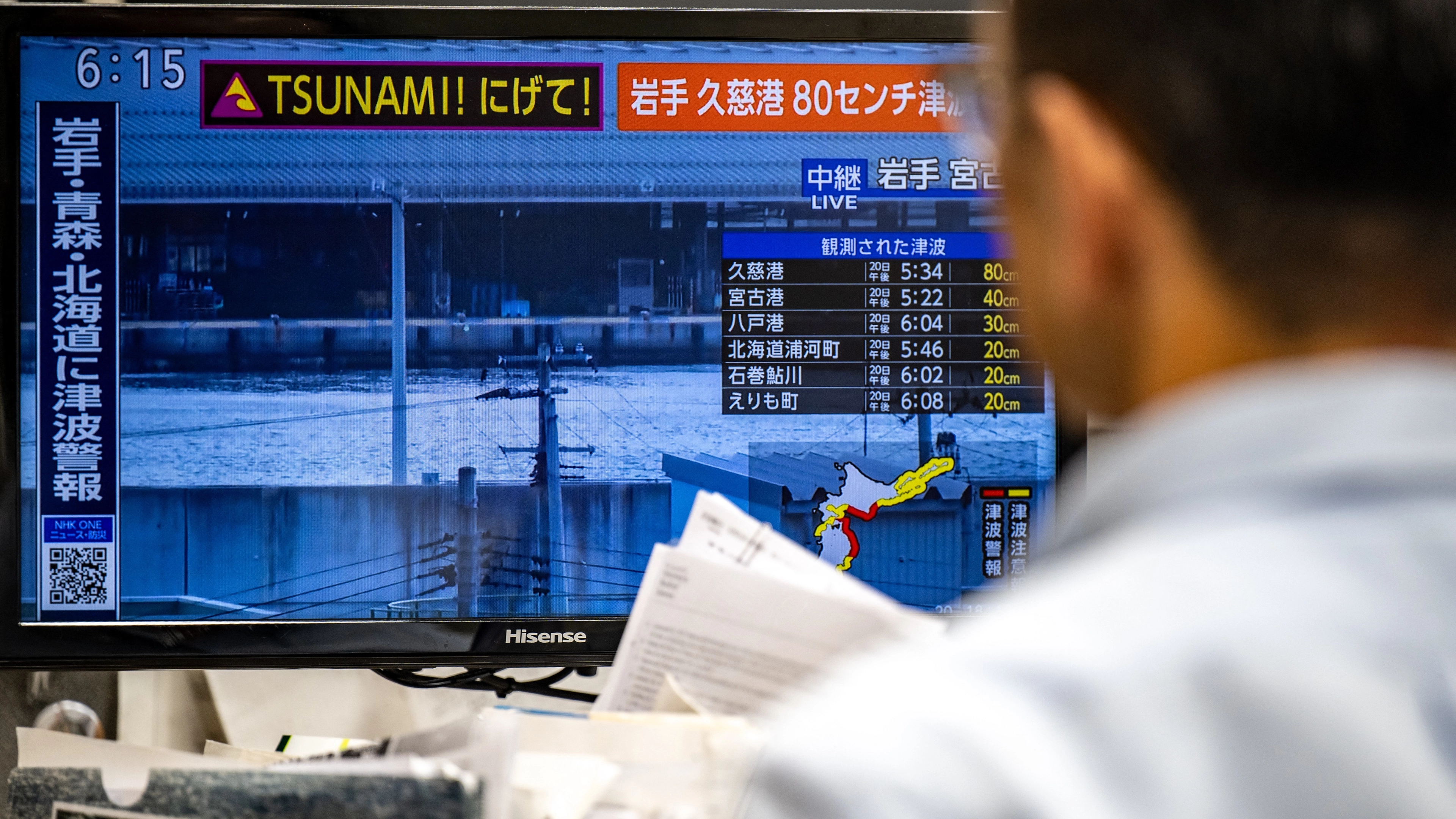
Damage 10 foot tsunami could do as Japan braces for impact after earthquake

Japan is facing a national emergency as an earthquake with a magnitude of 7.5 struck off the coast of the country, and now tsunami warnings have been issued.
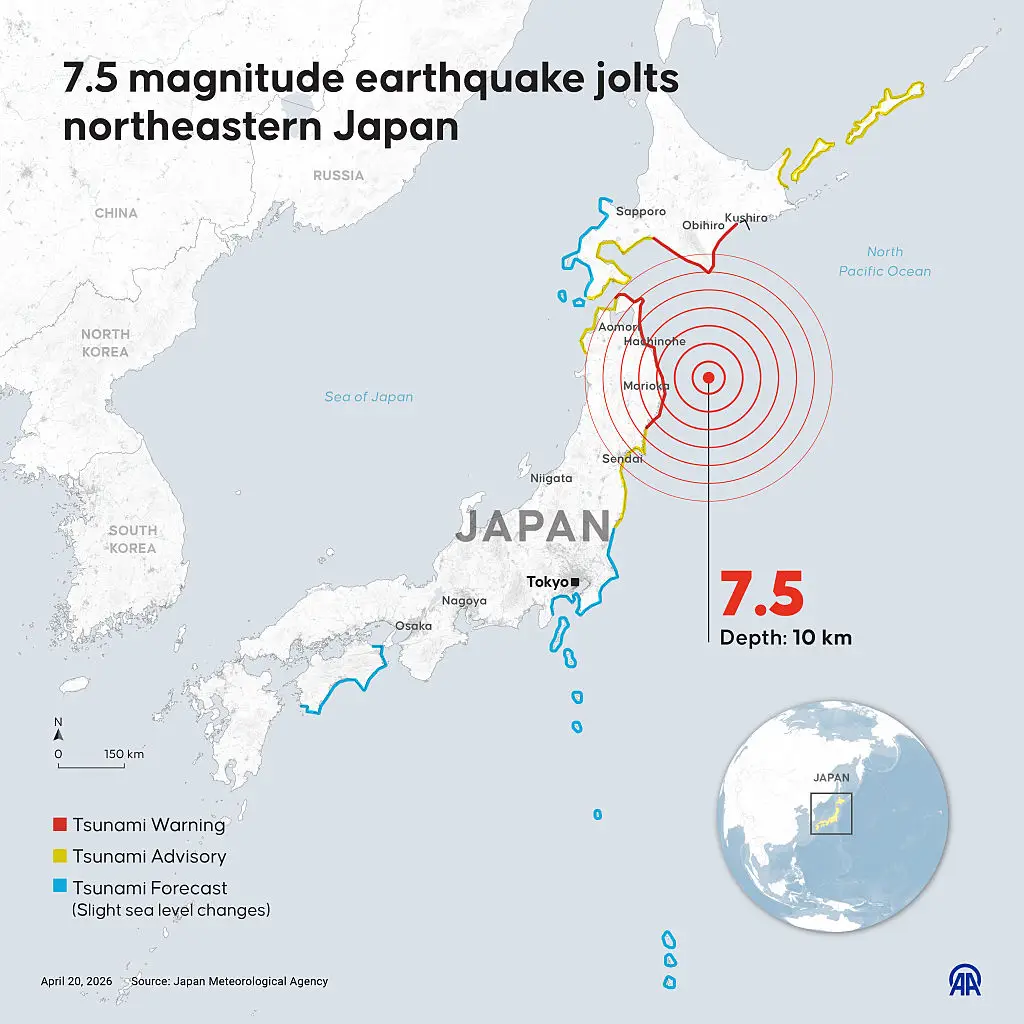
At approximately 5pm local time, Japan raised the alarm that a major earthquake was recorded off the Sanriku coast, to the country's east.
The impact was recorded as being at a depth of approximately 10km, 100km off Japan's eastern coast, per Japan's meteorological agency.
As a result, an emergency warning has been issued for coastal areas, as well as a tsunami warning and subsequent advisory notices.
Advert
According to NHK news, people in 11 towns in Iwate prefecture in the northeast have been told to evacuate, with Japan’s prime minister Sanae Takichi confirming a task force has been set up to deal with potential destruction.
She went on to reiterate the evacuation warning to those in Iwate prefecture, where the biggest waves are forecast to hit.
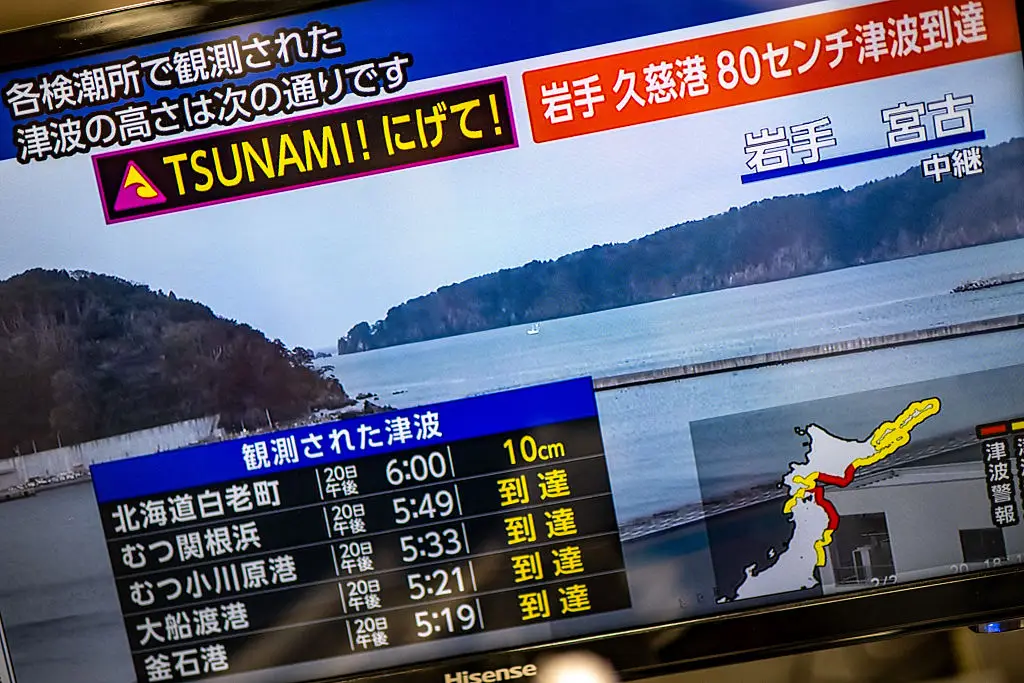
In the last hour since the earthquake hit, the Japan Meteorological Agency has issued safety warnings to residents, as the true impact and damage an impending tsunami could create is slowly being realized.
Officials have warned that 3-meter (10-foot) waves could hit coastal areas shortly, and the agency states all people should stay clear of coast and rivers, and take shelter on higher ground.
Dr Simon Boxal, a senior lecturer in oceanography at the University of Southampton, told Sky News that he expects the impact to be ‘moderate’, explaining that time will tell how bad it’ll be: "You'd expect the main waves to be hitting, probably, given the water depth, about an hour later. So, we'd expect those waves to be hitting pretty soon."
On the potential damage, he said: "This has the potential to create a moderate tsunami. When I say 'moderate', you've got to put this into perspective with the huge tsunami back in 2011, which killed over 20,000 people.
"That created waves that were over 10 meters high, which basically breached all of the tsunami defence systems that Japan has very effectively put across their coastline.
"We're now looking at waves of between 30cm and 80cm. That still could cause some damage. Ships have left the ports, because once you get away from the shore you're safe.
"We'll wait to see if we get any bigger waves. There's talk of waves up to three metres and that will cause some destruction, particularly in these low-lying areas.
"This is an important area for tourism as well, you've got a lot of people along that coastline."
More generally, Weather.gov explains that tsunamis can destroy boats, vehicles and buildings and ultimately lead to fatalities.
It adds that it 'only takes six inches of fast-moving water to knock over an adult and two feet of fast-moving water to carry away most vehicles'.
As reported by the BBC, warnings for landslides or similar earthquakes have been issued for this week, with the potential for an even bigger tsunami to hit.
Previously, Japan has faced severe economic and human damage caused by its quakes.
Takichi has already confirmed that 'human and material damage' has been reported today, as long tremors that could rock high-rise buildings have been recorded in the worst-affected areas, per Sky News.
Currently, The Independent reports that tsunami waves as high as 80cm (2 feet, 7.5 inches) have been detected, with the possibility of them increasing in size.
Right now, the following areas are expected to feel the brunt: the central Pacific Hokkaido coast; the Aomori prefecture coast; and the Iwate prefecture coast.
Japan is one of the most earthquake-prone countries in the world due to its location in the region of what’s known as the ‘Ring of Fire’.
This area sees the most volcanoes and oceanic trenches, with a 2011 disaster being the worst earthquake the country has seen.
That instance was overwhelmingly traumatic, as a 9-magnitude quake triggered tsunami waves of up to 40m.
Nearly 20,000 people died or were marked as missing.
Topics: Japan, World News, Weather
 Britt Jones