• News
  • Film and TV
  • Music
  • Tech
  • Features
  • Celebrity
  • Politics
  • Weird
  • Community
  • Advertise
  • Terms
  • Privacy & Cookies
  • LADbible Group
  • LADbible
  • SPORTbible
  • GAMINGbible
  • Tyla
  • UNILAD Tech
  • FOODbible
  • License Our Content
  • About Us & Contact
  • Jobs
  • Latest
  • Topics A-Z
  • Authors
Facebook
Instagram
X
Threads
TikTok
YouTube
Submit Your Content
Scientists make new discovery to reveal 'Chinese dragon' that lived 240 million years ago

Home> News> World News

Published 19:57 23 Feb 2024 GMT

Scientists make new discovery to reveal 'Chinese dragon' that lived 240 million years ago

The dragon-like creature was found to have 32 separate neck vertebrae

Chelsea Connor

Chelsea Connor

Featured Image Credit: Wikimedia Commons/Jun Liu, Chris L. Organ, Michael J. Benton, Matthew C. Brandley & Jonathan C. Aitchison / Wikimedia Commons/Stephan N.F. Spiekman​, Nicholas C. Fraser, Torsten M. Scheyer

Topics: Animals, China, World News, Science

Chelsea Connor
Chelsea Connor

Chelsea is a Journalist for UNILAD. Before this she worked as a Journalist and Comedy Writer for seven years, working for companies such as Newsquest, NationalWorld and Samahoma Productions. She became a qualified journalist back in 2017, completing a NCTJ at Liverpool City College.

X

@theccjourno

Advert

Advert

Advert

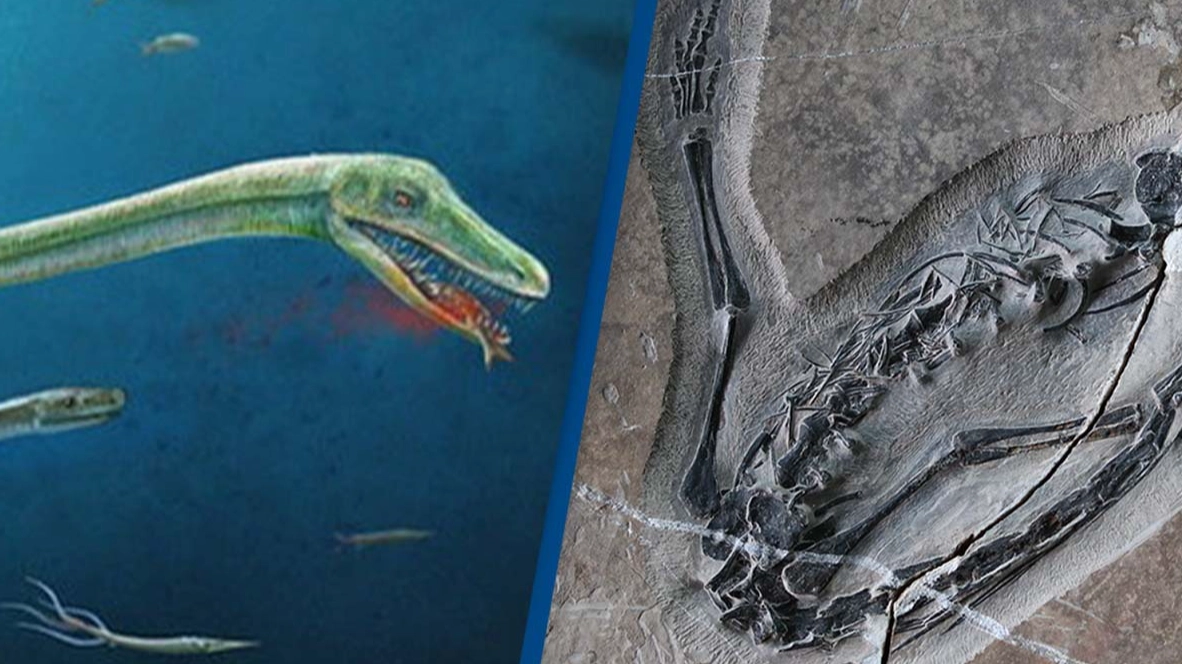
Scientists have revealed they've found remains similar to a 'Chinese dragon' that lived 240 million years ago.

Found in Guizhou province, Southern China, the creature boasts a long 32-vertebrae neck, which earned it the comparison to the ancient Chinese 'dragon'.

The creature was first identified back in 2003, but technology and research improvements since then have helped researchers be thorough with their findings.

Given the catchy name 'Dinocephalosaurus orientalis', the fossils were found to have had 'flippered limbs' and well-preserved fish in its stomach region, which would suggest the creature lived an aquatic life.

Advert

Keeper of Natural Sciences at National Museums Scotland, Nick Fraser, was involved in the research of the remains and described the creature as a 'very strange animal'.

He said: "This discovery allows us to see this remarkable long-necked animal in full for the very first time.

“It is yet one more example of the weird and wonderful world of the Triassic that continues to baffle palaeontologists.
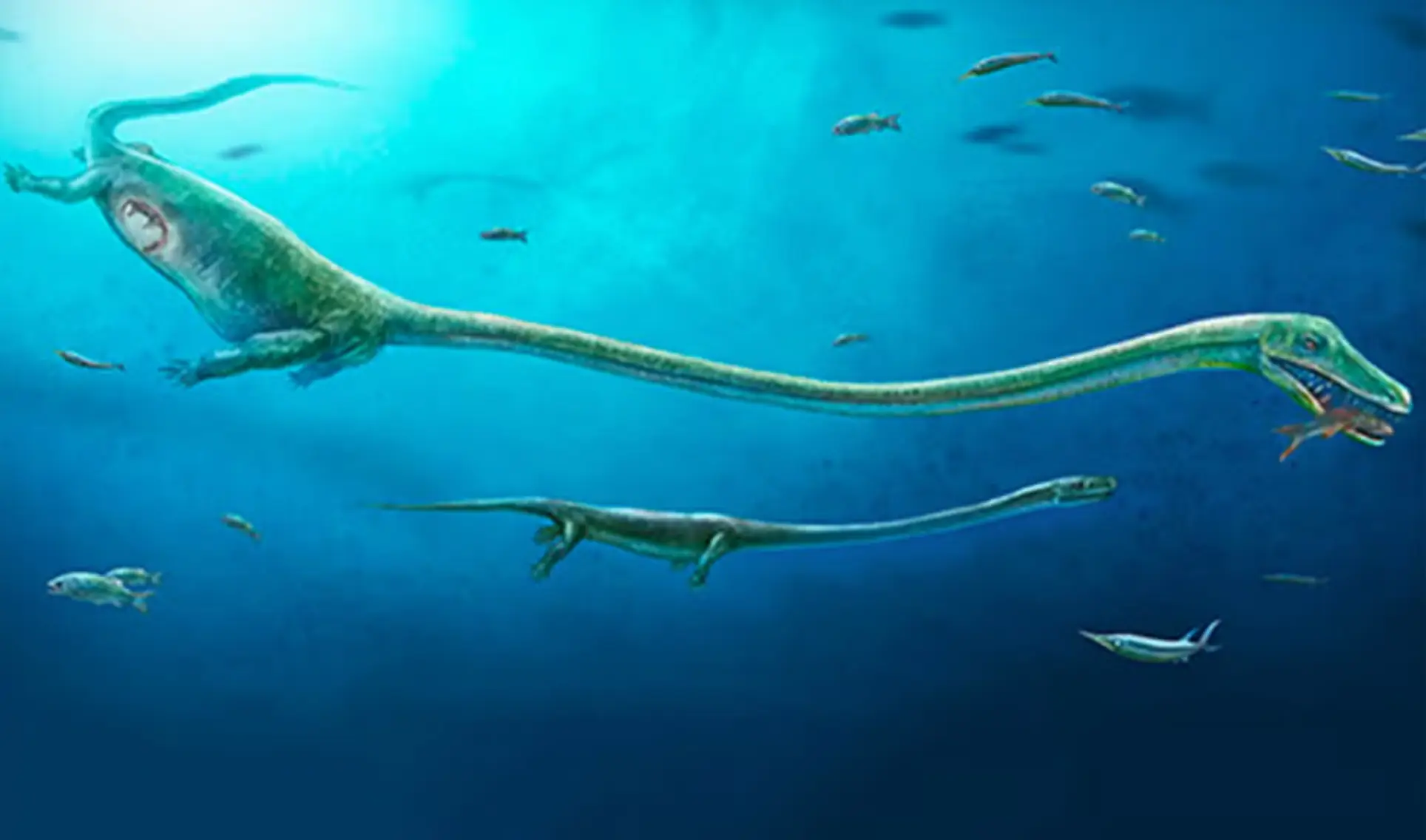
The creature is believed to have been aquatic.
Dinghua Yang/University of Bristol

Advert

“We are certain that it will capture imaginations across the globe due to its striking appearance, reminiscent of the long and snake-like mythical Chinese dragon," Fraser continued.

It's said that the remains of the Dinocephalosaurus orientalis is similar to that of the Tanystropheus hydroides - with both having very long necks.

However, the Tanystropheus was uncovered in Middle Triassic period of both Europe and China.

Researchers from Scotland, America and Germany studied the Dinocephalosaurus orientalis over the course of 10 years, and found that although the creatures were similar in size, the Dinocephalosaurus has many more vertebrae both in the neck and in the torso, giving it a longer body.

Advert

Speaking to BBC News, Fraser said: "This discovery just adds to the weirdness of the Triassic. And every time we look in these deposits, we find something new."
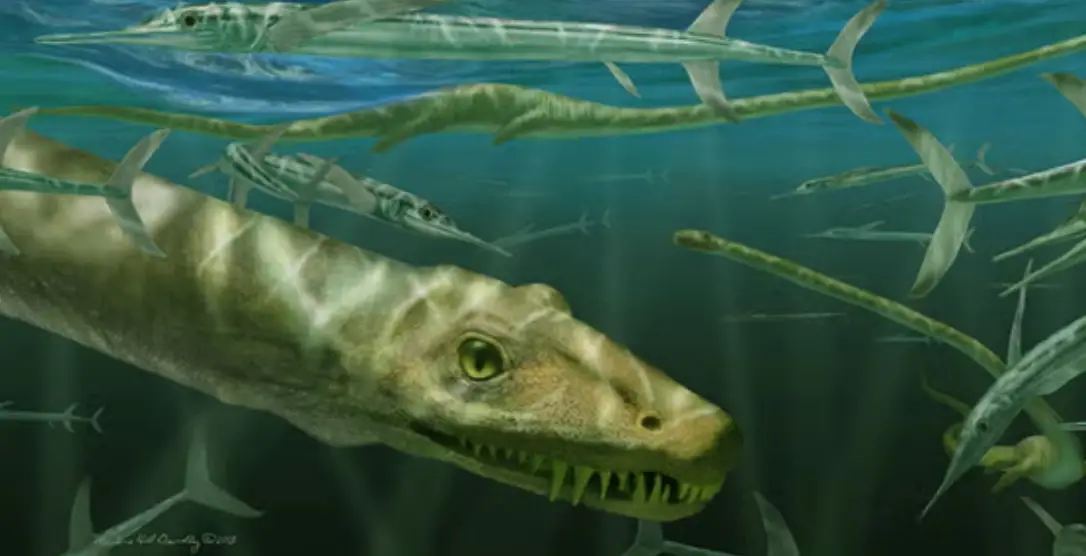
Wouldn't like to meet him in a dark alley.
National Museums Scotland/PA Wire

Professor Li Chun from the institute said: “This has been an international effort.

"Working together with colleagues from the United States of America, the United Kingdom and Europe, we used newly discovered specimens housed at the Chinese Academy of Sciences to build on our existing knowledge of this animal.

Advert

“Among all of the extraordinary finds we have made in the Triassic of Guizhou province, Dinocephalosaurus probably stands out as the most remarkable.”

The study which describes the findings of the creature has been published in the latest volume of the Academic journal Earth And Environmental Science: Transactions Of The Royal Society Of Edinburgh.

  • Scientists make unbelievable discovery inside rare 520-million-year-old fossil that made their ‘jaws drop’
  • Woolly mammoths could be brought back to life as scientists make breakthrough discovery
  • Scientists create groundbreaking spray that can heal wounds in seconds
  • Scientists make groundbreaking discovery about chimpanzees' likeness to humans and it could change everything

Choose your content:

4 hours ago
5 hours ago
  • TikTok/nianoir.xo
    4 hours ago

    Expert reveals AI red flags to look for as truth is revealed about 'world’s most beautiful' influencer

    Social media 'model' Nia Noir was revealed to actually be entirely generated by AI

    News
  • Instagram/@theanandapivot
    4 hours ago

    Influencer with ALS announces her own death in heartbreaking post just 3 years after diagnosis

    The influencer's fans have sent kind words and condolences after hearing of her death

    News
  • Kaitlyn Morris/Getty Images
    5 hours ago

    John Mellencamp gives update on daughter Teddi's cancer battle saying she's 'suffering'

    He recently spoke to Joe Rogan about his daughter's condition

    Celebrity
  • Justin Sullivan/Getty Images
    5 hours ago

    Expert issues security warning over iPhone 4 comeback that could leave people 'vulnerable'

    People are forking out a lot for an iPhone 4

    Technology