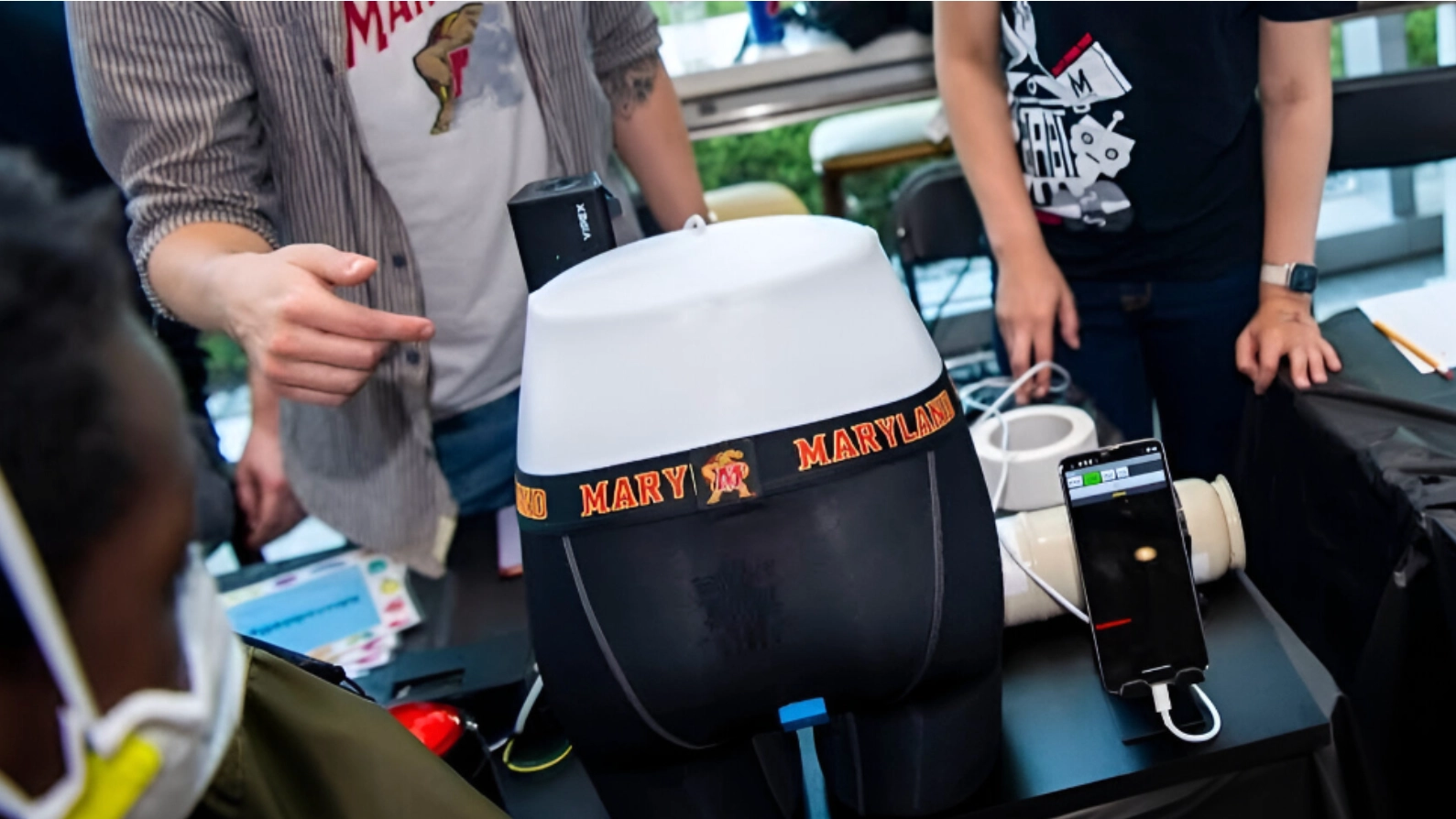
New study using 'smart underwear' reveals how much the average human farts and it's twice as much as we thought

Scientists at the University of Maryland are hoping to find the true amount that humans let one loose as previous numbers may not have been accurate.
As science continues to progress, researchers often take a look at what we think we know about the human body.
Scientists at the University of Maryland have developed both a convenient and accurate way of measuring just how often a person farts during the day.
The ‘smart underwear’ is a coin-sized wearable device that can attach to a normal piece of underwear and measures human flatulence by tracking hydrogen in farts.
Advert
For years, doctors have struggled to help patients with intestinal gas issues, and the researchers involved wanted to take steps forward to make this a thing of the past.
Brantley Hall, an assistant professor in the Department of Cell Biology and Molecular Genetics at UMD, stated that we currently don’t know how much flatulence is actually normal as older estimates may not have been as accurate as possible.

A press release about the smart underwear explained this by stating: “Previous research relied on invasive techniques in small studies or self-reporting, which suffers from missed events, imperfect memory and the impossibility of logging gas while asleep. Visceral sensitivity also varies widely: two people can produce similar amounts of flatus yet experience it very differently.”
So it may not have come as such a surprise when the smart underwear revealed that people actually fart more than twice as much as previously thought.
The team of researchers found that healthy adults produced flatus an average of 32 times per day, roughly double the 14 (±6) daily events often reported in medical literature.
While this might seem an odd thing to focus on, getting a better understanding of how often a person farts allows those in the medical community to get a baseline for what is healthy and what isn’t, the same way we baseline health expectations for heart rate and cholesterol.

Hall added: “Objective measurement gives us an opportunity to increase scientific rigor in an area that's been difficult to study.
“We don't actually know what normal flatus production looks like. Without that baseline, it's hard to know when someone's gas production is truly excessive."
The team behind the study are aware that there can be vast differences in flatulence rates in healthy people and hope to launch the Human Flatus Atlas project.
This will use Smart Underwear to objectively measure flatulence patterns, day and night, across hundreds of participants and correlate those patterns with diet and microbiome composition.
 Gerrard Kaonga