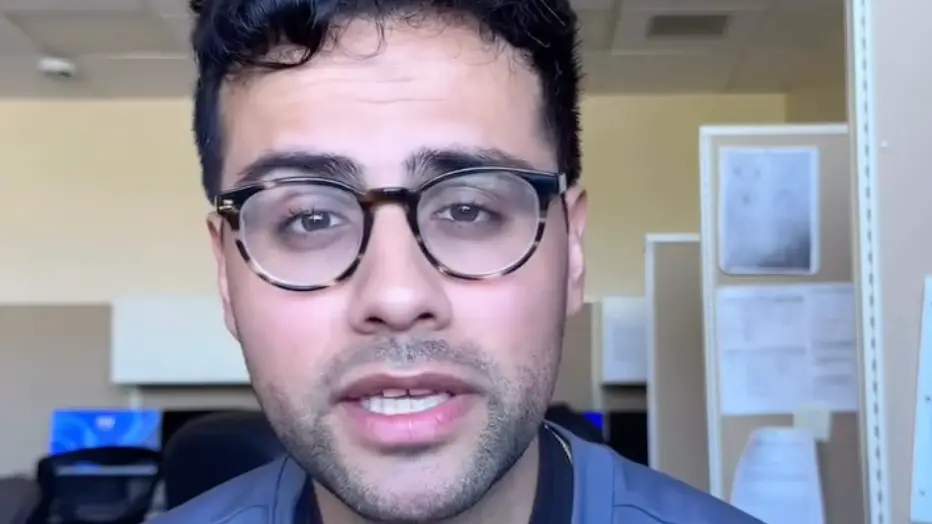
10-second hand test is 'quickest way' to spot signs of dementia – and it's left people freaking out

A neurologist's simple three-move hand sequence has sent people across TikTok into a spiral, convinced they've just diagnosed themselves with dementia from their living room.
The test, known as the Luria Test or Fist-Edge-Palm test, asks users to make a fist, place it on their opposite palm, then flip that hand to rest its little-finger edge down, before flattening it palm-down, all in a smooth, repeating sequence.
It sounds simple. Millions of people trying it have found out it isn't.
Dr Adnan Husein, the neurologist who posted the original clip, explained why hands are used as a diagnostic tool in the first place.
Advert
"Hands can display subtle clues about brain health," he said, according to the viral TikTok video.
"Certain changes in movement, tone, dexterity, or behaviour of the hands may point clinicians toward conditions such as Alzheimer's disease, frontotemporal dementia, or other neurological disorders."
What is the Luria Test actually measuring?
The test was built to test motor function, executive function and sequencing, all of which are governed by the brain's frontal lobe.
That's the same region affected in several forms of dementia, which is why doctors originally developed the test as a clinical screening tool rather than a viral stunt.
It was created decades ago by Soviet neuropsychologist Alexander Luria as part of a wider battery of assessments used to detect frontal lobe damage.
In a clinical setting, it's never used alone, it's combined with memory assessments, language tests, behavioral observations, and brain imaging before any conclusions are drawn.
According to Dr Husein, only around 2% of people with normal cognition struggle to complete the Luria Test.
That figure jumps dramatically in people with diagnosed conditions: over 50% of Alzheimer's patients struggle with it, and that rises to almost 70% among those with frontotemporal dementia.
In other words, fumbling the sequence once on a phone camera, while anxious about the outcome, puts most people firmly in the 98%, not the 2%.
Dr Husein was careful to stress that a shaky first attempt isn't a red flag on its own.
"Not every change in the hands means dementia," he said.
"However, when hand changes occur alongside memory loss, personality shifts, language difficulties, or problems with planning and judgment, they strengthen the case for neurological assessment."
The test isn't the first screening tool to blow up online and trigger mass panic, a viral finger flexibility test earlier this year prompted a similar wave of doctors clarifying that struggling with a TikTok challenge isn't the same as a clinical diagnosis.
For most people who fumbled Fist-Edge-Palm, the advice is straightforward: try again when rested, and save the real concern for if other symptoms, like memory loss or trouble finding words, show up alongside it.
 Thomas Bamford