
Expert reveals exactly how long it should take to fall asleep at night and when it could be a more serious problem

An expert has explained how long it should ideally take to nod off to sleep - and what it means if you struggle.
While some people are able to fall asleep pretty quickly, for others it can take a little longer.
Then there are sleep preferences - while some need to have total silence and darkness to fall asleep comfortably, others would rather have background noise while nodding off.
Whatever you prefer at nighttime, experts have revealed how long it should take a healthy adult to fall asleep and when it might be an issue if it's consistently taking longer.
Advert
Of course, this can vary hugely depending on other factors, such as stress levels, comfort, sleep environment and how much sleep you're getting in general.
For example, a person who is sleep deprived may fall asleep immediately, while those who have overslept the night before or taken daytime naps might struggle the following evening.

The experts over at TRT UK have explained what we should be aiming for.
They told UNILAD: "For most healthy adults, it should take about 10-20 minutes to fall asleep," the experts explain.
"Falling asleep the moment your head hits the pillow might sound like a dream; however, it can actually show sleep deprivation.
"But if you find yourself lying there awake for more than 30 minutes it can suggest overstimulation, stress, or circadian system disruption.
"The key is ‘sleep latency’, the time it takes to drift off. If you always need more than half an hour that can mean your mind and body isn’t fully ready to relax yet. Which can be linked to high stress levels, late caffeine, an inconsistent schedule or too much light exposure in the evening."

The experts also explain when taking longer to fall asleep could be a problem.
If it becomes a pattern to take longer than 30 minutes, and if you're suffering with fatigue during waking hours, it might be worth seeking some advice.
"If it sometimes takes longer, this is normal. But if trouble falling asleep starts to be a pattern, as well as daytime fatigue, it’s a sign your sleep-wake cycle may need changing," they explain.
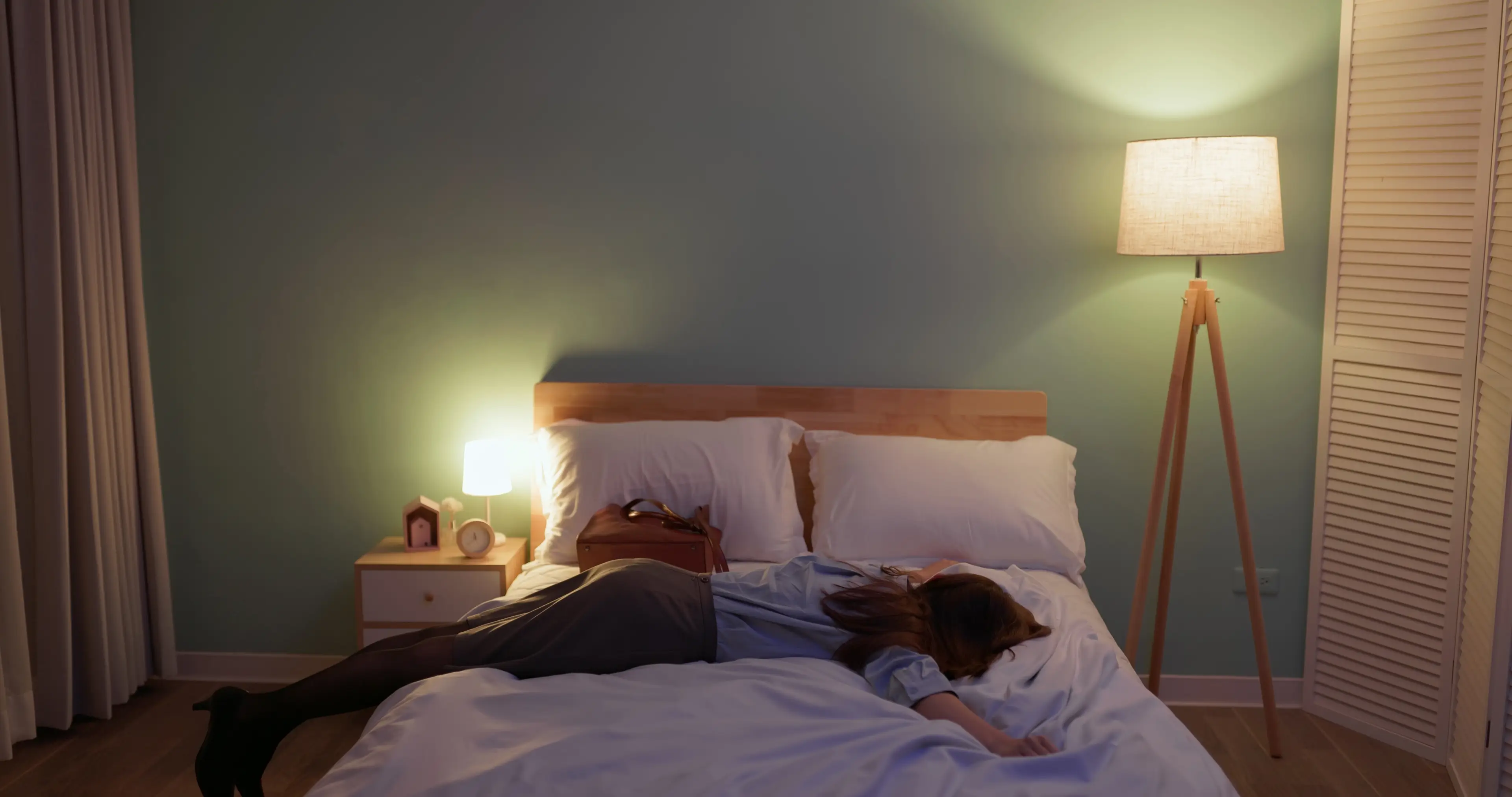
The sleep-wake cycle refers to a person's daily sleeping pattern.
John Hopkins Medicine explains that there are two body processes in charge of sleeping and waking.
These are the sleep-wake homeostasis and the circadian biological clock.
"With sleep/wake homeostasis, the longer you are awake, the greater your body senses the need to sleep... But your circadian biological clock causes highs and lows of sleepiness and wakefulness throughout the day," they explain.
Many adults will feel drowsy between 2am and 4am, as well as between 1pm and 3pm, which could explain the pull of the afternoon nap.
However, sufficient nighttime sleep should help with combatting this.
 Lucy Devine