unilad homepage
unilad homepage
  • News
    • UK News
    • US News
    • World News
    • Crime
    • Health
    • Money
    • Sport
    • Travel
  • Music
  • Technology
  • Film and TV
    • News
    • DC Comics
    • Disney
    • Marvel
    • Netflix
  • Celebrity
  • Politics
  • Advertise
  • Terms
  • Privacy & Cookies
  • LADbible Group
  • LADbible
  • SPORTbible
  • GAMINGbible
  • Tyla
  • UNILAD Tech
  • FOODbible
  • License Our Content
  • About Us & Contact
  • Jobs
  • Latest
  • Archive
  • Topics A-Z
  • Authors
Facebook
Instagram
X
Threads
TikTok
YouTube
Submit Your Content
Scientists decipher the world's oldest map on 3,000-year-old Babylonian tablet
Home>News
Published 15:19 29 Oct 2024 GMT

Scientists decipher the world's oldest map on 3,000-year-old Babylonian tablet

The map could help identify the location of the remnants of 'Noah's ark'.

Stefania Sarrubba

Stefania Sarrubba

google discoverFollow us on Google Discover
Featured Image Credit: The British Museum

Topics: History, World News, Religion

Stefania Sarrubba
Stefania Sarrubba

Advert

Advert

Advert

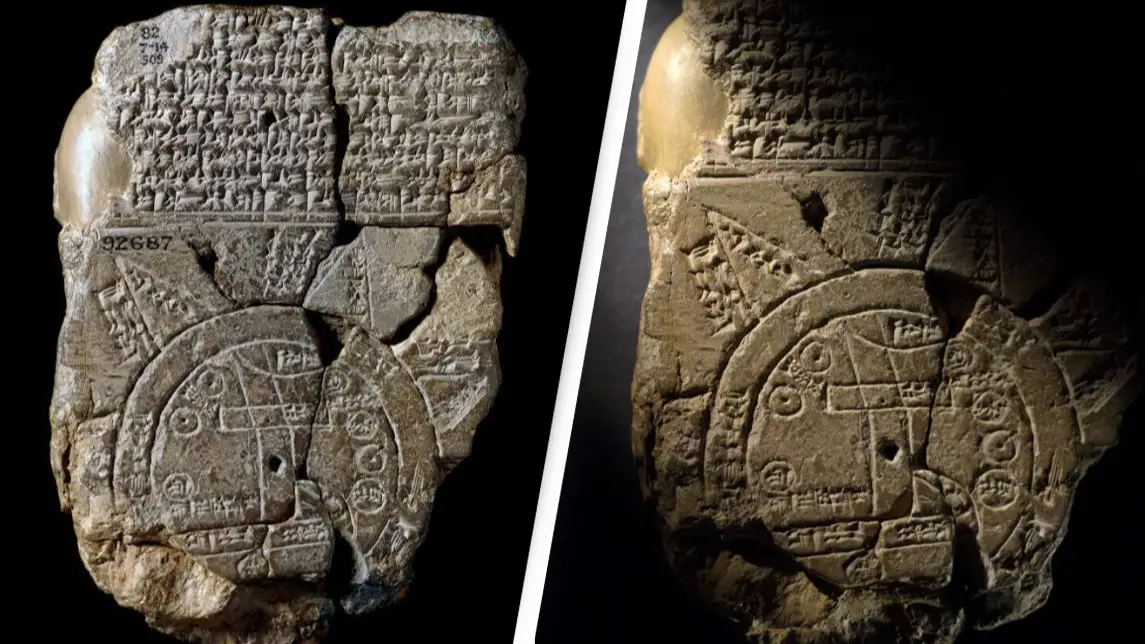
Scientists have deciphered the world's most ancient map that could help locate the remnants of ‘Noah’s ark’ in ancient Mesopotamia.

Housed at the British Museum, a Babylonian artefact known as Imago Mundi (Latin for 'Image of the World') features a map of Mesopotamia — present-day Iraq — enclosed by two circles representing the bitter river.

The tablet provided contemporary travellers with a set of directions on its reverse.

Discovered in 1882 by renowned archaeologist Hormuzd Rassam in Sippar, the map was written and inscribed on clay in Mesopotamia around 2,900 years ago.

Advert

The artefact was damaged, but used to include eight triangles surrounding the central circle and indicating mountains.
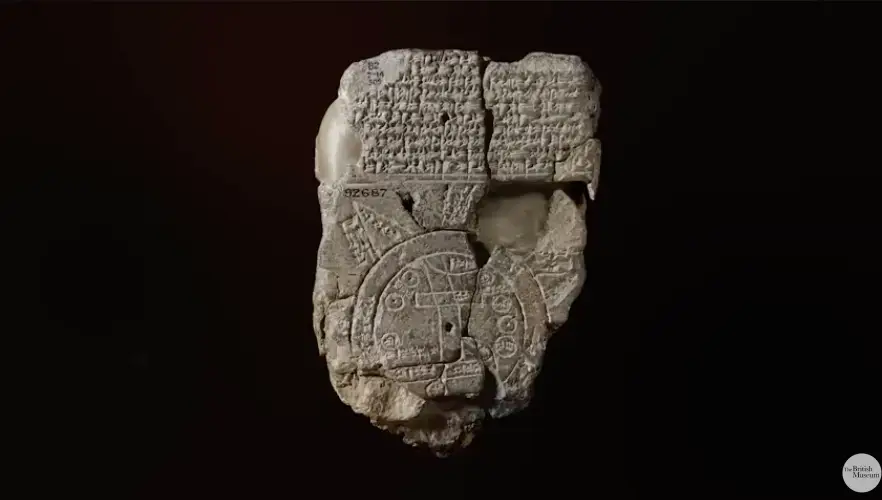
The Imago Mundi is a Babylonian map on display at the British Museum. (YouTube/The British Museum)

Assyriologist Dr Irving Finkel, who works for the Department of the Middle East in the British Museum and specialises in cuneiform inscriptions, and a gifted student of his, Edith Horsley, joined a fragment of the tablet to the map back in 1995, with this missing piece helping researchers to uncover a biblical reference.

Among the keys to read the map, one portion says that travellers must pass through 'seven leagues... [to] see something that is thick as a parsiktu-vessel'.

In a gripping YouTube video, Dr Finkel said that 'parsiktu' is a crucial term in his field.

The word appeared on another ancient Babylonian tablet, specifically in connection to the size of a boat needed to survive the Great Flood.

"This parsiktu measurement, is something to an Assyriologist which makes their ears prick, and the fact is it's only once otherwise known from cuneiform tablets and it's rather an interesting cuneiform tablet too," said Dr Finkel.

"Because it is the description of the Ark which was built, theoretically, by the Babylonian version of Noah."

It seems that when following the instruction of the Imago Mundi, researchers would find a path to 'Urartu', where an ancient Mesopotamian poem claims a man and his family landed an ark to preserve life amid the flood.
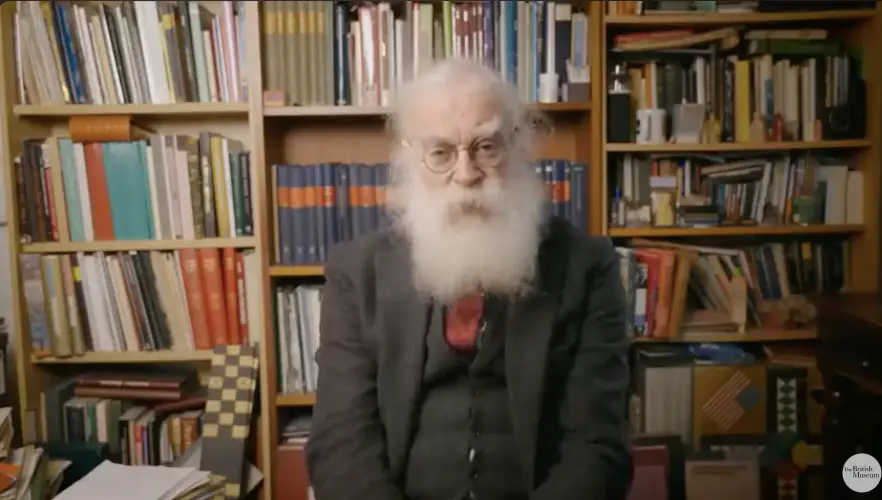
Dr Irving Finkel and his student Edith Horsley managed to find a piece to join to the map in 1995. (YouTube/The British Museum)

The location is the Assyrian equivalent to 'Ararat,' which is the Hebrew word for the mountain where Noah crashed the Biblical vessel.

"It shows that the story was the same, and of course that one led to the other but also, that from the Babylonian point of view, this was a matter of fact thing,” Dr Finkel said. "That if you did go on this journey you would see the remnants of this historic boat."

He continued: "For the first time, we can pronounce with authority, that if we were an ancient Babylonian, we would know where to go to see the remnants of that wonderful boat."

Choose your content:

7 mins ago
9 mins ago
2 hours ago
11 hours ago
  • Dave Kotinsky/Getty Images for SiriusXM
    7 mins ago

    Sports commentator Stephen A. Smith facing backlash after 'ignorant' World Cup take

    "Could 2026 finally be the year Stephen A. Smith wins a clue about soccer ?"

    News
  • ABC7 New York
    9 mins ago

    US senator issues warning after tourist, 18, killed in New York horse-drawn carriage crash

    Horse-drawn carriages in New York's Central Park have been a controversial topic for some time now

    News
  • John Phillips/Getty Images for The Other Songs
    2 hours ago

    The men most at risk of prostate cancer as Jeremy Clarkson reveals 'aggressive' diagnosis

    Jeremy Clarkson recently shared the news of his cancer diagnosis on his hit Prime Video show, Clarkson's Farm

    News
  • Luke Hales/Getty Images
    11 hours ago

    Merlin the jersey-wearing duck officially becomes the World Cup’s first viral mascot

    The two-year-old pet went viral after joining thousands of roaring fans in a custom mini kit—and now FIFA has officially gotten involved.

    News
  • Scientists make sourdough bread from yeast found in 5000 year old mummy
  • Oldest New Testament fragments reveal 'what Jesus said' 2,000 years ago as expert gets rare inside look
  • 2-year-old girl chosen as new 'virgin goddess' worshipped by two religions
  • 4,500-year-old ancient mystery finally solved after key discovery in pyramid