• News
  • Film and TV
  • Music
  • Tech
  • Features
  • Celebrity
  • Politics
  • Weird
  • Community
  • Advertise
  • Terms
  • Privacy & Cookies
  • LADbible Group
  • LADbible
  • SPORTbible
  • GAMINGbible
  • Tyla
  • UNILAD Tech
  • FOODbible
  • License Our Content
  • About Us & Contact
  • Jobs
  • Latest
  • Topics A-Z
  • Authors
Facebook
Instagram
X
Threads
TikTok
YouTube
Submit Your Content
Astronomers have discovered ‘strongest’ evidence that Planet Nine is really in the solar system

Home> Technology> Space

Published 19:55 22 Jul 2024 GMT+1

Astronomers have discovered ‘strongest’ evidence that Planet Nine is really in the solar system

In a breakthrough moment, scientists may be revising the number of planets back up to nine

Kit Roberts

Kit Roberts

There's something lurking out there in the depths of the solar system.

Just beyond Neptune's orbit, there's something massive enough to stabilise the orbits of the objects around it.

It might be something sinister lurking at the edge of the solar system, but more likely than Cthulhu is that scientists have found evidence for the elusive 'Planet Nine'.

Advert

If this is confirmed in the future, then it could potentially restore the number of planets in the solar system back up to nine since Pluto's demotion.

You can't help but feel a bit sorry for Pluto if things did turn out that way.

Nonetheless, the latest body of evidence has been described as the 'strongest statistical evidence yet that Planet Nine is really out there'.

But what's that you say, 'statistical evidence'? Surely this is literally a planet, how could we miss it in our own solar system when we routinely discover planets around other stars all the time?
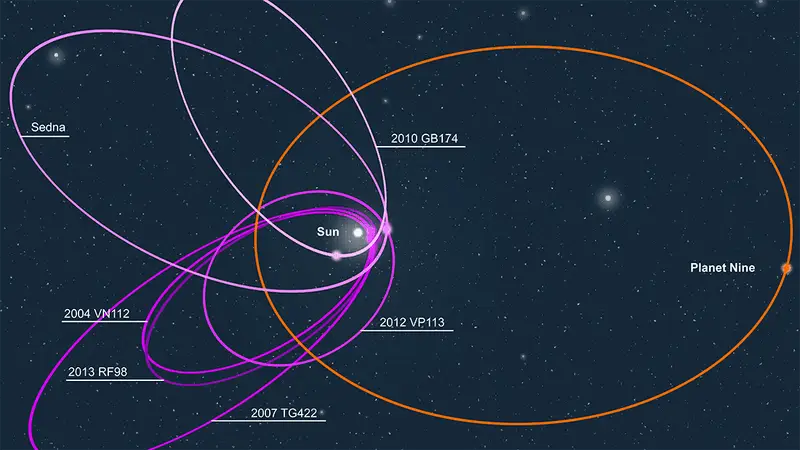
This could be the orbit of a Planet Nine. (MagentaGreen/Prokaryotes/Wikimedia Commons (CC BY 1.0))

That's because it's actually easier to spot planets which are located around other stars than it is around our own.

One method is the 'transit method', which involves seeing how a planet blocks light from a star as it passes, or you could see how a star 'wobbles' as planets orbit it, or use a variety of other methods.

But around the Sun it's a bit more tricky as we effectively have to rely on either seeing the planet directly or seeing the reactions it causes in the objects around it.

In this case, it was because of the orbits of objects which are located just beyond the orbit of Neptune in the solar system.

These orbits were disturbed by some object out there which was clearly large enough to be able to exert such a force on its surroundings.
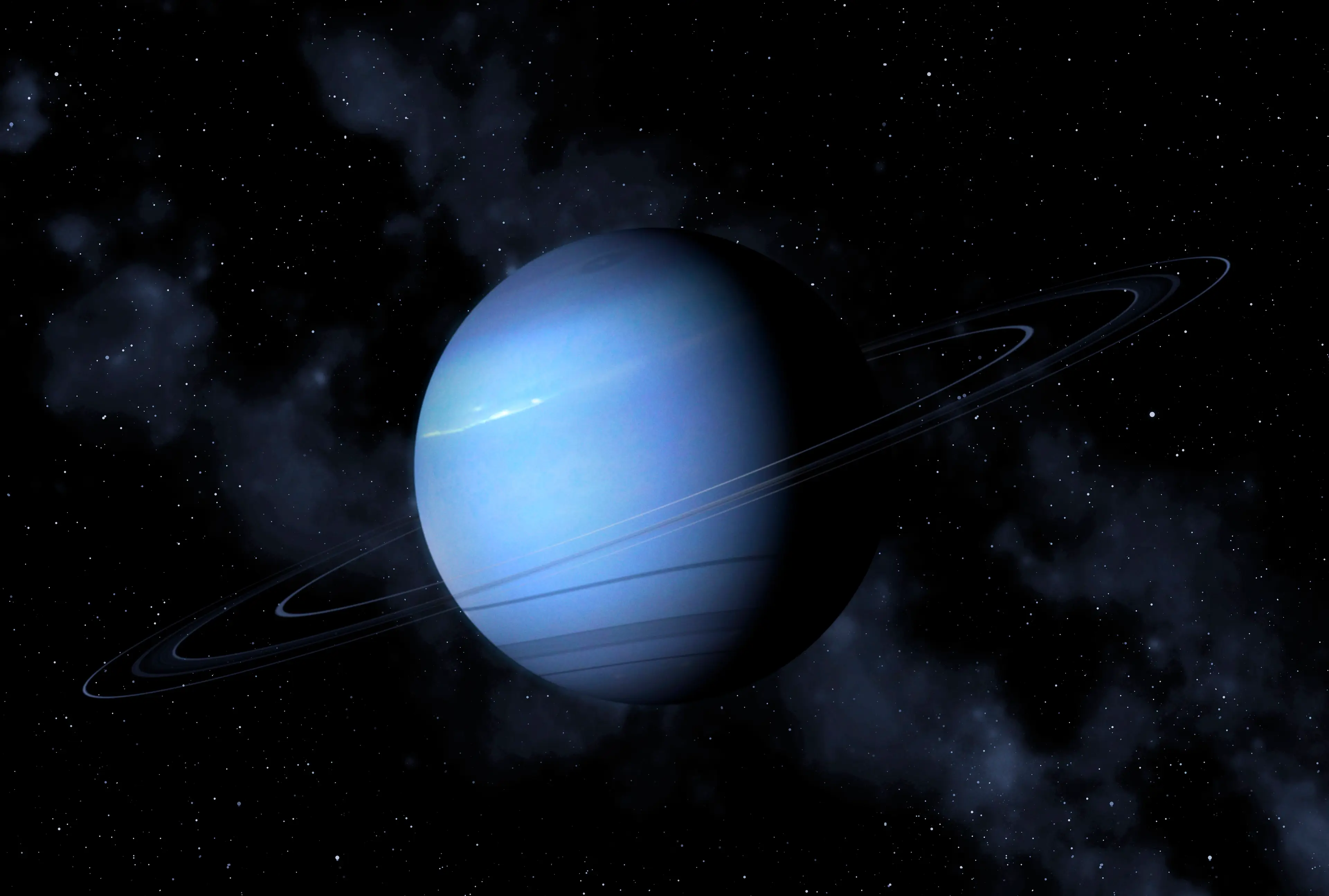
The orbit could be located just behind that of Neptune. (Science Photo Library - MARK GARLICK / Getty)

While it's not definitive proof, it does point to the possibility of Planet Nine being out there.

The authors of a study examining the data said: "Excitingly, the dynamics described here, along with all other lines of evidence for Planet Nine, will soon face a rigorous test with the operational commencement of the Vera Rubin Observatory.

"This upcoming phase of exploration promises to provide critical insights into the mysteries of our solar system’s outer reaches."

So that's not a definitive yes there's a ninth planet, but ultimately who know what could be lurking at the edge of the solar system.

Featured Image Credit: Getty Stock Images / Tomruen

Topics: News, Space, Science, US News, World News

Kit Roberts
Kit Roberts

Kit joined UNILAD in 2023 as a community journalist. They have previously worked for StokeonTrentLive, the Daily Mirror, and the Daily Star.

Advert

Advert

Advert

  • Scientist claims to have evidence 'our entire universe is trapped inside a black hole'
  • Scientists have discovered monumental 'weak spot' in Earth's magnetic field is growing and it could have huge consequences
  • Scientists have discovered an early warning sign of Alzheimer's visible in routine scans
  • Asteroid worth $10,000,000,000,000,000,000 that NASA is capturing could have a devastating impact

Choose your content:

5 hours ago
2 days ago
5 days ago
7 days ago
  • Miguel J. Rodriguez Carrillo / AFP/ Getty Images
    5 hours ago

    Astronaut Suni Williams explains what she realized when looking down at the Earth after 608 days in space

    It comes as Suni confirmed her retirement from NASA, months after being rescued from space

    Technology
  • Getty Stock Images
    2 days ago

    NASA responds to wild theory Earth will lose gravity on August 12 for seven seconds after social media frenzy

    NASA has set the record straight on the wild internet theory

    Technology
  • Justin Sullivan/Getty Images
    5 days ago

    Expert issues security warning over iPhone 4 comeback that could leave people 'vulnerable'

    People are forking out a lot for an iPhone 4

    Technology
  • SERGEI ILNITSKY/AFP via Getty Images
    7 days ago

    Ex-NASA astronaut who spent 695 days in space reveals ‘strict’ routine that's key for a successful mission

    Peggy Whitson detailed her nightly routine in space - and it's world's apart from ours at home

    Technology