unilad homepage
unilad homepage
    • News
      • UK News
      • US News
      • World News
      • Crime
      • Health
      • Money
      • Sport
      • Travel
    • Music
    • Technology
    • Film and TV
      • News
      • DC Comics
      • Disney
      • Marvel
      • Netflix
    • Celebrity
    • Politics
    • Advertise
    • Terms
    • Privacy & Cookies
    • LADbible Group
    • LADbible
    • SPORTbible
    • GAMINGbible
    • Tyla
    • UNILAD Tech
    • FOODbible
    • License Our Content
    • About Us & Contact
    • Jobs
    • Latest
    • Archive
    • Topics A-Z
    • Authors
    Facebook
    Instagram
    X
    Threads
    TikTok
    YouTube
    Submit Your Content
    Scientists discover new 'super-Earth' six times bigger than ours that could inhabit alien life

    Home> Technology> Space

    Published 20:58 29 Jan 2025 GMT

    Scientists discover new 'super-Earth' six times bigger than ours that could inhabit alien life

    'Excitingly' it's 'only 20 light-years' away from us, discoverer Dr Michael Cretignier explained

    Joe Yates

    Joe Yates

    google discoverFollow us on Google Discover
    Featured Image Credit: Getty Stock Image

    Topics: Space, Earth, Aliens

    Joe Yates
    Joe Yates

    Joe is a journalist for UNILAD, who particularly enjoys writing about crime. He has worked in journalism for five years, and has covered everything from murder trials to celeb news.

    X

    @JMYjourno

    Advert

    Advert

    Advert

    Our universe is so great that there has to be life out there - I mean, it's literally still expanding in every direction.

    Well, we could be closer to discovering whether there really is alien life out there after researchers discovered a new 'super-Earth' which is six times bigger than our planet and may well inhabit extraterrestrials.

    A team of scientists from Oxford University in England have identified an exoplanet - named HD 20794 - as far as 20 light-years away from our solar system.

    Advert

    It's the right distance away from its sun to be able to hold water on the surface of the planet, but due to its orbit of the star being far more oval than Earth's, scientists could not verify whether it could host life.

    While we're only just hearing about it, Dr Michael Cretignier, a postdoctoral research assistant in the Department of Physics at the college, actually identified it three years ago back in 2022, while looking through archived data which was recorded at the La Silla Observatory in Chile.

    Although, at the time he couldn't confirm whether or not it was a planet and so needed the help of a crew from around the globe, who worked together to analyze data over the last two decades.
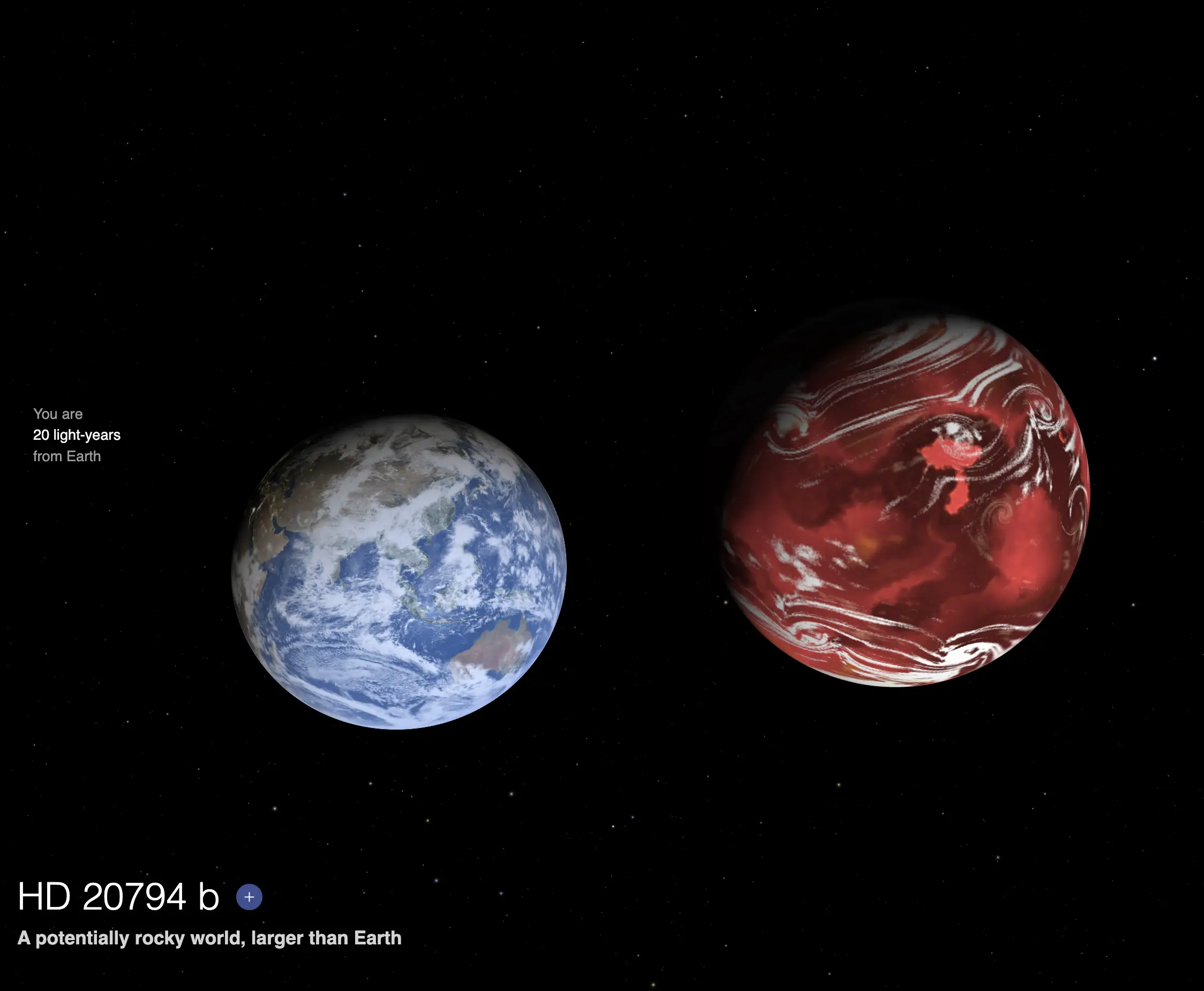
    Earth next to the exoplanet 'HD 20794 d', which may possibly host alien life (NASA)
    Earth next to the exoplanet 'HD 20794 d', which may possibly host alien life (NASA)

    "With its location in a habitable zone and relatively close proximity to Earth, this planet could play a pivotal role in future missions that will characterise the atmospheres of exoplanets to search for biosignatures indicating potential life," Cretignier said.

    "We worked on data analysis for years, gradually analysing and eliminating all possible sources of contamination.

    "For me, it was naturally a huge joy when we could confirm the planet's existence.

    "It was also a relief, since the original signal was at the edge of the spectrograph’s detection limit, so it was hard to be completely convinced at that time if the signal was real or not."

    He went on to explain that 'excitingly', with it being 'only 20 light-years' away from us, there is a possibility that future missions to space could 'obtain an image of it'.

    Dr Cretignier concluded: "While my job mainly consists of finding these unknown worlds, I’m now very enthusiastic to hear what other scientists can tell us about this newly discovered planet, particularly since it is among the closest Earth-analogues we know about and given its peculiar orbit."

    His study, 'Revisiting the multi-planetary system of the nearby star HD 20794. Confirmation of a low-mass planet in the habitable zone of a nearby G-dwarf’, has been published in Astronomy & Astrophysics.

    Choose your content:

    3 days ago
    6 days ago
    8 days ago
    9 days ago
    • Justin Sullivan/Getty Images
      3 days ago

      OpenAI names 22 industries at risk of job losses as it proposes four day week

      Two new reports suggest AI might be coming for your job - but you could also get a three day weekend

      Technology
    • Kayla Bartkowski/Bloomberg via Getty Images
      6 days ago

      Congressman Tim Burchett claims he has seen UFO footage that ‘defies logic’

      Tim Burchett says he has seen UFO footage that couldn't be man made - and he wants answers from the government

      Technology
    • NASA/JPL-Caltech/MSSS
      8 days ago

      NASA's Curiosity rover makes groundbreaking discovery that suggests Mars can support life

      An expert has claimed the new reveal 'increases the prospect that Mars offered a home for life in the ancient past'

      Technology
    • John Nacion/Variety via Getty Images
      9 days ago

      Bill Nye issues stern warning to Trump over concerns he could 'end NASA'

      Bill Nye the Science Guy revealed that Donald Trump's NASA proposal is a 'huge mistake'

      Technology
    • Scientists studying NASA’s James Webb Space Telescope discover black hole 300 million times bigger than the sun
    • Shocking new study reveals ‘possible hostile’ alien threat could be attacking Earth in a few months
    • Experts issue urgent warning over city-destroying asteroid that could devastate Earth without direct impact
    • Harvard scientist issues alien statement as 'not natural' space object approaches Mars