unilad homepage
unilad homepage
    • News
      • UK News
      • US News
      • World News
      • Crime
      • Health
      • Money
      • Sport
      • Travel
    • Music
    • Technology
    • Film and TV
      • News
      • DC Comics
      • Disney
      • Marvel
      • Netflix
    • Celebrity
    • Politics
    • Advertise
    • Terms
    • Privacy & Cookies
    • LADbible Group
    • LADbible
    • SPORTbible
    • GAMINGbible
    • Tyla
    • UNILAD Tech
    • FOODbible
    • License Our Content
    • About Us & Contact
    • Jobs
    • Latest
    • Archive
    • Topics A-Z
    • Authors
    Facebook
    Instagram
    X
    Threads
    TikTok
    YouTube
    Submit Your Content
    NASA telescope takes mind-blowing photo of the exact moment a star is born
    Home>Technology>NASA
    Published 18:58 3 Mar 2025 GMT

    NASA telescope takes mind-blowing photo of the exact moment a star is born

    A star is born...literally

    Gerrard Kaonga

    Gerrard Kaonga

    google discoverFollow us on Google Discover
    Featured Image Credit: NASA/ESA/CSA

    Topics: NASA, Science, Space, Technology

    Gerrard Kaonga
    Gerrard Kaonga

    Gerrard is a Journalist at UNILAD and has dived headfirst into covering everything from breaking global stories to trending entertainment news. He has a bachelors in English Literature from Brunel University and has written across a number of different national and international publications. Most notably the Financial Times, Daily Express, Evening Standard and Newsweek.

    Advert

    Advert

    Advert

    NASA has shown off one of its most breathtaking photos, and it has people questioning everything they know about space.

    Technology is quite a wondrous thing. As a tool, it has allowed us to reshape the world and connect to each other, for better or worse.

    But when technological advancement are applied to the cosmos, things really do become fascinating.

    NASA and other space agencies around the world have been looking into the skies and deep space for decades at this point, and yet the images are still quite the sight.

    Advert

    Knowing just how many amazing pictures they have, NASA has a website dedicated to the ‘astronomy picture of the day’ and a recent snap has started doing the rounds on social media.
    You have got to admit that space is pretty cool (NASA)
    You have got to admit that space is pretty cool (NASA)

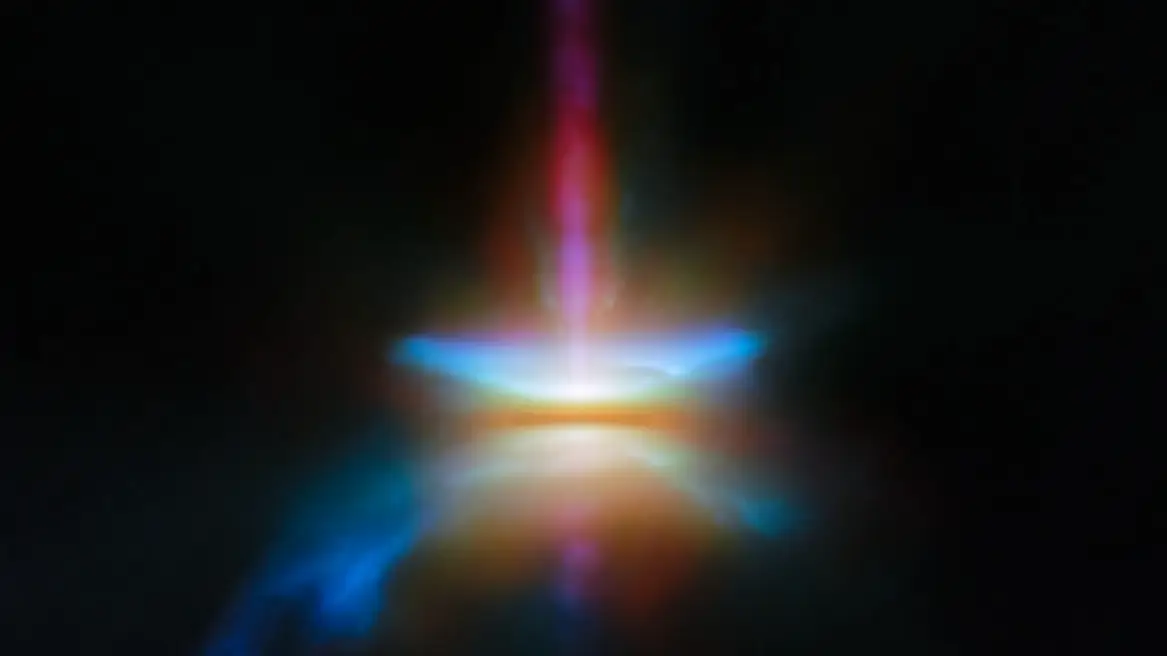
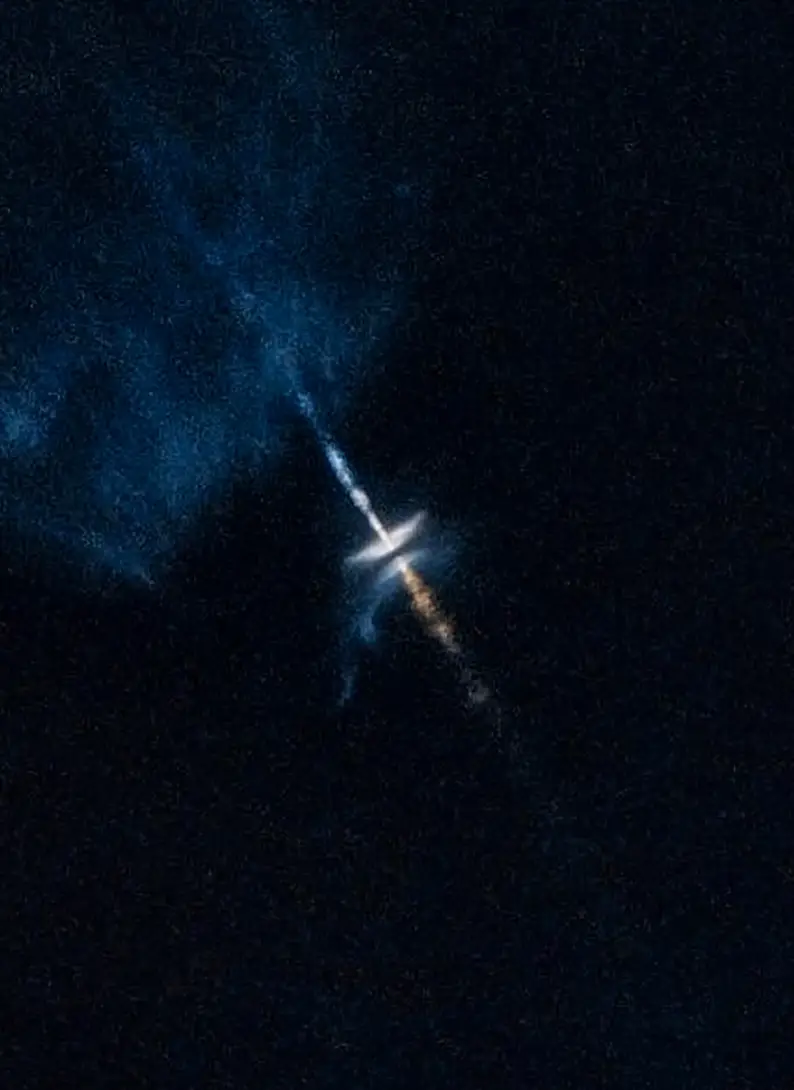
    The picture was taken by the James Webb Space Telescope and shows a star being born in the protoplanetary system Herbig-Haro 30.

    Now due to the vastness of space, we aren’t *actually* looking at the exact moment the star was born, but rather, how this cosmic creation would have looked like when it happened thousands, if not millions of years ago.

    It's basically a whole lot of timey-wimey stuff over deep space.

    Explaining what you are actually looking at, when the image featured on February 19 2025, the page explained: “The observations show, among other things, that large dust grains are more concentrated into a central disk where they can form planets.

    “The featured image from Webb shows many attributes of the active HH-30 system. Jets of particles are being expelled vertically, shown in red, while a dark dust-rich disk is seen across the center, blocking the light from the star or stars still forming there.

    “Blue-reflecting dust is seen in a parabolic arc above and below the central disk, although why a tail appears on the lower left is currently unknown."
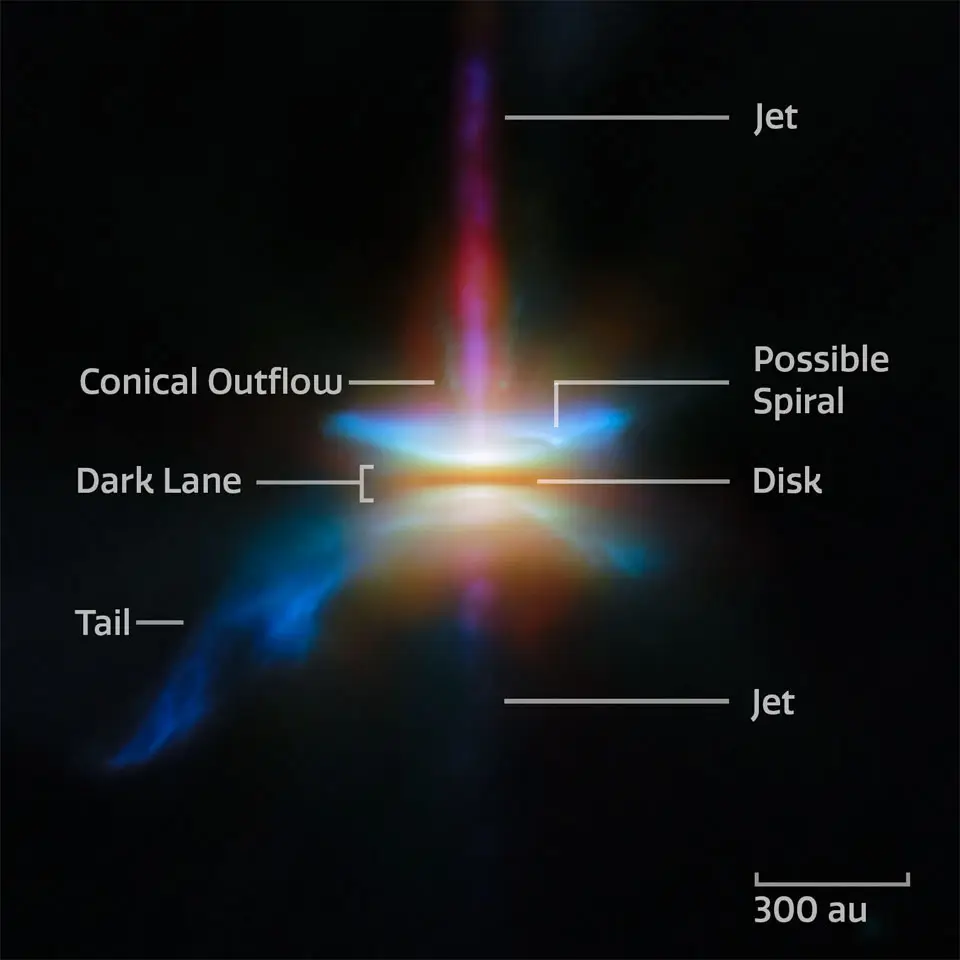
    An astronomer breaks down what you are actually looking at(NASA)
    An astronomer breaks down what you are actually looking at(NASA)

    NASA believes this image can also help us understand how stars and planets are formed.

    Though they seem to have a pretty good idea of how that happens as things already stand.

    An explanation on their website reads: “Stars form in large clouds of gas and dust called nebulae that scatter the visible wavelengths of light our eyes can see. Hubble’s capability to see ultraviolet, visible, and near-infrared light enables study of several aspects of star formation.

    “Young stars shine brightly in ultraviolet light, while visible light reveals the structure of star-forming clouds, the shock waves induced by jets from forming stars, and colorful ionized gas in the nebulae energized by young stars.”

    So yeah, hope that clears up any questions on stars - if you have any more, please turn to your local astronomer or astrophysicist.

    Choose your content:

    an hour ago
    a day ago
    3 days ago
    • Dhiraj Singh/Bloomberg via Getty Images
      an hour ago

      iPhone users can check if they’re eligible for Apple's $250m payout over AI accusations

      The payout applies to people who bought certain iPhones between June 2024 and March 2025

      Technology
    • Christopher Willard/Disney via Getty Images
      a day ago

      Shark Tank star Lori Greiner issues warning over hidden Gmail setting and reveals how to disable it

      Lori Greiner has warned 1.8 billion Gmail users about a setting that allows access to their private emails

      Technology
    • Getty Stock
      a day ago

      Every country where ChatGPT is banned and why

      One in eight people on the planet can't access ChatGPT - and their governments want to keep it that way

      Technology
    • Getty Stock Images
      3 days ago

      Man who used AI to apply to 1,000 jobs while he was sleeping woke up to mind blowing results

      Work smart, not harder has taken on a whole new meaning

      Technology
    • NASA scientists reveal mind-blowing glowing life form in ocean that's visible from space
    • NASA telescope made terrifying planet discovery where it rains glass at 4,300 miles per hour
    • True story behind eerie NASA photo that’s still freaking people out 40 years later
    • Scientist claims to have found the 'exact location of Heaven' with mind-blowing theory