unilad homepage
  • News
    • UK News
    • US News
    • World News
    • Crime
    • Health
    • Money
    • Sport
    • Travel
  • Film and TV
    • Netflix
  • Music
  • Tech
  • Features
  • Celebrity
  • Politics
  • Advertise
  • Terms
  • Privacy & Cookies
  • LADbible Group
  • LADbible
  • SPORTbible
  • GAMINGbible
  • Tyla
  • UNILAD Tech
  • FOODbible
  • License Our Content
  • About Us & Contact
  • Jobs
  • Latest
  • Archive
  • Topics A-Z
  • Authors
Facebook
Instagram
X
Threads
TikTok
YouTube
Submit Your Content
NASA discovers ‘spiderwebs’ on Mars that could contain signs of alien life

Home> News> US News

Updated 17:36 27 Nov 2024 GMTPublished 17:31 27 Nov 2024 GMT

NASA discovers ‘spiderwebs’ on Mars that could contain signs of alien life

The Mars discovery could also prove that warm, salty water flowed from the Martian mountain dubbed Mount Sharp

Joe Yates

Joe Yates

google discoverFollow us on Google Discover
Featured Image Credit: NASA/ NASA/JPL-CALTECH/MSSS / HANDOUT/Anadolu Agency/Getty Images

Topics: NASA, Mars, Space, Science

Joe Yates
Joe Yates

Joe is a journalist for UNILAD, who particularly enjoys writing about crime. He has worked in journalism for five years, and has covered everything from murder trials to celeb news.

X

@JMYjourno

Advert

Advert

Advert

Martians, we've seen them take many different forms on our TVs over the years but we've grown to understand that there is no life on Mars. Or is there?

NASA's Curiosity Rover has made an incredible discovery and one that may prove significant in determining whether there has been life on the big red planet.

For those that don't know about the rover, the space agency explains: "Part of NASA's Mars Science Laboratory mission, Curiosity, was the largest and most capable rover ever sent to Mars when it launched in 2011.

Advert

"Curiosity set out to answer the question: Did Mars ever have the right environmental conditions to support small life forms called microbes? Early in its mission, Curiosity's scientific tools found chemical and mineral evidence of past habitable environments on Mars.

"It continues to explore the rock record from a time when Mars could have been home to microbial life."

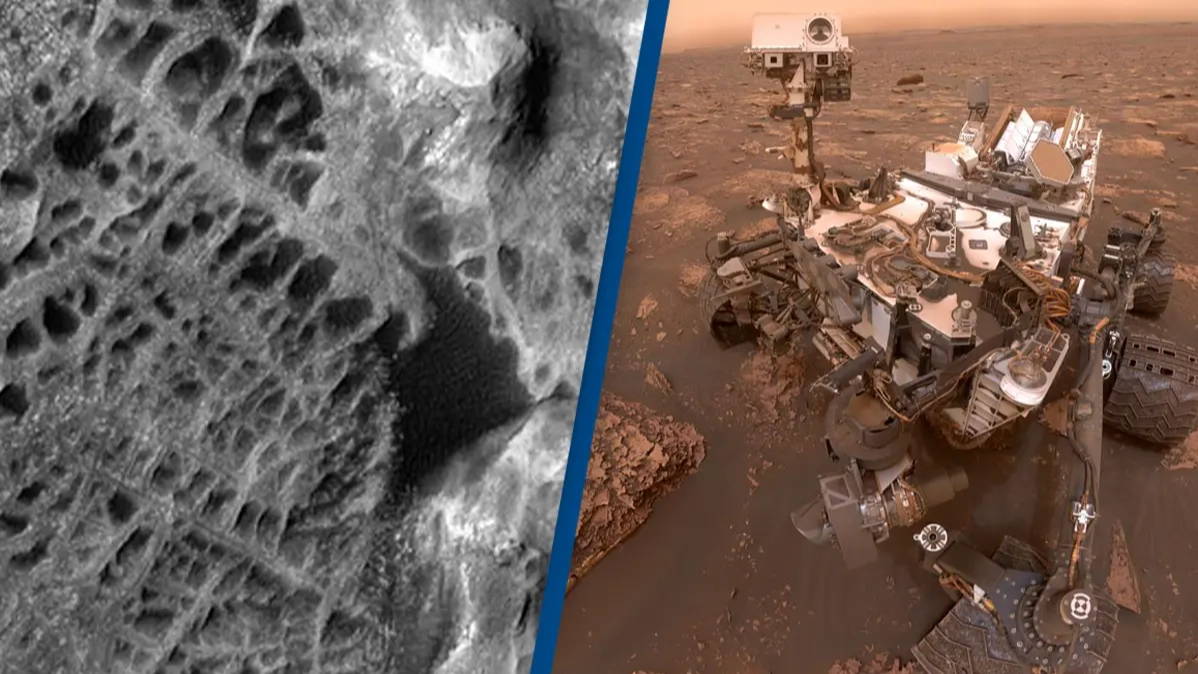
It is certainly delivering results too, as it's discovered that Mars could have been habitable many, many, many years ago, and now it has happened upon 'spiderwebs' in the planet's surface that could contain signs that there was once alien life.

These spiderweb-like structures were first spotted back in 2006 and span six to 12 miles in length, but this section of a Martian desert close to its equator is only now being explored - while the formations lie close to the three-mile tall Mount Sharp.
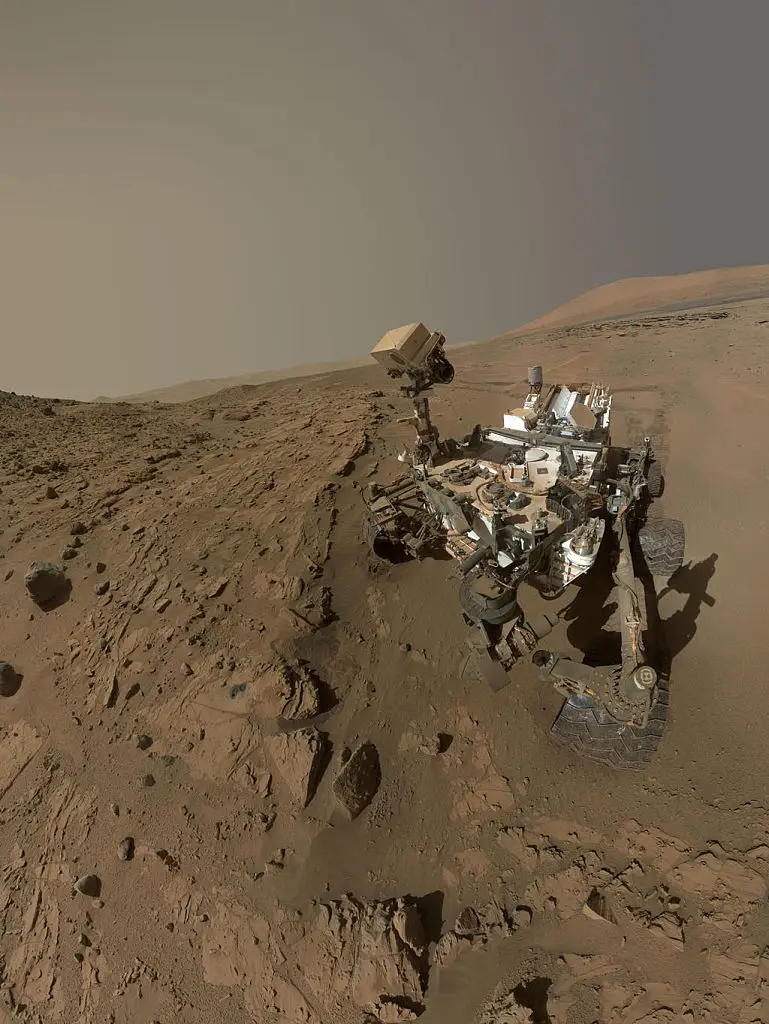
NASA's Curiosity Mars rover used the camera at the end of its arm in April and May 2014 to take dozens of component images combined into this self-portrait where the rover drilled into a sandstone target called 'Windjana' (NASA/JPL-Caltech/MSSS via Getty Images)

Now, I don't think we're talking full-blown aliens like E.T. but micro-organisms which would still be classed as alien life.

So, these spiderweb-like structures are believed to be giant versions of 'boxwork' - which is just a mineral formation that can be found in caves on Earth.

The National Park Service details how boxwork is formed, explaining it 'is made of thin blades of calcite that project from cave walls and ceilings, forming a honeycomb pattern. The fins intersect one another at various angles, forming 'boxes' on all cave surfaces'.

This unearthly form of boxwork appears to scientists to have been formed by seawater rather than calcite.
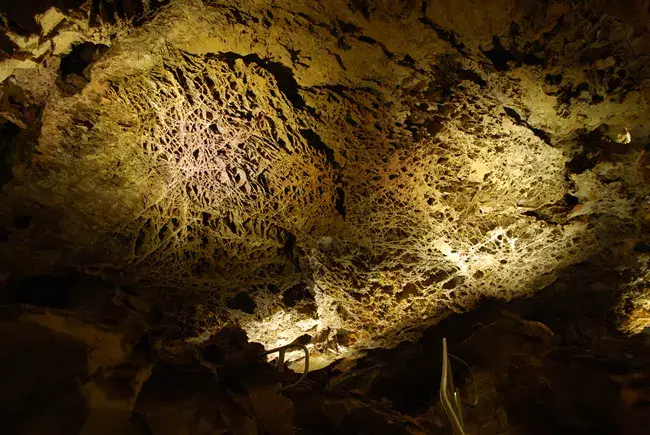
Boxwork as seen in Wind Cave National Park, South Dakota (National Park Service)

Speaking per Marca, geologist Dr Kirsten Siebach, of Rice University, Texas, believes they may contain fossils of past life that inhibited the planet.

"These ridges will include minerals that crystallized underground, where it would have been warmer," she said.

"Early Earth microbes could have survived in a similar environment."

Researchers now believe that mineral-rich water flowed down from Mount Sharp to create the webbing, with an estimate 113 billion gallons of salty, warm water required to form it.

  • NASA's Curiosity rover makes groundbreaking discovery that suggests Mars can support life
  • NASA reveals significant new evidence that shows potential signs of previous life on Mars
  • Bill Nye issues stern warning to Trump over concerns he could 'end NASA'
  • NASA scientists baffled after discovering rock structure on Mars that isn't from there

Choose your content:

an hour ago
5 hours ago
  • Logan Bowles/Getty Images
    an hour ago

    Fernando Mendoza will become $54.6 million richer after becoming NFL Draft 2026 first pick

    The quarterback has joined the Las Vegas Raiders, who finished dead last in the league last season

    News
  • Jason Kempin/Getty Images for A&E Networks
    an hour ago

    A&E shares plans to honor Darrell Sheets in upcoming Storage Wars episode after death at 67

    The network plans to celebrate Sheets' life in the show's new episode after the reality star died of an apparent suicide

    Film & TV
  • FOX via Getty Images
    5 hours ago

    Kidnap victim Elizabeth Smart wins first place in bodybuilding competition as she reveals her new passion

    Smart now works to support and protect children from abuse after her own horrific childhood ordeal

    News
  • VALERIE MACON / AFP via Getty Images
    5 hours ago

    Adam Scott describes 'terrible' time he had at Coachella and why he 'hated it'

    The 'Severance' star had been to Coachella before, but his experience this year left him hating it

    Celebrity