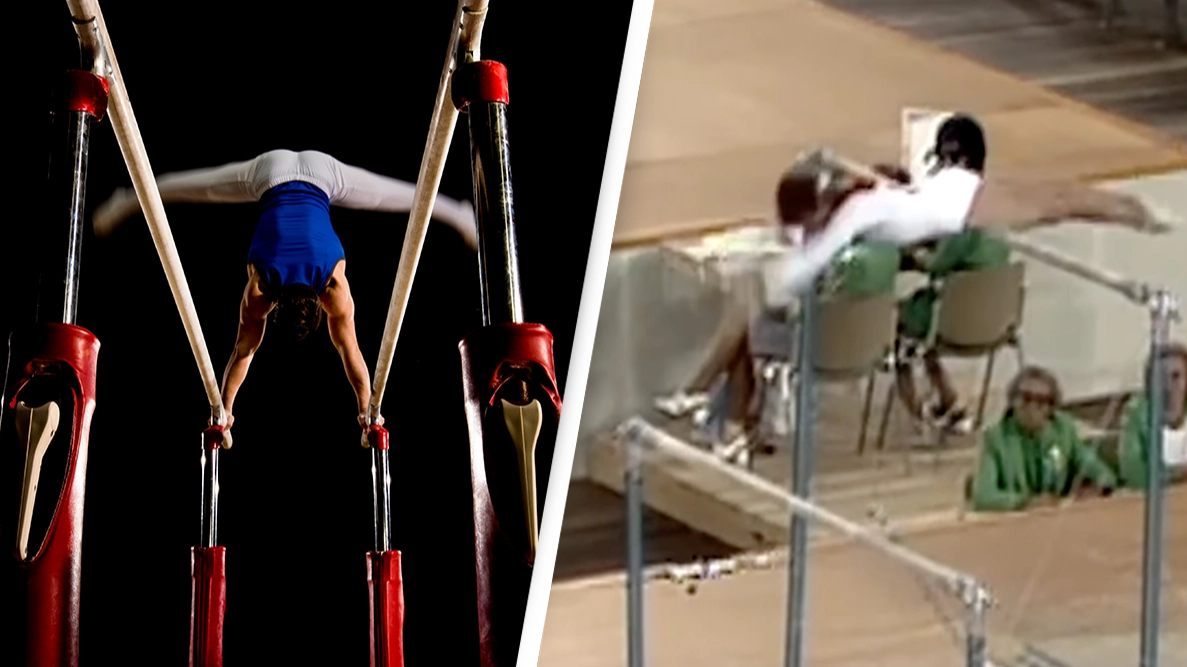
This banned Olympic gymnastics move could lead to death if done incorrectly

Olympic athletes are so talented that they pretty much make every move seem effortless.
But of course, there's so much skill behind every event, and the athletes involved have often trained all their lives to get there.
In gymnastics, there is one move that's so dangerous, it's actually been banned by the International Gymnastics Federation.
Advert
And for good reason, too. Turns out, if athletes get the move wrong, it could be a fatal error.
What is the Dead Loop?
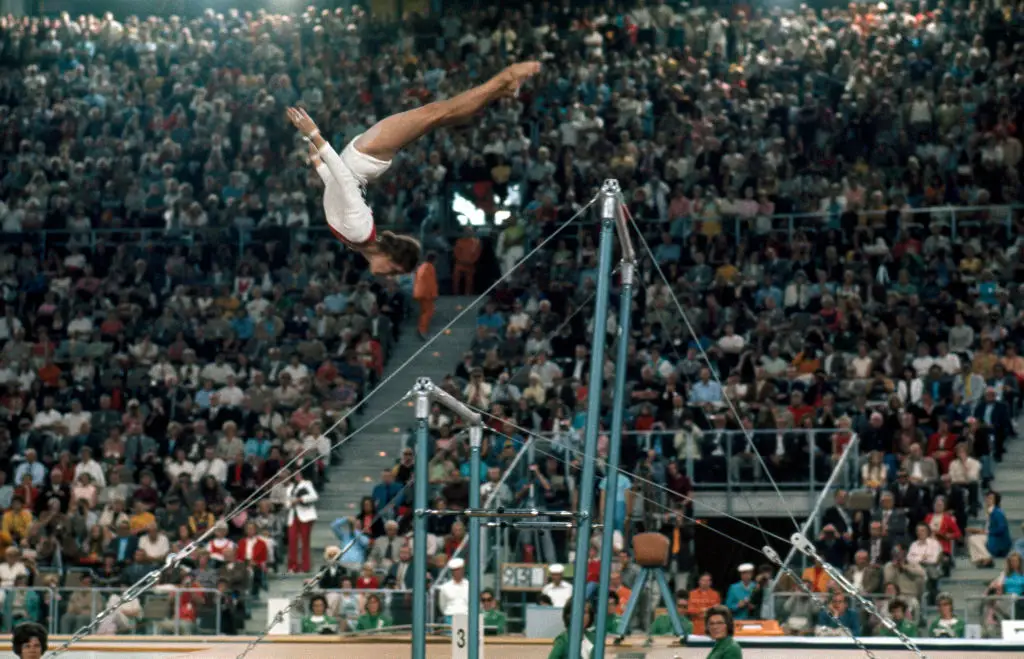
The Dead Loop - or the Korbut flip - was made famous by Olga Korbut at the 1972 Munich Olympics.
The move saw Korbut standing on the high bar and backflipping, before managing to, incredibly, catch the bar on her return.
Korbut - who bagged three gold medals at the 1972 games - performed the move perfectly, but that didn't stop the International Gymnastics Federation deciding to ban the flip to protect gymnasts.
You can watch the moment below:
Why is it so dangerous?
Gymnastics website Gymnast Gem explains that one of the reasons why the manoeuvre is so risky is because the flip is performed on uneven bars.
It requires a huge amount of strength, co-ordination and importantly, precise timing.
"To understand the dead loop, one must first grasp the basic mechanics of the move," the site states.
"At its core, the dead loop involves a gymnast swinging around the horizontal bar, releasing their grip, and re-grasping the bar in a seemingly effortless motion."
The move first begins with a swing in order to generate enough momentum to then release, perform a half turn and a somersault, before re-grasping the bar.
"With precise timing and accuracy, the gymnast re-grasps the bar, allowing them to continue their routine without breaking the flow or momentum of their performance," adds Gymnast Gem.
The main issue is the risk of a serious neck, spine or head injury, if the gymnast lands awkwardly, or if they end up hitting the bar instead of grasping it.

Fast-forward to this year's Olympic Games in Paris and athletes might not be doing the Korbut flip, but they are performing some seriously impressive routines.
In fact, after Team USA gymnast Simone Biles won gold at the Women's Artistic Individual All-Around final on Thursday (August 1) people have been labeling her the 'greatest athlete of all time'.
Her win makes her the oldest all-around Olympic champion since 1952, USA Today Sports reports.
Brazil's Rebeca Andrade came in close second to Biles and took home silver, while Biles' USA teammate Suni Lee took bronze.
UNILAD has contacted the International Gymnastics Federation for comment.
The most bizarre, discontinued Olympic sports
Painting
Back in the day, the Olympics dished out medals for art too, with events including painting and sculpture, as well as music, architecture and even literature.
Making its debut all the way back at the 1912 Olympics in Stockholm and continuing until the 1948 London games, juries awarded competitors a total of 151 medals for artistic projects inspired by sport.
Tug of War
Bet you didn't think this playground classic was once part of the Olympics, did you?
Well, it turns out not only was the sport popular, but it stirred up a lot of drama too - with accusations of foul play flying around at the 1908 Olympics in London, with Team USA accusing Team GB of cheating due to their 'illegal' heavy footwear.
A mainstay for around five Olympic games from 1900 to 1920, Tug of War enthusiasts have even campaigned for organisers to reintroduce the retired sport back into the Games.
Hot Air Balloon Racing
Launching at the 1900 Olympics, hot air balloon drivers would compete in races scoring how far they could travel, altitude reached, ability to land within the correct coordinates and - to top it all off - who got the best photo from the balloon.
The sport ended up being canned after a ban on motorised sports was brought in.
Live Pigeon Shooting
Also making its debut at the 1900 Olympics, the event was pretty self explanatory - a load of pigeons were released into the air as the competitor tried to shoot as many as possible. Grim.
The event only appeared at the Games once, and all in all, it's estimated that Olympic hopefuls killed around 300 pigeons.
Pistol Duelling
It doesn't take much guessing as to why this event was scrapped, but back in 1906, people clearly didn't bat an eyelid at competitors waving pistols around and shooting at each other.
It began with competitors shooting at dummies, but two years later organisers decided to shake things up and have them shoot at each other with wax bullets. Ouch.
1908 would be the last time the sport was included in the Olympics, so I'm guessing they quickly realised it was a bad idea - wax bullets or not.
 Lucy Devine