unilad homepage
unilad homepage
  • News
    • UK News
    • US News
    • World News
    • Crime
    • Health
    • Money
    • Sport
    • Travel
  • Music
  • Technology
  • Film and TV
    • News
    • DC Comics
    • Disney
    • Marvel
    • Netflix
  • Celebrity
  • Politics
  • Advertise
  • Terms
  • Privacy & Cookies
  • LADbible Group
  • LADbible
  • SPORTbible
  • GAMINGbible
  • Tyla
  • UNILAD Tech
  • FOODbible
  • License Our Content
  • About Us & Contact
  • Jobs
  • Latest
  • Archive
  • Topics A-Z
  • Authors
Facebook
Instagram
X
Threads
TikTok
YouTube
Submit Your Content
School Asks 9-Year-Olds To Explain Why Native Genocide Helped America 'Grow And Prosper'
Home>News
Updated 14:38 7 Feb 2022 GMTPublished 16:35 23 Jan 2022 GMT

School Asks 9-Year-Olds To Explain Why Native Genocide Helped America 'Grow And Prosper'

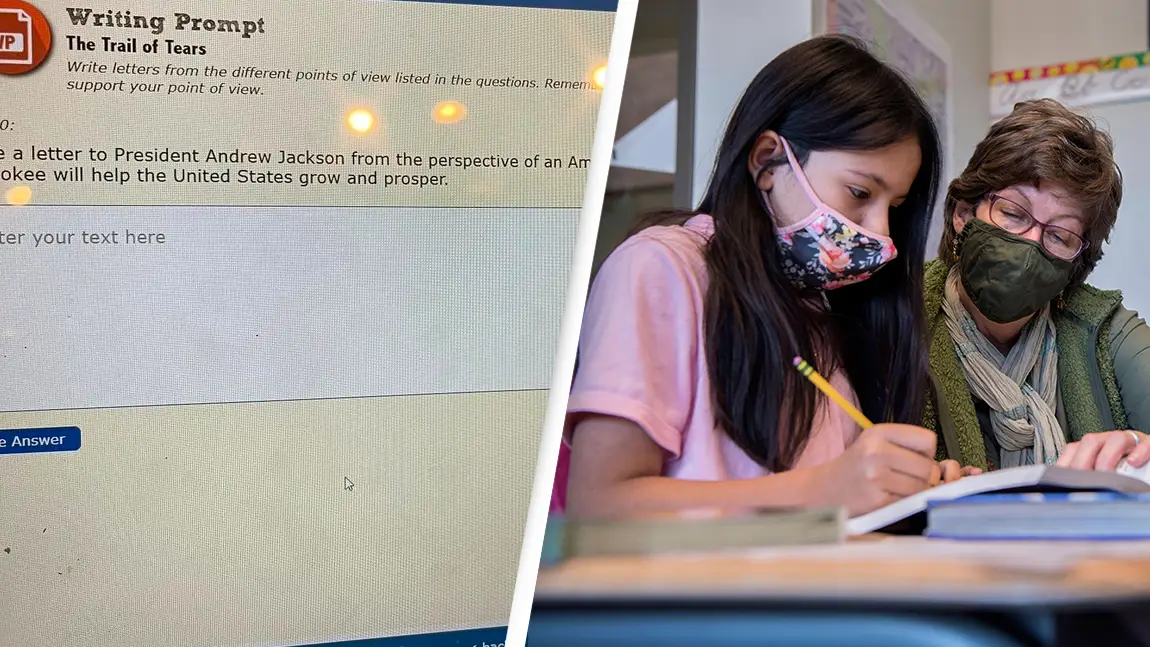
A Georgia school has asked students to explain why forced relocation of Native Americans helped the US 'grow and prosper'.

Joe Harker

Joe Harker

google discoverFollow us on Google Discover
Featured Image Credit: @notreallyjcm/Twitter/Alamy

Topics: US News

Joe Harker
Joe Harker

Joe graduated from the University of Salford with a degree in Journalism and worked for Reach before joining the LADbible Group. When not writing he enjoys the nerdier things in life like painting wargaming miniatures and chatting with other nerds on the internet. He's also spent a few years coaching fencing. Contact him via [email protected]

X

@MrJoeHarker

Advert

Advert

Advert

School Asks 9-Year-Olds Explain Why Native Genocide Helped America 'Grow And Prosper' (@notreallyjcm/Twitter/Alamy)

A school in the US state of Georgia has been criticised after asking fourth-grade students to explain why the Trail of Tears helped America 'grow and prosper'.

For a homework assignment, Georgia Cyber Academy asked nine-year-olds to write a letter to then-president Andrew Jackson from the perspective of an American settler, explaining why the removal of the native Cherokee population would help the United States.

Jackson was the seventh US president, and during his administration he signed the Indian Removal Act, which gave the federal government the power to forcibly relocate thousands of Native Americans westwards away from lands where US citizens wanted to settle.

Advert

The forced relocation of the Cherokee saw more than 15,000 people made to travel on foot from their homes to what is now Oklahoma, with more than 4,000 dying during the journey.

my friend's kid's school in Georgia sent homework with this question pic.twitter.com/pSFhJ0Ucvz

— Jennifer C. Martin (@notreallyjcm) January 20, 2022

The assignment has provoked a debate, with some arguing that the question was asking children to take the side of the American settler and make a case for forcible relocation and genocide.

Dr Twyla Baker told Native Viewpoint, 'I think I can point to the entire tribal college movement as proof that there are myriad ways to teach history that doesn’t ask marginalized groups of students to "play Devil’s Advocate" or justify genocide on behalf of oppressors.

'There are better ways to teach history that respect the voices and perspectives of everyone involved, and include multiple narratives, because history belongs to all of us. We need to actively dismantle the idea that only one narrative exists.

'Many, many scholars are doing it in classrooms across the country; to do otherwise is intellectually lazy, and disrespects our children, no matter their background.'

It is common practice in education to ask students to place themselves in others' shoes to try and understand, good or bad, what a defined group in history believed and why. If it makes the students uncomfortable for having to defend it? Even better.

— Margo Lee 🍎👩🏻‍🌾🦺🚩🏴 (@MargoLee) January 20, 2022

However, others argued that writing from the viewpoint of the US settler did not mean agreeing with their point of view, and that understanding a historical perspective well enough to represent it was an important part of learning history.

They took to social media to argue that children will often be asked to explore the viewpoints of people they don't agree with while learning history, without being asked to adopt the ideas they are being taught about.

Georgia Cyber Academy has not yet responded to requests from Native Viewpoint for comment.

If you have a story you want to tell, send it to UNILAD via [email protected]  

Choose your content:

Just now
an hour ago
  • Getty Stock Image
    Just now

    Doctors warn of ‘bag of worms’ testicle condition affecting 1 in 5 men that can harm fertility

    The condition can be asymptomatic for some men

    News
  • Oli Scarff/Getty Images
    an hour ago

    Madeleine McCann's mom says restaurant note may have led to her disappearance

    Kate McCann said she will 'bitterly regret' a note that she believes may have led to Maddie's disappearance

    News
  • Getty Stock
    an hour ago

    This is why you sometimes see patterns when you close your eyes

    The medical anomaly can be due to underlying conditions

    News
  • Aaron Schwartz/Sipa/Bloomberg via Getty Images
    an hour ago

    Trump blasted after revealing reason he might not be able to attend son Eric's wedding this weekend

    Trump said he would be crucified by 'fake news' whether he attends or not

    News
  • ICE detains five-year-old boy immediately after he returns home from school
  • How Snapchat feature led investigators to tragic discovery and helped solve double murder case
  • Real reason why Donald Trump’s meeting with Putin was canceled as WW3 fears grow
  • Everything we know about the 24 people found dead in Houston bayous this year as serial killer fears grow