• News
  • Film and TV
  • Music
  • Tech
  • Features
  • Celebrity
  • Politics
  • Weird
  • Community
  • Advertise
  • Terms
  • Privacy & Cookies
  • LADbible Group
  • LADbible
  • SPORTbible
  • GAMINGbible
  • Tyla
  • UNILAD Tech
  • FOODbible
  • License Our Content
  • About Us & Contact
  • Jobs
  • Latest
  • Topics A-Z
  • Authors
Facebook
Instagram
X
Threads
TikTok
YouTube
Submit Your Content
Scientists find strange 'polygonal structures' buried on Mars

Home> Technology> Space

Published 19:53 2 Jul 2024 GMT+1

Scientists find strange 'polygonal structures' buried on Mars

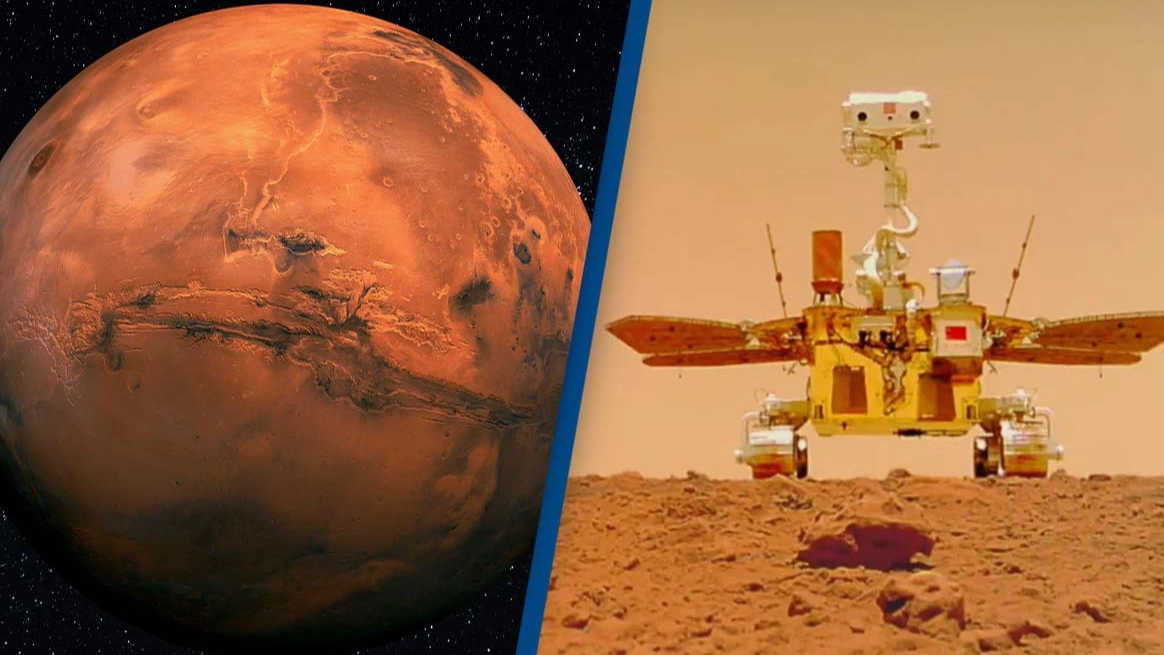
Chinese rover Zhurong made the discovery on Mars, and it could shed some light on the Red Planet's history

Kit Roberts

Kit Roberts

google discoverFollow us on Google Discover

Scientists have found an interesting set of structures buried beneath the surface of Mars.

Now before you get too excited, no these are not 'structures' as in an alien colosseum or some sort of giant underground temple complex.

These are not artificial structures, but geological structures which formed over millions and millions of years.

Advert

So if you were worried about a War of the Worlds style invasion or some sort of Alien vs Predator complex for extraterrestrials to do battle, you can relax.

But while the discovery by China's Zhurong rover may not be in the realms of science fiction, it does reveal some interesting details about Mars' past.

They might seem like innocuous structures, but bear with me as they are rather interesting.

So what are these weird structures found beneath the planet's surface?
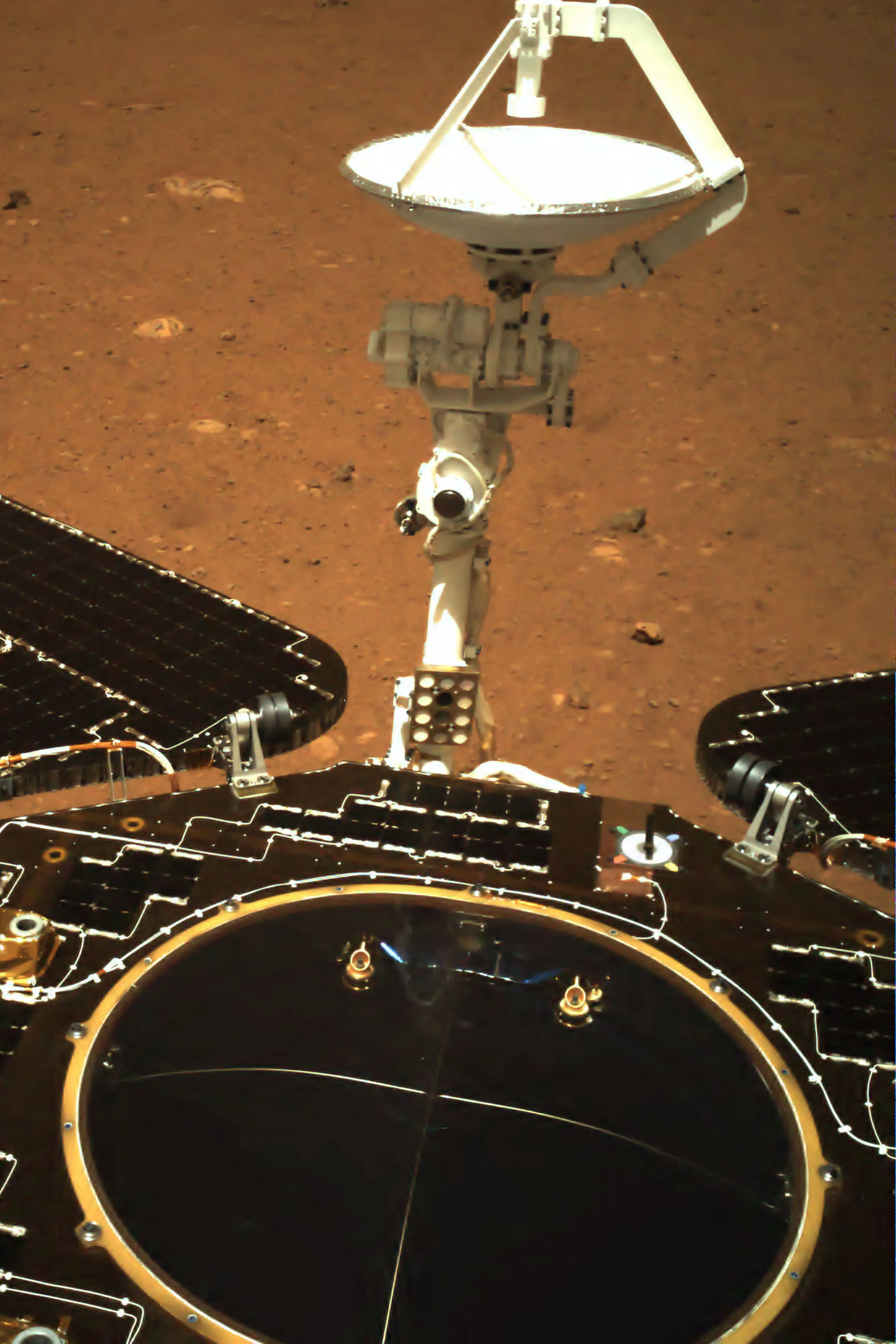
The Zhurong rover on the surface of Mars. (CNS/CNSA/AFP via Getty Images)

Well, there are 16 polygonal structures. But what's interesting about the shapes is that scientists think that they were formed as a result of several 'freeze-thaw' cycles.

And if you're thinking that this suggests the substance doing the freezing and thawing was water, then you'd be correct.

Not only that, but the discovery could suggest that the process of sublimation, going directly from a solid to a gas, and freezing had been going on for millions of years.

The formation itself was around 35 metres beneath the surface of the Red Planet.

This suggested that there could have been floods in the area quite a long time ago.
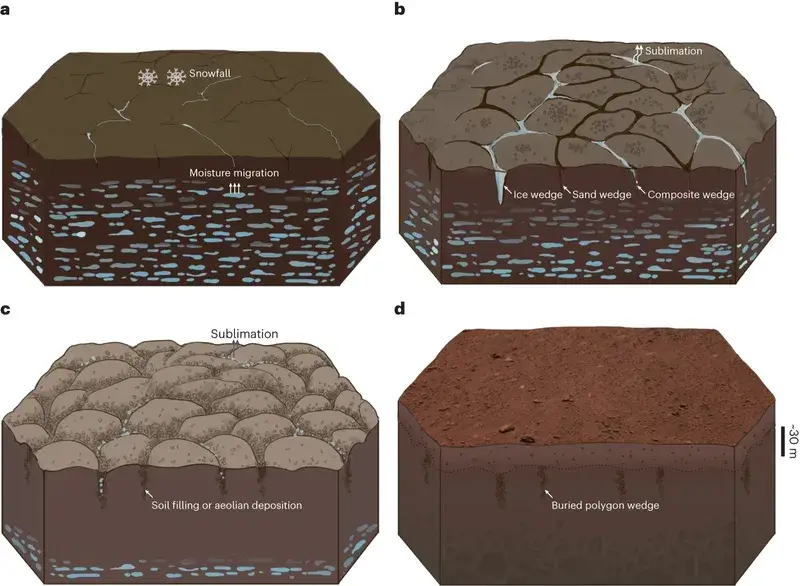
The structure in question. (Zhang et al, Nature Astronomy 2023 (CC BY 4.0))

We are talking a VERY long time here as well by the way, as in not even millions of years but billions of years.

Around three billion years to be precise, or as precise as that could be.

While the team of investigators wasn't sure precisely where the structure came from, they became confident that it would be formed by thermal processes caused by varying climates.

This is the main implication of the study, as freeze and thaw cycles imply that Mars had a potentially quite varied climate at one point.

The study authors said: “Occurring at low latitudes (∼25° N), the polygonal terrain, which is interpreted as having most likely formed by thermal contraction cracking, makes a compelling case for the high obliquity of early Mars.

"The subsurface structure with the covering materials overlying the buried palaeo-polygonal terrain suggests that there was a notable palaeoclimatic transformation some time thereafter."

Featured Image Credit: Getty Stock Images/China News Service

Topics: News, World News, China, Mars, Science, Space

Kit Roberts
Kit Roberts

Kit joined UNILAD in 2023 as a community journalist. They have previously worked for StokeonTrentLive, the Daily Mirror, and the Daily Star.

Advert

Advert

Advert

Choose your content:

15 hours ago
22 hours ago
a day ago
  • (YouTube/NASA Goddard)
    15 hours ago

    Terrifying NASA simulation reveals biggest known black holes and the largest could devour our galaxy

    It's very unlikely Earth will be swallowed whole, though.

    Technology
  • Getty Stock Photo
    22 hours ago

    Amazon returns worker explains what you should 'never ever' do when sending back items

    The insider also revealed the most disgusting item they had seen get returned

    Technology
  • NurPhoto/Getty
    a day ago

    Urgent warning to nearly 2 billion iPhone users over calendar scam you shouldn't click

    iPhone users have reported being unable to stop hackers from flooding their calendars with dangerous scam invites

    Technology
  • Joe Raedle/Getty Images
    a day ago

    NASA engineer explains what actually happens to poop in space as Artemis II mission around Moon launches next week

    Four astronauts will make history as they travel farther than anybody else during the Artemis II mission

    Technology
  • NASA's Mars rover discovers strange spheres on planet's surface that has experts stunned
  • Astonishing new picture taken on Mars leaves people shocked as they all point out surprising detail
  • Scientists find simple Chinese practice which takes just 10 minutes to do could help lower risk of heart disease
  • NASA make shocking discovery after finding mysterious skull-shaped feature on Mars