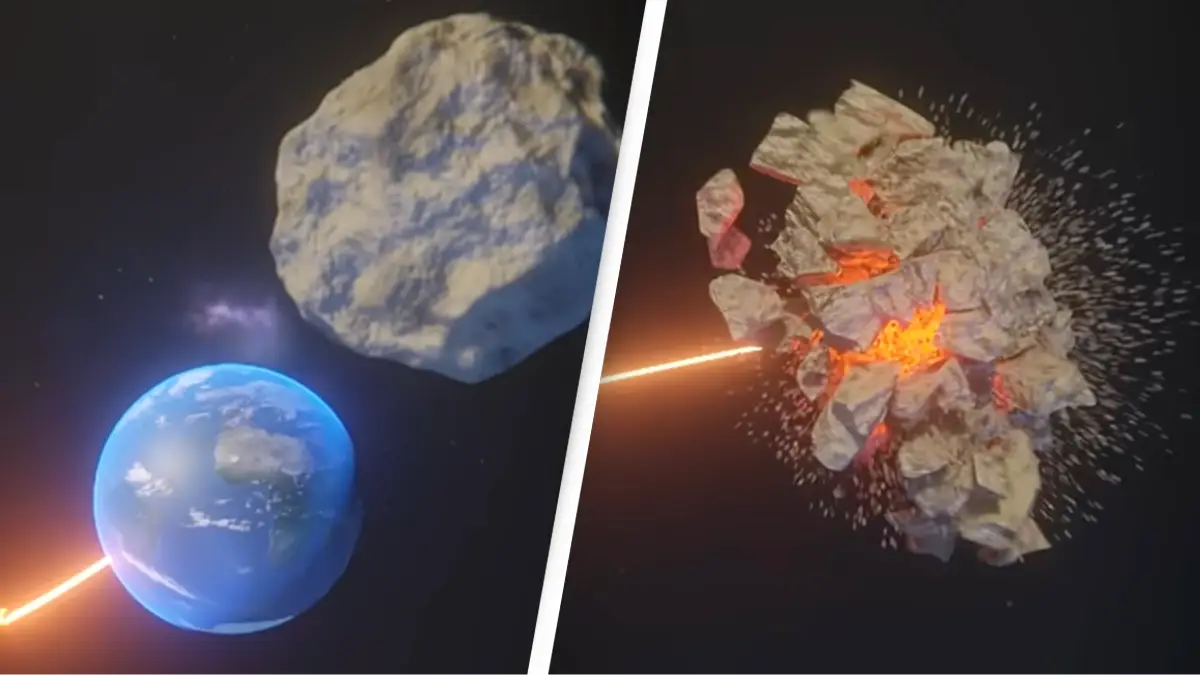
Shocking simulation reveals strange reason why blowing up an asteroid won't stop it from hitting Earth

While it may not be something to worry about just yet, astronomers are always looking at the potential risks of asteroids.
And a simulation revealing why blowing up an asteroid might not actually stop it from tumbling towards Earth is only going to create more unanswered questions.
The short video posted to YouTube by Zack D Films showcases the simulation while quashing any preconceived ideas about asteroids.
The video begins with Zack explaining that if an asteroid was about to hit Earth many would assume we would simply 'deflect' it by blowing it up - but it isn't that straight forward.
Advert
The YouTuber explained how gravity can bring the exploded pieces back together once more, where it can then continue with its journey.
Terrifying.
The worry for astronomers is whether that path would see a direct impact with us on Earth.
A study published in 2019 found just how ineffective blowing up an asteroid with nuclear weapons or something similar could be.
Scientists simulated a 4,000-foot asteroid crashing into a 15.5-mile asteroid at 11,200 miles per hour, and the results were certainly interesting.
The large asteroid cracked considerably, but its heart was not critically wounded, which could prove crucial in a real-life situation.
So, as time passed, the gravitational pull of the remaining bit of asteroid was able to bring the fragmented parts back together.
Charles El Mir, who was the lead author on the study, said the findings 'could be interpreted as an argument against ‘blowing up’ an asteroid as a defensive strategy'.
The study does have its limitations however, as real asteroids can vary in size and general characteristics - something which is not possible to take into account with current experiments.
What scientists learn may prove useful for the asteroid named Bennu that could hit Earth in the future.
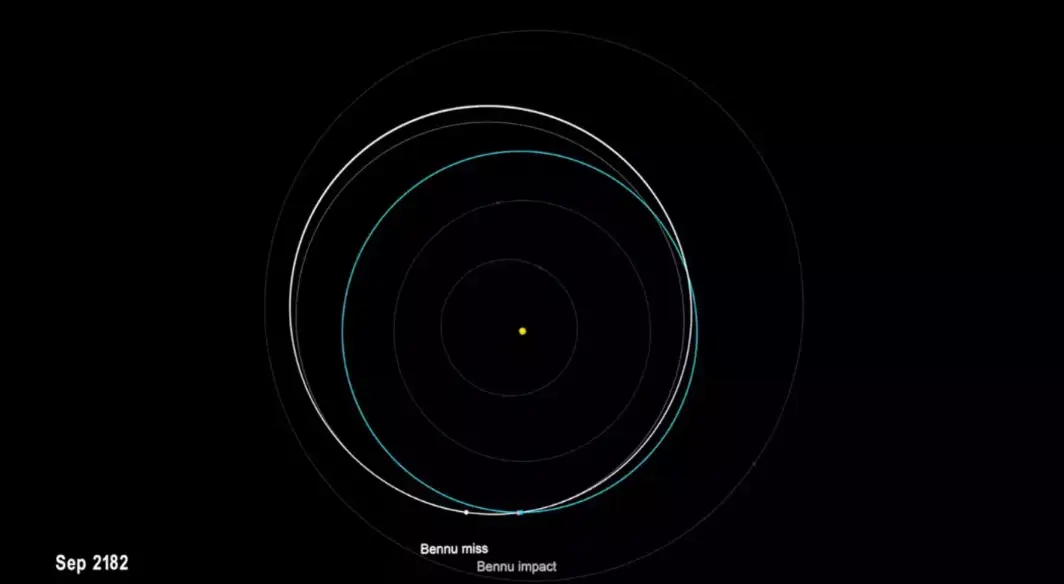
Thanks to the work of many at NASA, there is an 'extremely small chance' Bennu will hit Earth on September 24, 2182.
Richard Burns, project manager for OSIRIS-REx at NASA’s Goddard Space Flight Center in Greenbelt, Maryland explained how a lot of work has gone into diverting the asteroid.
"We are now in the final leg of this seven-year journey, and it feels very much like the last few miles of a marathon, with a confluence of emotions like pride and joy coexisting with a determined focus to complete the race well," he said.
There is a 1:2700 (0.037%) chance of this missile impacting Earth on September 24, 2182, according to a paper shared by the OSIRIS-REx science team.
 Callum Jones