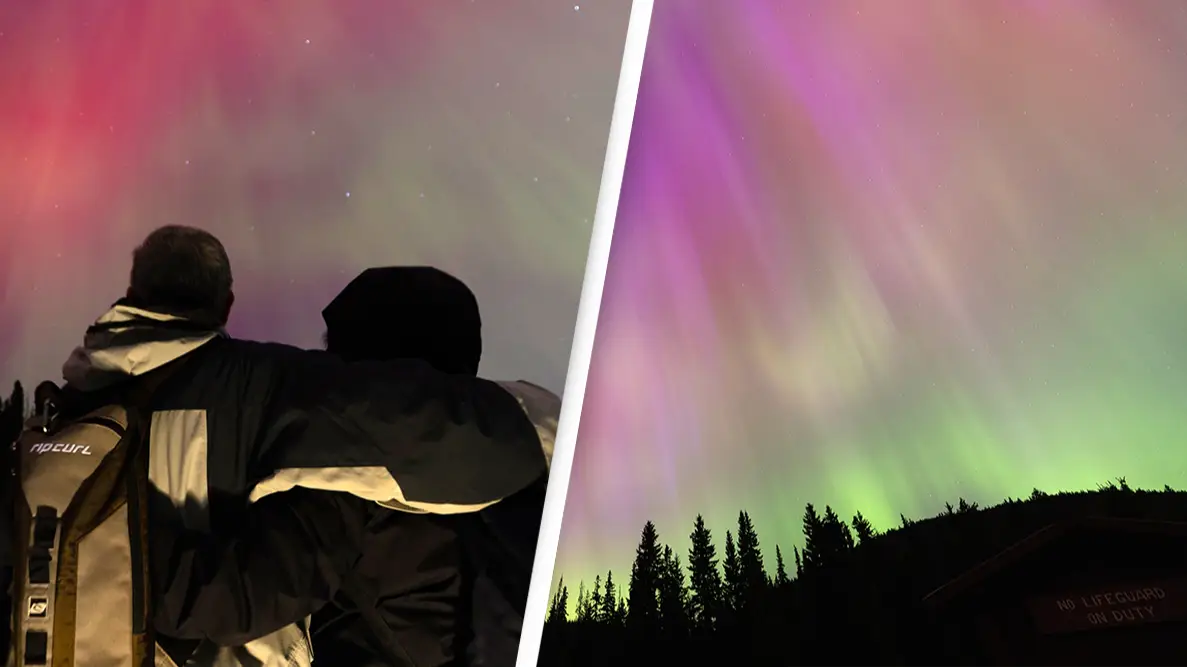
Electron storm caused rare 'polar rain' aurora seen from Earth for the first time ever

A remarkable Christmas Day aurora observed over the Arctic back in 2022 was as a result of a 'rainstorm' of electrons coming directly from the sun.
Japanese and US-based scientists have been working over recent months and even years to explain the impressive display many saw while enjoying their Christmas dinner over 18 months ago.
It was the first time a rare aurora of that kind had been seen from the ground, coming at a time when the gusts of the solar wind had almost completely dropped off.
This left a region of calm around Earth while many were enjoying the Christmas festivities with their nearest and dearest.
Advert
Usual auroras we see have a very similar pattern, as they move and pulsate, with clearly discernible shapes in the sky.

Powered by electrons from the solar wind, a stream of charged particles that flow from the sun become trapped in an extension of Earth's magnetic field called the magnetotail.
More extreme weather events see trapped electrons flow down Earth's magnetic field lines to the poles, as they encounter molecules in Earth's atmosphere.
They typically collide with them, which then prompts them to glow in the colors of the aurora - whether that be blue, green or red.
READ MORE
LISTEN TO THE 'UNSETTLING' NOISE THE AURORA MAKES
NASA VOLUNTEERS ON YEAR-LONG MARS HABITAT MISSION EMERGE FOR FIRST TIME
The aurora that took place on Christmas Day 2022 was very different, as the spectacle seen in Norway was a faint, featureless glow that spanned 4,000 kilometres in extent.
On top of that, it had no structure, no pulsing or varying brightness.
And the aurora certainly made a bit of history too, as no type of space event like it had ever been seen from Earth before.

With this aurora, dwindling solar winds allowed 'an intense flux of electrons' to reach the atmosphere.
This created a polar rain aurora, according to the research papers.
Keisuke Hosokawa, from the Center for Space Science and Radio Engineering at the University of Electro-Communications in Tokyo, said: "When the solar wind disappeared, an intense flux of electrons with an energy of >1keV was observed by the DMSP, which made the polar rain aurora visible even from the ground as bright greenish emissions."
The diameter of the magnetic funnel was also different from the ordinary, opening at about 7,500 kilometres when projected at Earth's distance from the sun.
This essentially provides reasoning as to why the aurora seemed so smooth.
 Callum Jones