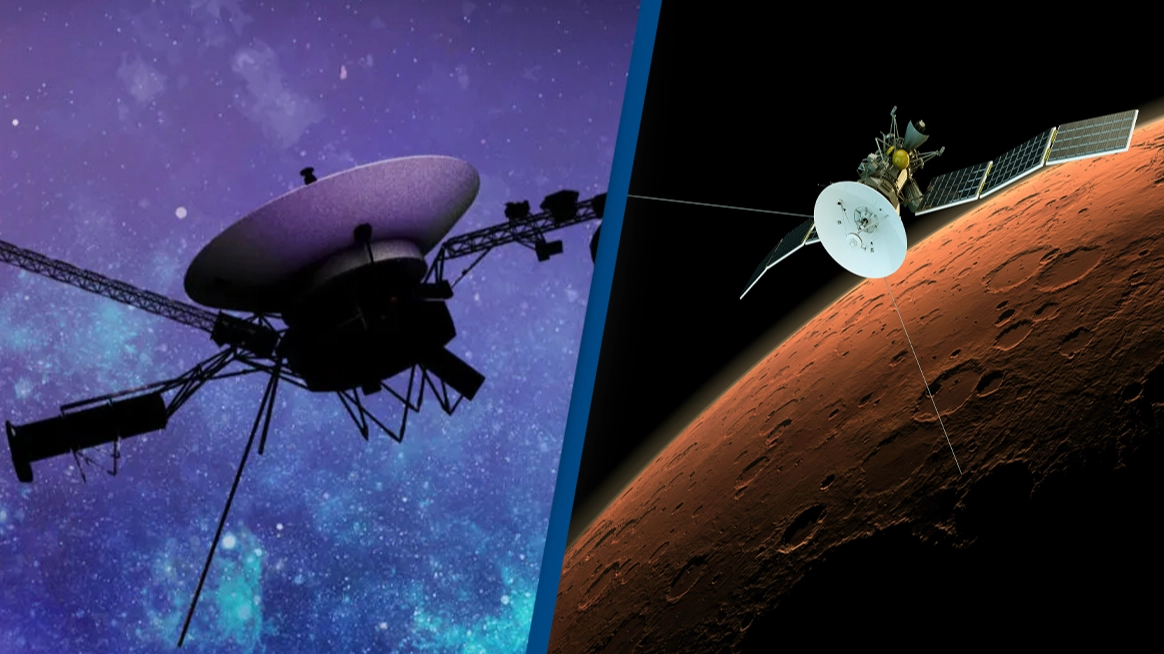
Voyager 1 spacecraft reconnects with Earth from 24,000,000,000 kilometers away on transmitter not used in 43 years

NASA has reconnected to a spacecraft that's currently 24 billion kilometers from Earth using a radio that hasn't been used since 1981.
If you weren’t aware of how cool the Voyager 1 was, prepare yourself.
What is NASA's Voyager 1 spacecraft?
This handy craft has been soaring through space along with Voyager 2 for over 47 years now and they are actually the only two spacecraft operating in interstellar space right now.
Voyager 1 recently went silent, causing NASA to go into a bit of a panic.
Advert
However, they’ve managed to reconnect to the radio transmitter, which is on the craft and more than 24 billion kilometers (15 billion miles) from Earth.
Why did Voyager 1 fall silent?
Strangely, the spacecraft switched off one of the two transmitters for no apparent reason and now experts are trying to figure out what happened.
Because Voyager 1 is so old, there may be a risk of technical issues, as well as further work for the mission engineering team to get it back to tip top shape.
According to scientists, they believe the transmitter was shut off after it was triggered by its fault protection, which automatically reacts to any issues onboard.
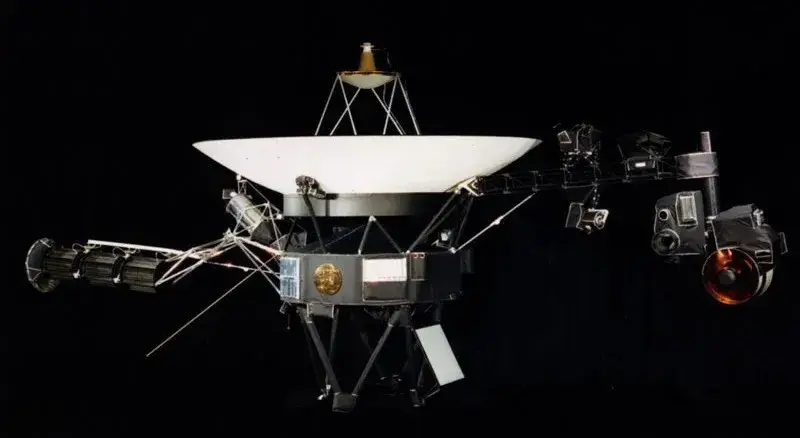
NASA says that if the spacecraft uses too much power, this fault protection system reaction will help it to save energy by letting go of anything that’s not essential to be turned on.
But it could take weeks for the team to find out why it turned on its fault protection system.
Typically, when the team at NASA's Jet Propulsion Laboratory in Southern California sends instructions to it through the Deep Space Network, Voyager 1 returns engineering data back to the team so they can see how it processed the instructions.
This takes a few days.
So, when they sent out their command and finally was able to get a response for the radio silent Voyager 1, it ended up taking 23 hours for the command to travel a whopping 24 billion kilometers from Earth to where the spacecraft was flying, and then another 23 hours for it to return back.
That’s pretty far for it to have flown out.
When the team reached out to the craft on October 16 to command it to activate a heater, it caused it to set of the fault protection system, even though it had enough power to carry out the instruction.
Two days later on October 18, they realised that there was an issue as the spacecraft wasn’t communicating with Earth using its X-band radio transmitter, and they struggled to pick up its signal.

The flight team believe that the fault protection system had reduced the transmitter's rate of sending back data, altering the X-band signal.
Engineers managed to locate the signal later that same day, and Voyager 1 appeared to be stable, but communication ceased to exist the following day.
The flight team believe Voyager 1's fault protection system had gone off twice during that time, which switched off the X-band transmitter.
How did NASA reconnect to Voyager 1?
NASA eventually found that Voyager 1 was using a second radio transmitter known as the S-band, which hasn’t been used to communicate with Earth since 1981.
It operates on a different frequency and the signal is significantly weaker.
“It uses a different frequency than the X-band transmitters signal is significantly fainter,” NASA’s Tony Greicius wrote in the Voyager Blog.
"The flight team was not certain the S-band could be detected at Earth due to the spacecraft’s distance, but engineers with the Deep Space Network were able to find it.”
Thankfully, when the Deep Space Network managed to locate the S-band signal, they issued a command on October 22 to verify it was functioning.
Now, they are have confirmed that the S-band transmitter is working well, and are working on restoring the spacecraft to its normal operations.
Topics: Space, NASA, Technology
 Britt Jones