
Health expert slams Trump administration’s new dietary guidelines that ‘go against decades of research'

The Trump administration has kicked off the new year by unveiling revised dietary guidelines for the US public, but experts have expressed concern that it may not be as healthy as they would have you believe.
On Wednesday (January 7), Health Secretary Robert F. Kennedy Jr shared the revised healthy eating guidelines with the public as part of his ‘Make America Healthy Again’ campaign.
Under the new guidance, people are asked to prioritise red meat, cheese, vegetables, and fruits in their diets, while also incorporating saturated fats, which until now have been considered a health taboo.
The drastic overhaul of nutritional guidance marks a stark change from the 15-year-old guidance first introduced in 2011, which saw the US shift to the circular MyPlate.
Advert
MyPlate was introduced after the US stopped using the 1992 Food Guide Pyramid, illustrating the five food groups.
Under previous guidance, the core staples of a healthy diet were grains, followed by vegetables and fruits in the middle, dairy and protein in a smaller portion, and then a small amount of fats, oils, and sweets.
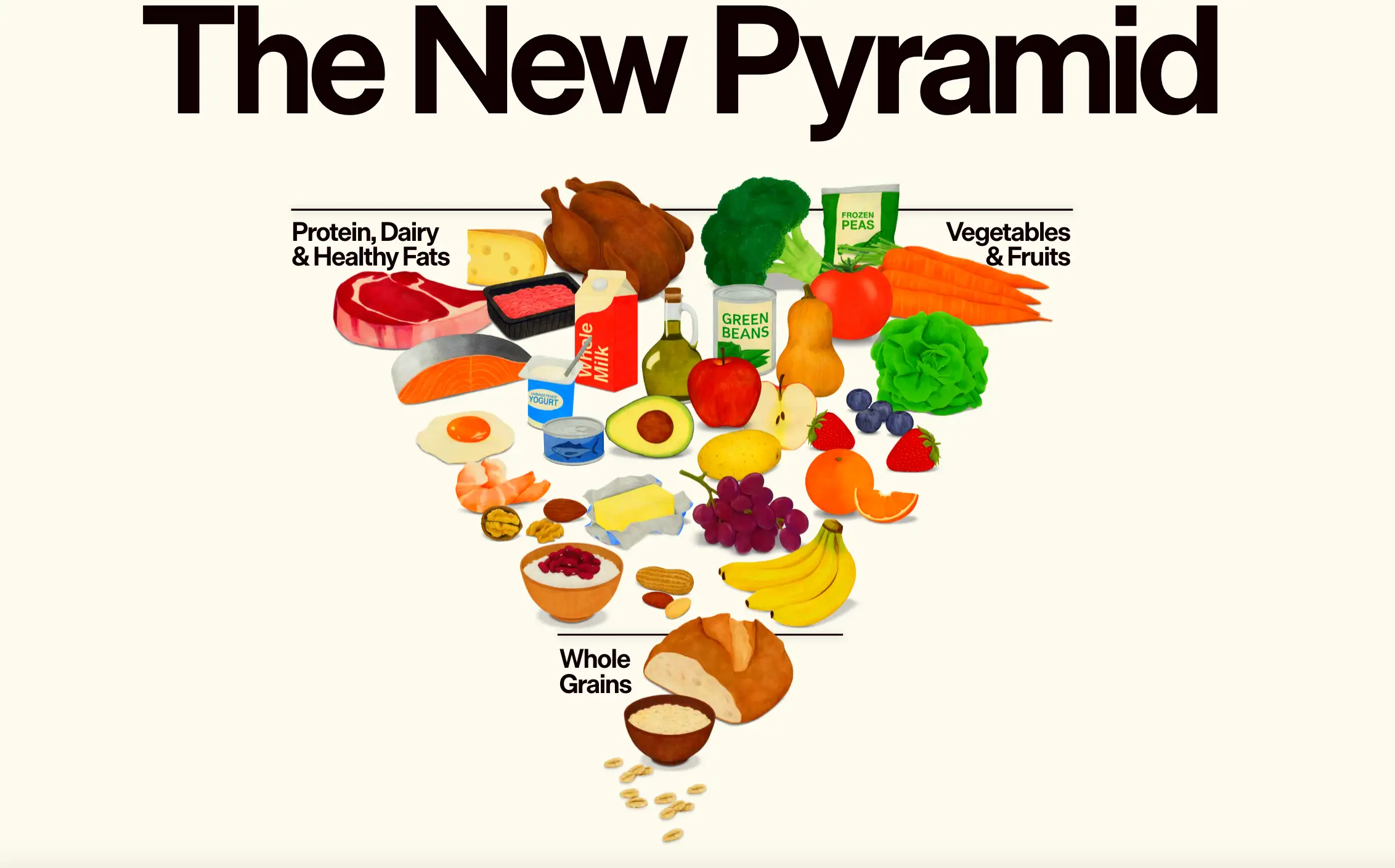
Yet Kennedy’s new overhaul has completely turned that model on its head, with protein, dairy, and healthy fats considered the most critical alongside vegetables and fruits, while whole grains make up the smallest part of the diet.
It is understood that the shift in policy is to try to encourage more Americans to increase their protein intake, with new guidance encouraging 1.2-1.6 grams per kilogram of body weight per day, an increase from the previous minimum of 0.8g/kg.
The new diet is also designed to try to steer consumers away from ultra-high processed foods and instead focus on more natural and minimally processed alternatives.
Essentially, they are asking Americans to ‘Eat real food.’
“Protein and healthy fats are essential and were wrongly discouraged in prior dietary guidelines,” Kennedy said at a press conference to announce the new guidelines.
“We are ending the war on saturated fats.”
Previous USDA dietary guidelines encouraged people to replace saturated fats with healthier unsaturated fats to lower LDL cholesterol and the risk of heart disease and stroke - yet this no longer appears to be the case.
It’s this shift in policy that has raised alarm among many health experts, with several arguing that it goes against decades of research and evidence that supported the previous guidelines.

“I'm very disappointed in the new pyramid that features red meat and saturated fat sources at the very top, as if that's something to prioritize,” Christopher Gardner, a nutrition expert at Stanford University, told NPR. "It does go against decades and decades of evidence and research.”
Similarly, the encouragement to incorporate more saturated fats also goes against the advice of several leading health organisations, including the American Heart Association and American Stroke Association, who have both previously said: “Diets high in saturated fat, trans fat and cholesterol can raise blood cholesterol levels.
"Those high in sodium (salt) can increase blood pressure. And those with high calories can lead to obesity.”
Up until now, both organisations had encouraged people to limit their saturated fat intake to six percent of their daily intake or less, yet under Kennedy’s new health guidance, this has been raised to 10 percent.
He has also encouraged people to utilise olive oil, beef tallow and butter in place of ‘seed oils’, which he says are the leading cause of obesity in the US.
A 2012 study, however, indicated a higher saturated fat intake could dramatically increase the risk of obesity, rather than reducing it.
According to the study, ‘High saturated fat intake contributes to obesity because fats are calorie-dense, but it also promotes weight gain by increasing inflammation, altering gut microbiota, and stimulating fat storage, making a saturated fat-rich diet more obesogenic (prone to causing obesity) than diets with unsaturated fats.’
The new guidelines also include changes to alcohol recommendations and have officially removed specific daily limits for both genders.
Up until now, one drink a day for women and two for men had been the standard recommended limit, yet the new guidance instead states the far more subjective: "Consume less alcohol for better health.”
Topics: Health, US News, Food and Drink, Donald Trump, Robert F Kennedy Jr
 Phoebe Tonks