unilad homepage
unilad homepage
  • News
    • UK News
    • US News
    • World News
    • Crime
    • Health
    • Money
    • Sport
    • Travel
  • Music
  • Technology
  • Film and TV
    • News
    • DC Comics
    • Disney
    • Marvel
    • Netflix
  • Celebrity
  • Politics
  • Advertise
  • Terms
  • Privacy & Cookies
  • LADbible Group
  • LADbible
  • SPORTbible
  • GAMINGbible
  • Tyla
  • UNILAD Tech
  • FOODbible
  • License Our Content
  • About Us & Contact
  • Jobs
  • Latest
  • Archive
  • Topics A-Z
  • Authors
Facebook
Instagram
X
Threads
TikTok
YouTube
Submit Your Content
Mutant 'Superhuman' Shows How People Would Need To Look To Survive Car Crashes
Home>News
Published 09:36 17 Feb 2022 GMT

Mutant 'Superhuman' Shows How People Would Need To Look To Survive Car Crashes

A team of doctors, artists and car crash specialists have unveiled a model for what a human would need to look like to survive a car crash.

Poppy Bilderbeck

Poppy Bilderbeck

google discoverFollow us on Google Discover
Featured Image Credit: TAC

Topics: Science, Australia

Poppy Bilderbeck
Poppy Bilderbeck

Poppy Bilderbeck is a freelance journalist with words in Daily Express, Cosmopolitan UK, LADbible, UNILAD and Tyla. She is a former Senior Journalist at LADbible Group. She graduated from The University of Manchester in 2021 with a First in English Literature and Drama, where alongside her studies she was Editor-in-Chief of The Tab Manchester. Poppy is most comfortable when chatting about all things mental health, is proving a drama degree is far from useless by watching and reviewing as many TV shows and films as possible.

Advert

Advert

Advert

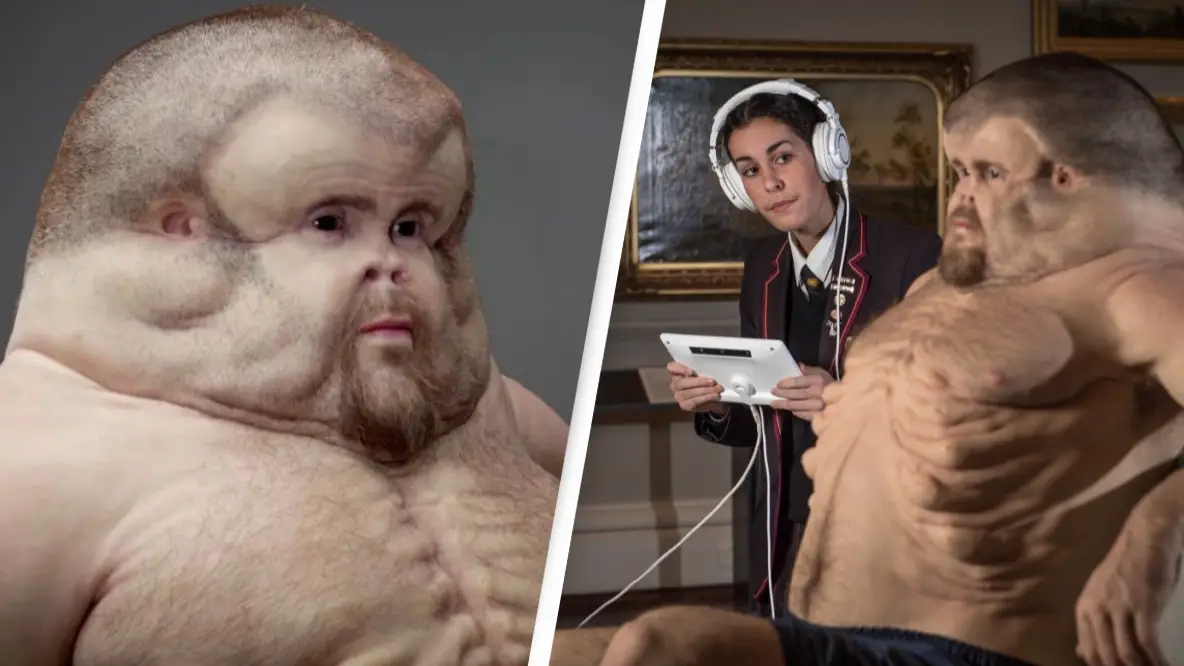
A team of doctors, artists and car crash specialists have unveiled a model for what a human would need to look like to survive a car crash. 

Melbourne Hospital trauma surgeon Christian Kenfield worked alongside Melbourne-based artist Patricia Piccinini and Dr David Logan, a road safety engineer, to create the model, which has since been named Graham.

Australia's Transport Accident Commission (TAC) commissioned the 'lifelike, interactive sculpture' in a bid to raise awareness of just how fragile the human body is and subsequently the importance of designing safe roadways.

Advert

Graham has no neck, has sunken eyes and a recessed nose; he's been designed with airbags between each rib and similar 'crumple zones' in his skull too, The Mirror reports. He is made up of human hair and silicone.

According to the study, if a human was driving a vehicle without any safety technology, they would have to look like Graham if they were to survive a high-impact crash.

On TAC introduces the model by stating: 'As much as we like to think we're invincible, we're not. But what if our bodies were to change to survive a low impact crash?

'The human body is highly susceptible to the forces involved in a transport accident. Studies show the human body can only survive a crash at impact speeds it can reach on its own – without the assistance of vehicles.'

The company adds on its website, 'Had we evolved to withstand the impact of high speed collisions, we would look very different.'

It goes on to explain: 'Our aim is to explore this with Graham and remind Victorians of how vulnerable our bodies really are by showing them what we might look like if we were built to survive a crash on our roads.

'Although our bodies will never look like Graham’s, there’s a safe system in place that can help protect us in much the same way. And at the centre of this system is the belief that human health is more important than anything else. Our bodies are strong, but there’s only so much force we can withstand before we break. That’s why we need to ensure we have a safe system in place – one that protects us from our own mistakes and those of others.'
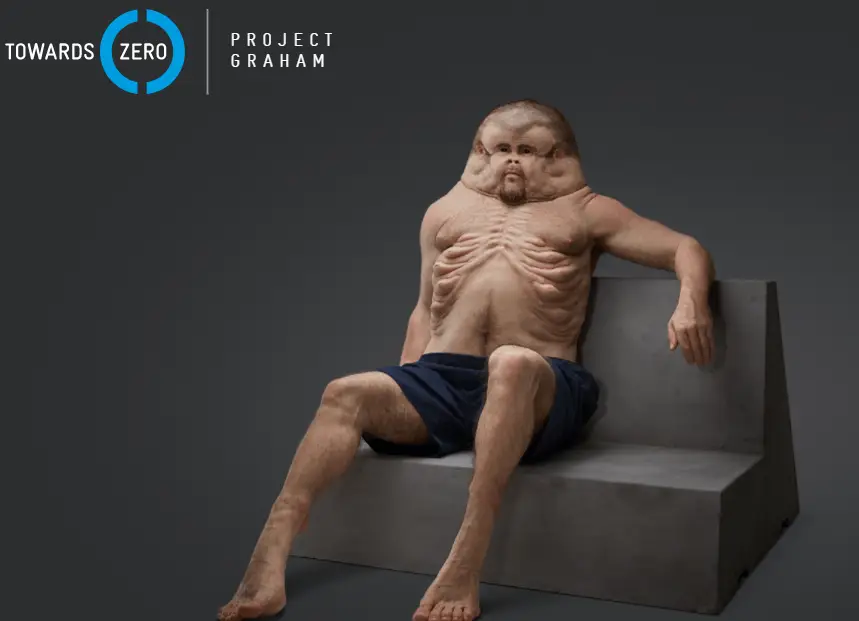
Project Graham, commissioned by Australia's Transport Accident Commission to raise awareness of road safety. (TAC)

Joe Calafiore, chief executive of TAC, explained that the model was created to help people 'understand why we need to improve every aspect of our road system to protect ourselves from our own mistakes'.

Piccinini added that while the $200,000 (AUD) construction that took six months to make is 'an artwork', 'it needs to connect with the audience on an emotional level while still communicating some very serious ideas. 'The idea is to stimulate conversation and questions rather than tell people what to think or feel,' she said.

A 360-degree interactive tool has also been created in order for people to engage with Graham.

If you have a story you want to tell, send it to UNILAD via [email protected]  

Choose your content:

an hour ago
2 hours ago
  • GoFundMe
    an hour ago

    Dad saves son from alligator attack after being seriously injured in 'death-roll'

    Brodie Terry was reportedly visiting Florida with family when the gator attacked him during a fishing trip

    News
  • Getty Images/Anna Moneymaker
    an hour ago

    Trump explains instruction he's left for US military if Iran assassinates him

    Banners with the words 'WE WILL KILL TRUMP' were seen in Tehran this week

    News
  • Per-Anders Pettersson/Liaison
    2 hours ago

    Death Row psychologist's account of two-hour botched lethal injection shows true reality of executions

    During his third visit to death row, one inmate asked Bill Kimberlin to attend his execution

    News
  • KFOR Oklahoma's News 4
    2 hours ago

    Last US polio patient using iron lung dies aged 78

    Martha Lillard was diagnosed with polio when she was just five

    News
  • Teen daughter breaks silence after dad who left sister, 2, to die in hot car to look up porn is found dead
  • How often you should change your underwear, according to doctor
  • This is how long foreplay should actually last according to experts
  • People disgusted by how Trump worded his response to if he'd ever visited Epstein's island