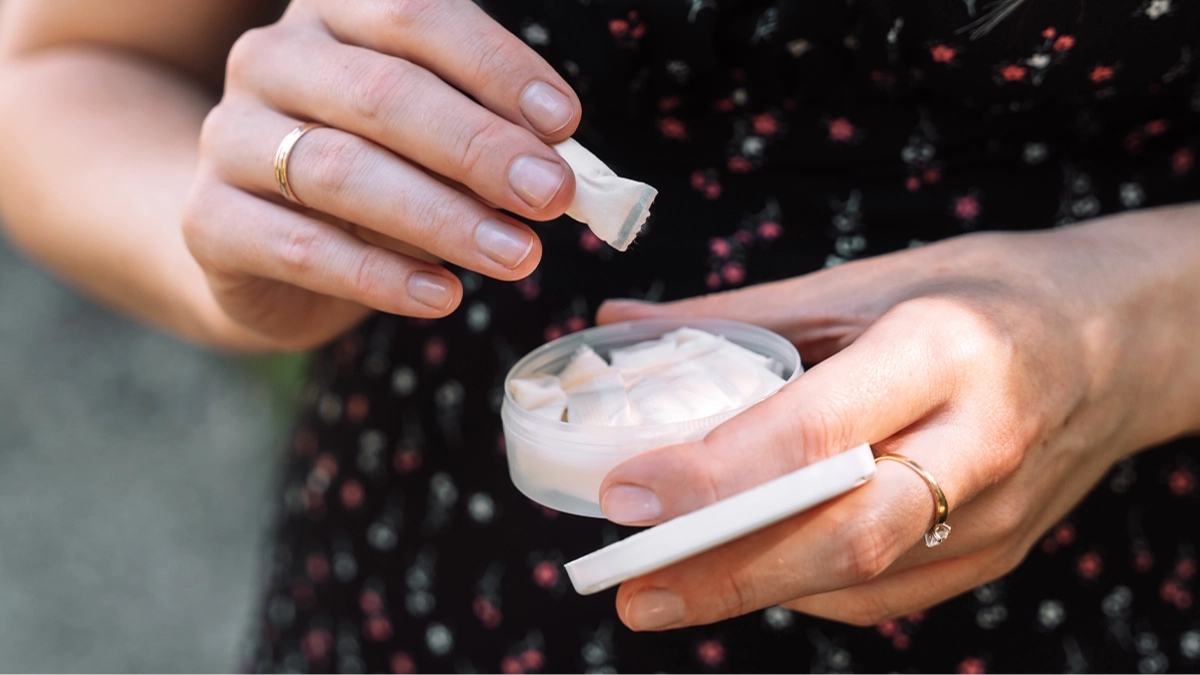
Terrifying impact nicotine pouches can have on your body despite being ‘safer’ alternative to smoking

Experts have warned that nicotine pouches are not risk-free, despite being a healthier alternative to smoking cigarettes.
Pouches are designed to help people cut back on smoking, or perhaps want to get a hit of nicotine without the smell of smoke.
They work by placing one under your top lip, so it rests against your gum and releases nicotine, before being discarded later.
While it might work to help people quit, it could also be a gateway for people to start using nicotine products, as well as harming themselves unintentionally, say experts.
Advert
As per Harvard T.H. Chan School of Public Health’s Vaughan Rees, nicotine pouches may be appealing to young people because they aren’t as risky as smoking is, but it’s not without its issues.
The way it impacts a person's body is also something that is pretty scary, and despite being labeled as healthier than cigarettes, it's still not a healthy option.

What do nicotine pouches do to the body?
Adam Leventhal, PhD, director of the Institute for Addiction Science at the University of Southern California’s Keck School of Medicine, told SELF that nicotine pouches are safer than tobacco use or vaping, but they still come with the risk of nicotine dependence if people start using them who weren't previously smokers.
Leventhal told SELF: "Your brain gets used to having nicotine in your system, so you don’t get the same mood or attention boost on it as you did previously."
According to Dr Donna Shelley, professor and vice dean for research at the New York University School of Global Public Health, the pouches aren’t exactly ‘safe’.
“Some of the negative health effects of the nicotine pouches include gastrointestinal symptoms, like nausea, gum soreness and ulcers, and also some cardiovascular risks like elevated heart rate,” she told NBC News last year.
She added: “We don’t know the full safety profile yet.”
All in all, the pouches can still cause issues such as:
- gum irritation
- nicotine addiction
- sore mouth
- upset stomach
In general, the use of nicotine can cause:
- heart, stomach, and fertility problems
- weakened immune system
Why are experts worried?

Because the pouches are free of cancer-causing chemicals or tobacco that can be found in cigarettes, it could have unintentionally become an appealing prospect for non-smokers.
“Usually when you say that something is free of something, it makes it seem less harmful,” said Tory Spindle, associate professor of psychiatry and behavioral sciences at Johns Hopkins School of Medicine in Baltimore.
“Our concern is that, well, does that make them more appealing to someone that otherwise would have never tried any tobacco product?”
He explained that ‘the challenge is, how do you make the products accessible to someone like that, while not inadvertently addicting a new wave of individuals who never would have tried nicotine?’
Rees said: “Teens and young adults who do not smoke or vape should avoid this product.”
One example of nicotine pouches, Zyn, became the first oral nicotine pouch to be approved for marketing by the FDA in January.
The agency said the pouches have 'the potential to provide a benefit to adults who smoke cigarettes and/or use other smokeless tobacco products that is sufficient to outweigh the risks of the products, including to youth', adding that the number of young people using the pouches 'remains low', with only 1.7 percent of American middle and high school student reporting using them in 2024.
It also said it poses 'lower risk of cancer and other serious health conditions' than other smokeless nicotine products such as moist snuff and snus.
In a statement, Philip Morris, the company that bought Zyn, said it is ‘committed to developing products such as Zyn that are scientifically substantiated as a better alternative to continued smoking'.
It added that 'Zyn’s marketing is directed toward legal age nicotine users who are 21+'.
Topics: Health
 Britt Jones