
Symptoms of colorectal cancer as Dawson's Creek star James Van Der Beek dies from disease aged 48

Every year in the United States, around 55,000 people will sadly lose their lives to colorectal cancer, with Dawson’s Creek star James Van Der Beek the latest high-profile name to have died as a result of the disease.
The 48-year-old star passed away on Wednesday (February 11), with his loved ones announcing the news on social media.
“Our beloved James David Van Der Beek passed peacefully this morning. He met his final days with courage, faith, and grace. There is much to share regarding his wishes, love for humanity and the sacredness of time. Those days will come. For now we ask for peaceful privacy as we grieve our loving husband, father, son, brother, and friend,” they wrote in a statement.
Throughout his journey with cancer, James was a powerful advocate for recognising the disease early and regularly spoke about how quickly and silently it could strike, just as it had done with him.
Advert
"I think the biggest misconception is the same one I had, which is that you need to have something seriously wrong with you to get screened for colorectal cancer. You don't. You can have no symptoms and still have cancer," he said.
"There wasn’t any red flag or something glaring," the actor admitted. "I was healthy. I was doing the cold plunge. I was in amazing cardiovascular shape, and I had stage 3 cancer, and I had no idea.”
It was only after noticing a subtle change in his bowel habits that he visited his doctor and received the devastating news that he had advanced colorectal cancer.

What symptoms should people look out for?
According to the American Cancer Society, common symptoms of colorectal cancer can include bleeding from the rear, blood in the stool, unintentional weight loss, fatigue, and cramping or abdominal pain.
Additionally, any pain or lumps you can feel in your tummy or an incomplete sensation of not having fully emptied the bowel after going to the toilet can also be key warning signs.
Like James, you may also experience changes in your bowel habits, which can range from suddenly becoming more constipated to having diarrhoea.
Any changes in the consistency of your poop that last for more than 3 weeks should be checked out by a healthcare professional.

How is colorectal cancer diagnosed?
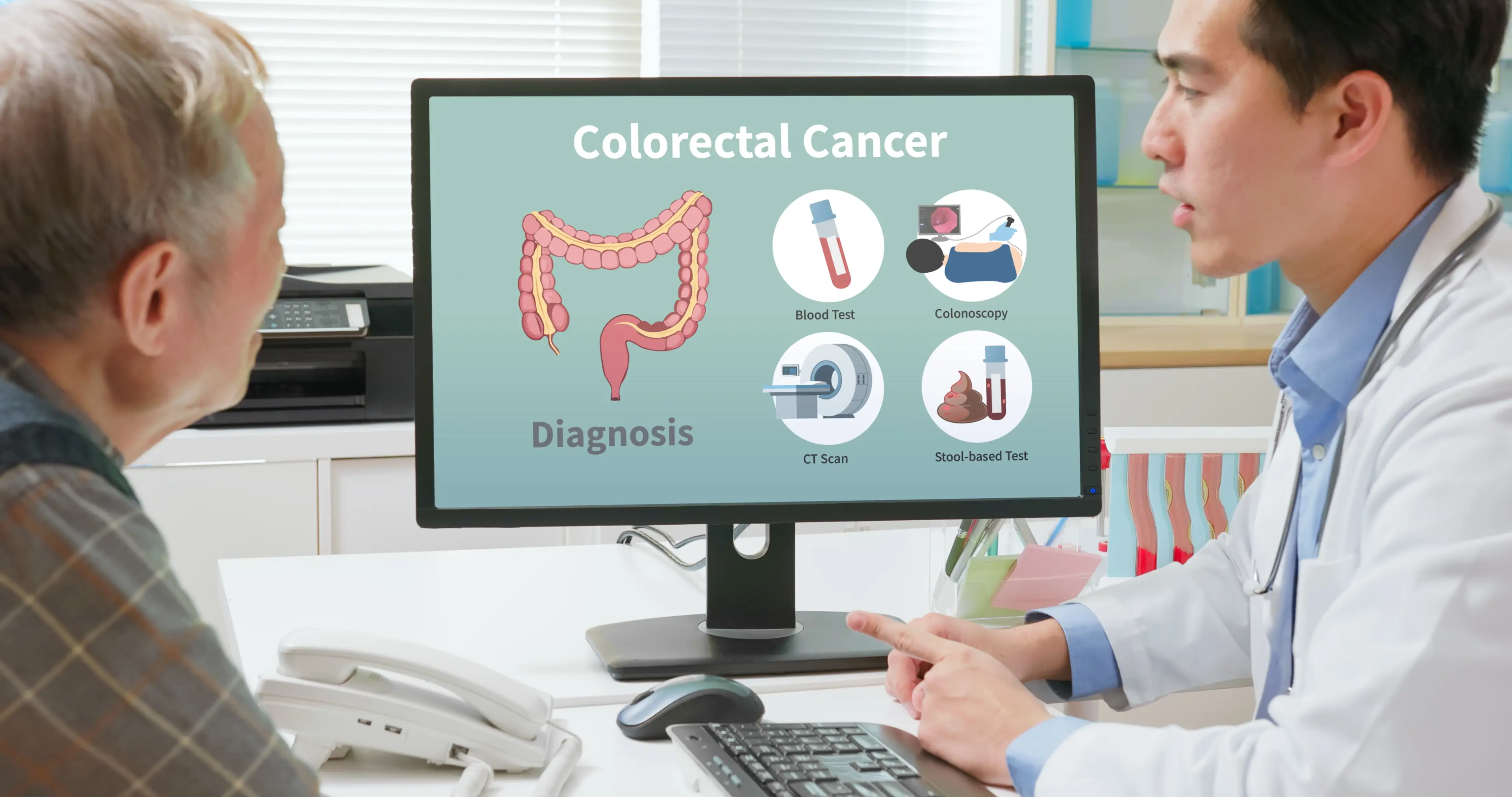
The first steps to a colorectal cancer diagnosis will be a trip to see your primary care doctor, who will review your symptoms and conduct a physical exam, which may include an examination of your back passage using a gloved, lubricated finger.
If your doctor thinks there is a cause for concern, you may undergo further screening tests such as a faecal occult blood test, a specialised test in which a sample of your poo is sent to the lab to be tested for any traces of blood, which may not be visible to the naked eye.
You may also be invited for a colonoscopy or sigmoidoscopy, which is a specific type of medical procedure conducted under sedation in which a small camera, about the size of your finger, is inserted through the rectum to find abnormal growths or blood. During this procedure, biopsies can also be taken, and sometimes even small lesions or polyps (small growths) can be removed.
An alternative, less invasive version of a colonoscopy can also be conducted virtually. Instead of using a camera, a CT scan (a special type of X-ray) takes place.
How is colorectal cancer treated?
Like many other cancers, colorectal cancer is usually best treated with a combined approach, meaning chemotherapy, radiotherapy and surgery all play a key role in managing the disease.
Sometimes, a small keyhole surgery to remove early-stage cancer is all that is necessary to eliminate the disease. Yet more advanced cases may need to undergo adjunct therapy, which means having surgery, followed by chemotherapy to reduce recurrence.
In some cases, patients may even need to have a portion of their bowel removed and a Stoma created.
This is a temporary or permanent opening made in the abdomen to allow waste to leave the body, often used if the bowel cannot be reconnected.
If you’ve been affected by any of these issues and want to speak to someone in confidence, contact the American Cancer Society on 1-800-227-2345 or via their live chat feature, available 24/7 every day of the year.
 Phoebe Tonks