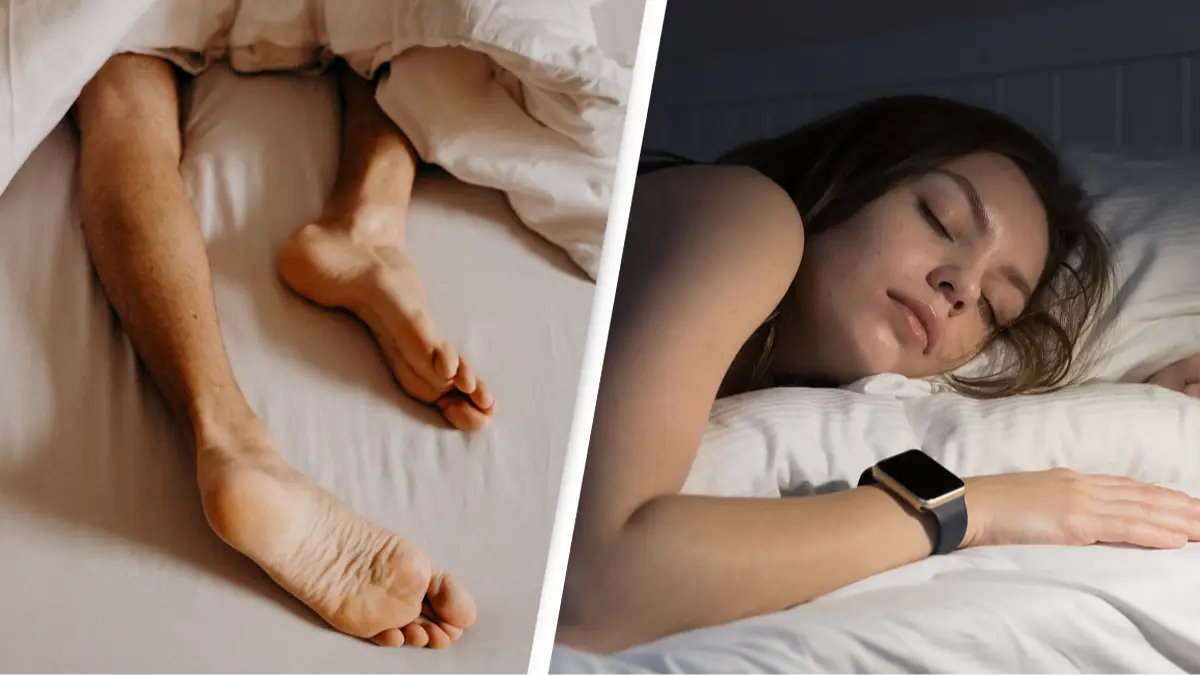
This is why your body suddenly jerks when you're falling asleep

There's an explanation behind why you sometimes twitch, jerk or jolt as you're falling asleep.
You've gotten into bed and finally managed to prise your phone out of your hands to try and get your eight hours. You snuggle down under your duvet, get comfy and feel yourself drifting off but suddenly, with a jolt, you feel your body jerk as if you're falling.
Sometimes it happens when you're dreaming of falling and you abruptly wake as you reach the bottom of your fall, and sometimes the movement happens mid-way through the night and you don't even notice. But why does it occur, is it normal and what does it all mean?
Advert
What are these jerks?
Well, these twitches or jerks are known as 'hypnic jerks' or 'hypnagogic jerks'.
According to Medical News Today, they're a type of 'sleep myoclonus' which is 'a scientific name for jerking movements the body makes during sleep or while falling asleep'.
"It tends to occur in stages one or two of sleep and disappear in stage three, which refers to rapid eye movement sleep. In other words, they occur when a person transitions from a wakeful state to a sleeping state," it adds.
What actually happens
When you experience a hypnic jerk, it's when one or multiple of your muscles is involuntarily moving at a quick speed.
You may experience one or multiple at a time and it's common to experience a dream or nightmare at the same time you feel the hypnic jerk.
Whether it be falling or seeing blinding lights or some people may experience certain sounds too.
And your experience of them might not always be the same; some are stronger than others, some may wake you up and some may be unnoticeable to anyone other than your partner - or pet, if you're a crazy dog woman like me - lying next to you.
Causes
Fear not, because hypnic jerks are 'common' so you're not the only one experiencing them and they aren't dangerous, either.
Unsurprisingly, one factor that can cause your body to experience hypnic jerks is having too much caffeine, so pop down that fizzy drink - oh and the vapes or cigarettes too.
Too much exercise late at night can also be a factor which leads to more twitching because it makes you more alert - use this as a good excuse for another rest day.
General stress as well as diagnosed anxiety disorders result in your cortisol levels being higher which can make it difficult to get to sleep or cause interruptions to your sleep.
And if you're not getting enough sleep in general - either because you're up late doom scrolling or have a condition such as insomnia - this can also increase the likelihood of you experiencing hypnic jerks.
Overall, they're typically more prevalent in adults opposed to children.
How to prevent them
If you aren't a fan of your limbs jerking about mid-snooze then there are steps you can take to try and prevent them.
First, is avoid caffeine, nicotine and alcohol before bed and try to reduce your overall intake of all of the above if you really want to nip the jolts in the bud.
You should also try to exercise earlier in the day if possible so you don't get too energised and alert before you're meant to be winding down for the night.
Try to regulate your bedtime hours too so you're going to bed and waking up at roughly the same time each day.
The temperature of your room is also pretty key as well - Sleep Foundation recommending trying to make it 65 to 68 degrees Fahrenheit. And a dark and quiet room is best too to make sure your sleep is as least interrupted as possible.
Finally, you've definitely heard this one before, but get off your screens at least an hour before bed, your eyes and brain will thank you.
And of course, if you're really worried you can speak to a doctor.
 Poppy Bilderbeck