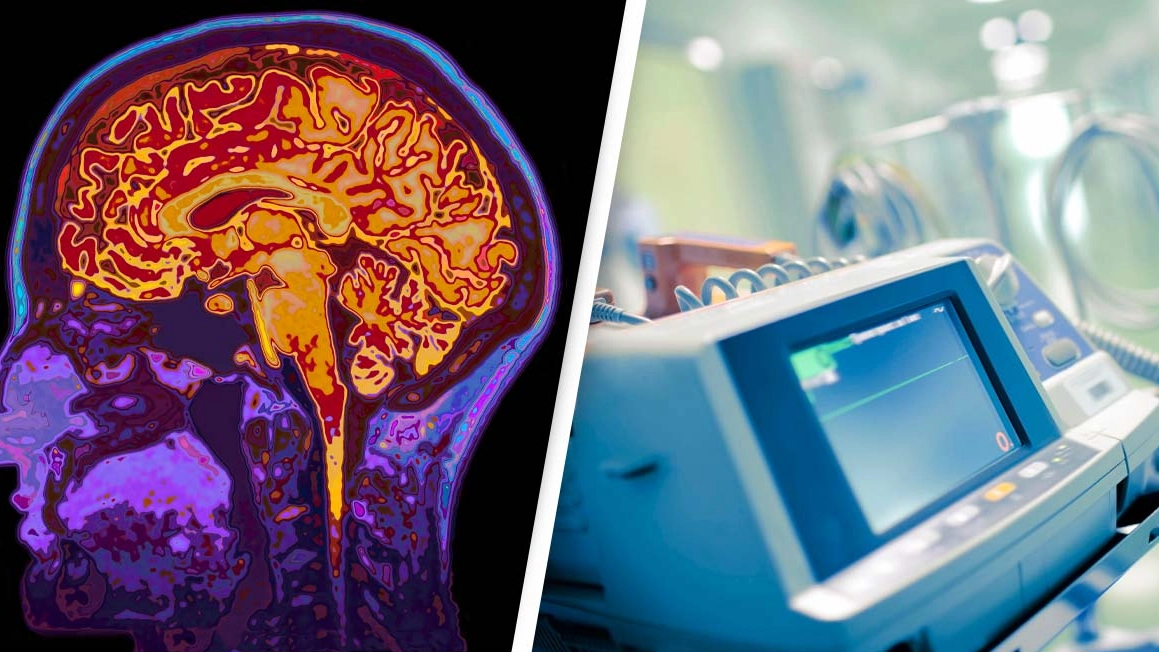
Ground-Breaking Study Suggests What Happens In Brain In Final Moments Before Death

A landmark study has revealed people could actually see their life flash before their eyes in the moments before their death.
Analysis of brain activity in dying people has shown that patterns around the time of death are similar to those seen in dreaming and memory recall, offering a possible explanation for why many people say they were able to vividly recall past moments in their lives when in near death experiences.
The study, which was published in the Frontiers in Aging Neuroscience journal, also challenges existing assumptions about when life actually ends, with the results said to raise important questions about the timing of organ donations.
Advert
The findings initially came about by accident, when a patient whose brain activity a team at the University of Tartu in Estonia were studying for information about epileptic seizures had a heart attack and died while being monitored by a electroencephalography (EEG) device.
The device recorded about 900 seconds of the patient's brain activity as they died, giving scientists the opportunity to focus on what exactly happened to the patient's brain in the 30 seconds before and after their heart stopped beating.
As the report explains, the EEG recording showed an increase in gamma oscillations, which are associated with dreaming and memory retrieval.
Oscillations are rhythmic electrical activity – better known as brain waves – different types of which are associated with different states.
Based on existing knowledge of gamma oscillation, researchers conducting the study have suggested that their dying patient may have been making a 'last recall of life'.
'Through generating oscillations involved in memory retrieval, the brain may be playing a last recall of important life events just before we die, similar to the ones reported in near-death experiences,' said Ajmal Zemmar, a neurosurgeon at the University of Louisville who co-authored the study.
Although this is the first such study of a human brain, the researchers noted that similar gamma oscillations had previously been observed in dying rats, suggesting that mammal brains may pass through a 'series of stereotyped activity patterns' during death.
Far more research is needed into these findings, however the researchers said they believed the activity observed in their patient could be seen as a 'source of hope' for the loved ones of people who are dying.
'Something we may learn from this research is: although our loved ones have their eyes closed and are ready to leave us to rest, their brains may be replaying some of the nicest moments they experienced in their lives,' Zemmar said.
If you have a story you want to tell, send it to UNILAD via [email protected]
 Hannah Smith