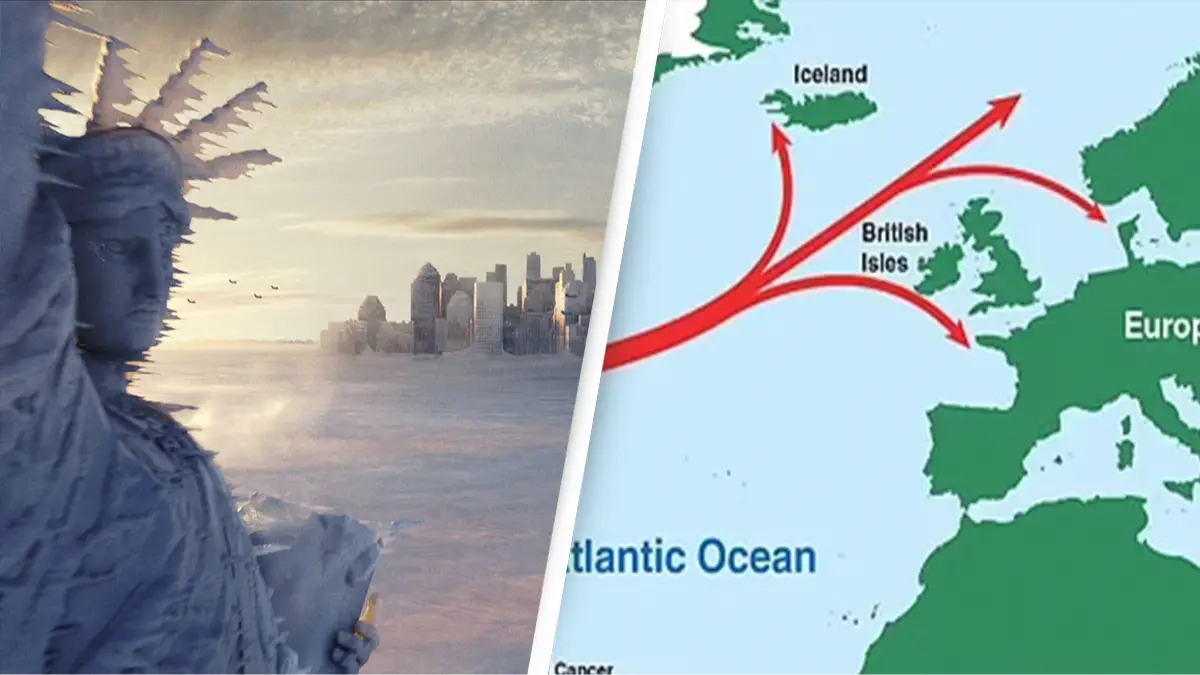
New study reveals apocalypse scenario that may make The Day After Tomorrow a reality

A new study has highlighted concerning trends that could see entire continents significantly colder than they have been in recent memory.
Now, if you can think back to the 2004, the film Day After Tomorrow seemed like a typical Hollywood far-fetched disaster film.
I mean...it still is, but a new study has suggested that it might not have been so far off from the truth.
Admittedly, the study doesn’t predict an ice age that will freeze you in seconds or a natural disaster event that radically changes the landscape of the world, but it has highlighted some concerning trends when it comes to temperature.
Advert
In fact, in the worst-case scenario, due to climate change, Europe could be completely plunged into a deep freeze.
Researchers from University College London have discovered that the Gulf Stream , which is essential to keeping a current of warm water, could be particularly sensitive to climate change.
If the Gulf Stream were to collapse, temperatures could drop massively by up to 15°C (27°F) in Europe.
Lead researcher Dr Jack Wharton said: “If in the future winds are weaker, as shown in a recent study using climate models, it could mean a weaker Gulf Stream and a cooler Europe.”
He also explained what scientists know about the last age the continent was gripped in and how the Gulf Stream was operating.
He said: “We found that during the last ice age, the Gulf Stream was much stronger because of stronger winds across the subtropical North Atlantic.
“As a result, the Gulf Stream was still moving lots of heat northwards, despite the rest of the planet being far colder.”
This could prove particularly important if changes in the world’s climates impact the Gulf Stream.
Speaking to the Mail Online, Professor Thornalley, who was a co author on the study, emphasized the importance in the ocean moving heat around planet Earth.

He said: “The ocean moves vast amounts of heat around the globe - equivalent to the energy from millions of power stations. “Changing the strength of ocean currents can therefore alter how much heat goes where. This alters our climate, and on shorter timescales our weather.”
While this is a worst-case scenario, it is important to note there is no evidence that the Gulf Stream will stop working, and it is just one part of the Atlantic Meridional Overturning Circulation (AMOC), a network of currents that pump hot water around the world.
Professor Thornalley added: He adds: “There is the subtropical loop—that the Gulf Stream is part of—and a subpolar loop, which carries heat further northwards into the Arctic.”
But the biggest concern still remains that warming global temperatures could have the possibility to disrupt the engine that drives this subtropical loop.
Topics: Weather, Climate Change, Film and TV, News
 Gerrard Kaonga