unilad homepage
  • News
    • UK News
    • US News
    • World News
    • Crime
    • Health
    • Money
    • Sport
    • Travel
  • Film and TV
    • Netflix
  • Music
  • Tech
  • Features
  • Celebrity
  • Politics
  • Advertise
  • Terms
  • Privacy & Cookies
  • LADbible Group
  • LADbible
  • SPORTbible
  • GAMINGbible
  • Tyla
  • UNILAD Tech
  • FOODbible
  • License Our Content
  • About Us & Contact
  • Jobs
  • Latest
  • Archive
  • Topics A-Z
  • Authors
Facebook
Instagram
X
Threads
TikTok
YouTube
Submit Your Content
Scientists have opened 200 million-year-old parasite eggs found in ancient predator

Home> News> Animals

Published 06:45 14 Aug 2023 GMT+1

Scientists have opened 200 million-year-old parasite eggs found in ancient predator

The scientists found the worm eggs in the poo of an ancient crocodile-like predator.

Keryn Donnelly

Keryn Donnelly

google discoverFollow us on Google Discover
Featured Image Credit: Ryan Somma (Creative Commons). PLOS One.

Topics: News, World News, Science

Keryn Donnelly
Keryn Donnelly

Advert

Advert

Advert

Well, this sounds like the beginning of a disaster movie.

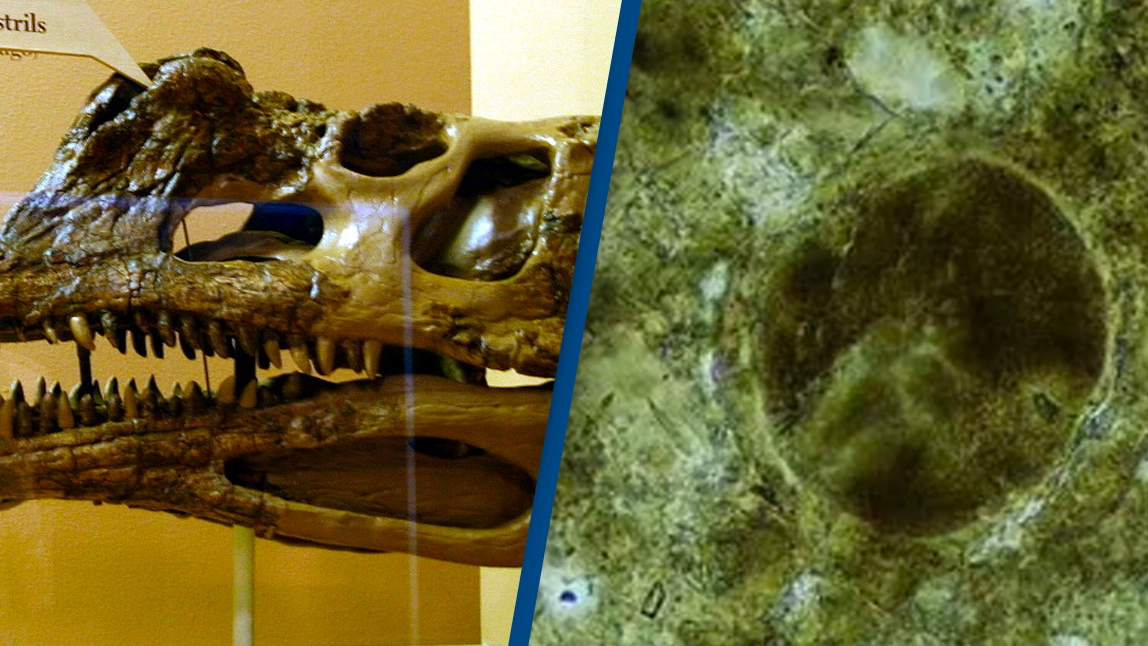
Scientists have cut open the fossilized poo of a crocodile-like predator that lived 200 million years ago, to discover the animal was infected with multiple parasite species, including worms.

The feces, which is also called a coprolite, was first unearthed in 2010 from the Huai Hin Lat Formation in north-eastern Thailand.

The coprolite is cylindrical in shape and over 7cm long. Based on its shape and contents, the researchers believe it was likely produced by some species of phytosaur, which are crocodile-like predators that are known to have roamed the same area that the poo was found in.

Advert

As part of their research, the team from Mahasarakham University, Thailand, analysed a portion of the poo and discovered five kinds of parasitic remnants, each around 50-150 micrometers long.

They then sliced open the parasitic egg with a diamond saw 'using a standard thin section method', according to their report published in the journal PLOS ONE.

These ultra-thin slices allowed the palaeontologists to view cross-sections of the ancient worm egg under the microscope.

Thanit Nonsrirach, the study's lead author, said the poo was first discovered by local villagers over 13 years ago.

"The peculiar appearance of these findings intrigued the villagers, who considered them potentially auspicious and capable of bestowing good luck if repurposed as talismans," Nonsrirach Inverse.

"In 2010, our team received word of this discovery and embarked on a field expedition, guiding the villagers to the actual fossil site."

Nonsrirach said its rare to come across a parasite fossil so he wanted to take a closer look.

“This new point of view gives us a deeper understanding of how past ecosystems were connected and how they affected the lives of prehistoric animals,” Nonsrirach told Inverse.

He says the discovery gives them some insight into how predator, prey animals and parasites interacted over 200 million years ago.

“Coprolites can preserve the soft bodies of ancient organisms, which helps us learn more about their biology,” Nonsrirach said.

“It's exciting to think that we might uncover new fossils that have never been seen before.”

Choose your content:

an hour ago
2 hours ago
  • Tim Roney/Getty Images
    an hour ago

    Original NSYNC member who had big impact on band's name speaks out about quitting

    The founding member of the group reflected on his early departure, before they found success

    Celebrity
  • Jim WATSON / AFP via Getty Images
    an hour ago

    NASA Artemis II astronaut realized what he was really afraid of when doing his spacewalk

    Reid Wiseman, who served as a flight engineer at the International Space Station in 2014, shared an iconic quote about his fear

    News
  • SWNS
    an hour ago

    Woman who realized she had cancer she saw on Grey's Anatomy reveals symptoms

    Watching TV helped a 19-year-old understand why her symptoms had led doctors to diagnose her with a form of fast-growing cancer

    News
  • Daniel Heuer/Bloomberg via Getty Images
    2 hours ago

    Body language expert breaks down Melania Trump's key authoritative signals during Epstein statement

    The First Lady of the United States made an unexpected public address about Jeffrey Epstein

    News
  • Scientists make unbelievable discovery inside rare 520-million-year-old fossil that made their ‘jaws drop’
  • Scientists think they've solved 180-million-year-old mystery of unusual heat beneath US mountains
  • Mom found to have ten brain tumors after mistaking symptoms for menopause
  • Million-year-old skull could rewrite entire timeline of human evolution according to researchers