unilad homepage
unilad homepage
    • News
      • UK News
      • US News
      • World News
      • Crime
      • Health
      • Money
      • Sport
      • Travel
    • Music
    • Technology
    • Film and TV
      • News
      • DC Comics
      • Disney
      • Marvel
      • Netflix
    • Celebrity
    • Politics
    • Advertise
    • Terms
    • Privacy & Cookies
    • LADbible Group
    • LADbible
    • SPORTbible
    • GAMINGbible
    • Tyla
    • UNILAD Tech
    • FOODbible
    • License Our Content
    • About Us & Contact
    • Jobs
    • Latest
    • Archive
    • Topics A-Z
    • Authors
    Facebook
    Instagram
    X
    Threads
    TikTok
    YouTube
    Submit Your Content
    Scientists make major breakthrough in treating aggressive form of breast cancer
    Home>Community>Life
    Published 14:46 16 Dec 2023 GMT

    Scientists make major breakthrough in treating aggressive form of breast cancer

    Researchers have said that there's cause for optimism after presenting their clinical findings at a conference

    Kit Roberts

    Kit Roberts

    google discoverFollow us on Google Discover
    Featured Image Credit: Getty Stock

    Topics: News, World News, Health, Cancer

    Kit Roberts
    Kit Roberts

    Kit joined UNILAD in 2023 as a community journalist. They have previously worked for StokeonTrentLive, the Daily Mirror, and the Daily Star.

    Advert

    Advert

    Advert

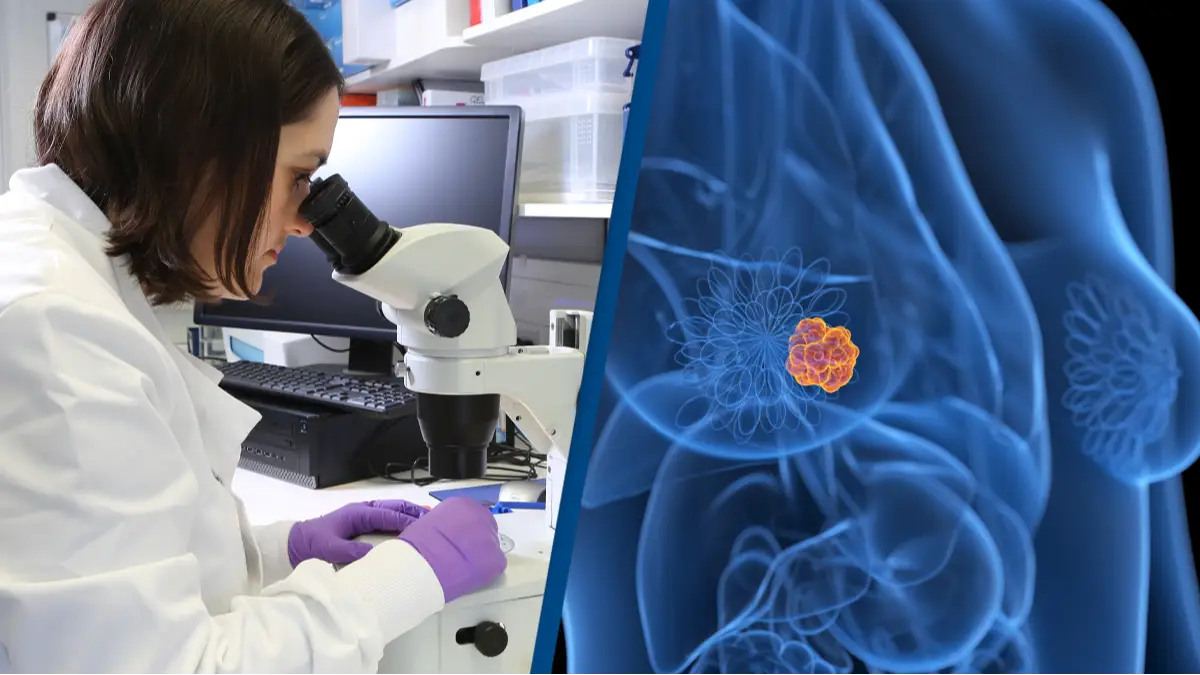
    Scientists have said that there is a cause for optimism after presenting the findings on a new treatment for an aggressive form of breast cancer.

    The treatment takes the form of a vaccine, and is targeted specifically at a type of breast cancer called 'Triple Negative Breast Cancer' (TNBC).

    This is an extremely aggressive variety of breast cancer in which tumours grow more quickly, meaning that fewer treatment options are open to patients.

    Advert

    It can also have a high chance of returning even after a patient goes into remission.

    The 'triple negative' element of the cancer refers to the fact the cancer cells do not have receptors for the hormones estrogen and progesterone, meaning that many normal treatments for breast cancer don't work for this.

    All of this means that there is a dire need for treatments which can target triple negative cancer specifically.

    The new treatment consists of a vaccine which was administered in three different doses during trials.

    The treatment has been trialled on a group of 16 patients.
    Alvaro Medina Jurado

    It was tested on sixteen volunteers who had previously been treated successfully for TNBC, and was found to successfully produce a T Cell Immune response in patients, meaning that it could be useful in fighting breast cancer.

    Patients in the trial also did not report many significant side effects from the vaccine.

    In a press release, Dr Amit Kumar, Chairman and CEO of vaccine developers Anixa Biosciences said: “The data from our Phase 1 trial to date has exceeded our expectations, and we are pleased with our progress."

    He added: “This vaccine is designed to direct the immune system to destroy TNBC cancer cells through a mechanism that has never previously been utilized for cancer vaccine development.”

    It is hoped the treatment could also be used to prevent more severe treatments.
    Pramote Polyamate / Getty

    Now, medics are looking to continue the research in an effort to make the treatment useful in trying to prevent more severe treatments such as mastectomies.

    Medical oncologist at the Cleveland Clinic Dr G. Thomas Budd explained: “Now, that's a tough group to study because it's not a large group.

    “It's going to take a long time for patients to develop cancer, and of course there are surgical options at present. But it would be a very exciting approach, and we're really looking forward to trying to get funding to do these additional trials.”

    Budd continued: “There is a large unmet need for preventing TNBC, an aggressive form of breast cancer with few targeted treatment options available. [...] Our hope is that future studies will demonstrate that the antigen-specific T cell responses we observed translate to the prevention of breast cancer recurrence.”

    Choose your content:

    13 days ago
    14 days ago
    23 days ago
    25 days ago
    • Facebook
      13 days ago

      Healthy woman explained why she chose to end her life by euthanasia

      Wendy Duffy died by suicide on Friday

      Community
    • EMMANUEL DUNAND/AFP via Getty Images
      14 days ago

      Bizarre 'Scientology run' challenge explained as 'raid' trend sees teens storm church's buildings

      Users are divided on the trial, with some asking how they can 'sign up' to take part

      Community
    • ITV
      23 days ago

      Woman marrying convicted murderer on death row opens up about their relationship

      Tiana Krasniqi is set to wed James Broadnax, who was convicted of a double murder in 2009

      Community
    • Getty Stock
      25 days ago

      Hiring managers are sharing the worst interview experiences that make them reject people instantly

      Hiring the right person for the job can be extremely difficult, especially in a world of artificial intelligence and Zoom interviews

      Community
    • 11 cancers on the rise in under 50s as scientists claim they may have explanation
    • Study finds that young people diagnosed with these cancers are highest risk of developing most aggressive form
    • Woman, 46, died of rare cancer after toilet symptom led to horrifying diagnosis
    • Mom diagnosed with cancer at 32 issues advice after 'unbearable' symptoms were dismissed