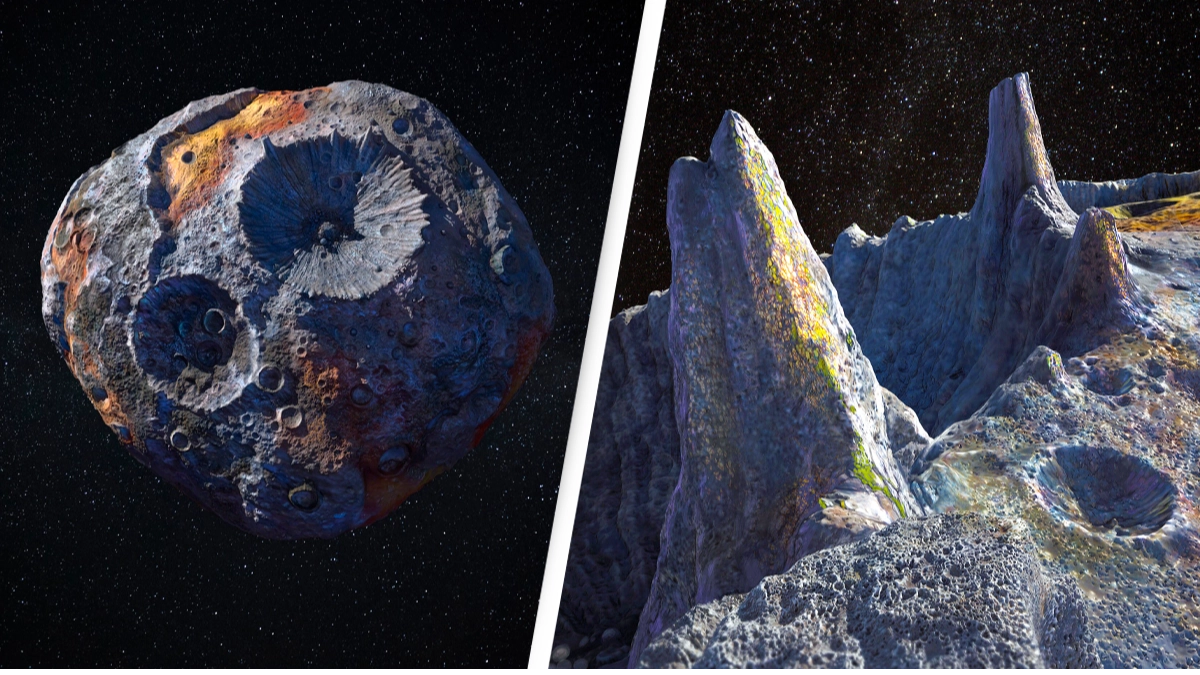
NASA shares timeline for when $10,000,000,000,000,000,000 asteroid will be brought to Earth

NASA have given a timeline of their launch mission to recover precious metals from the 16 Psyche asteroid.
Earlier this year, the space station said they'd made plans to approach a faraway asteroid, which is said to be filled with iron, nickel and gold worth an unfathomable $10,000,000,000,000,000,000.
Advert
In July, a statement made by NASA claimed there were 'less than 100 days until the mission was to launch'.
"Teams of engineers and technicians are working almost around the clock to ensure the orbiter is ready to journey 2.5 billion miles to a metal-rich asteroid that may tell us more about planetary cores and how planets form," the statement continued.
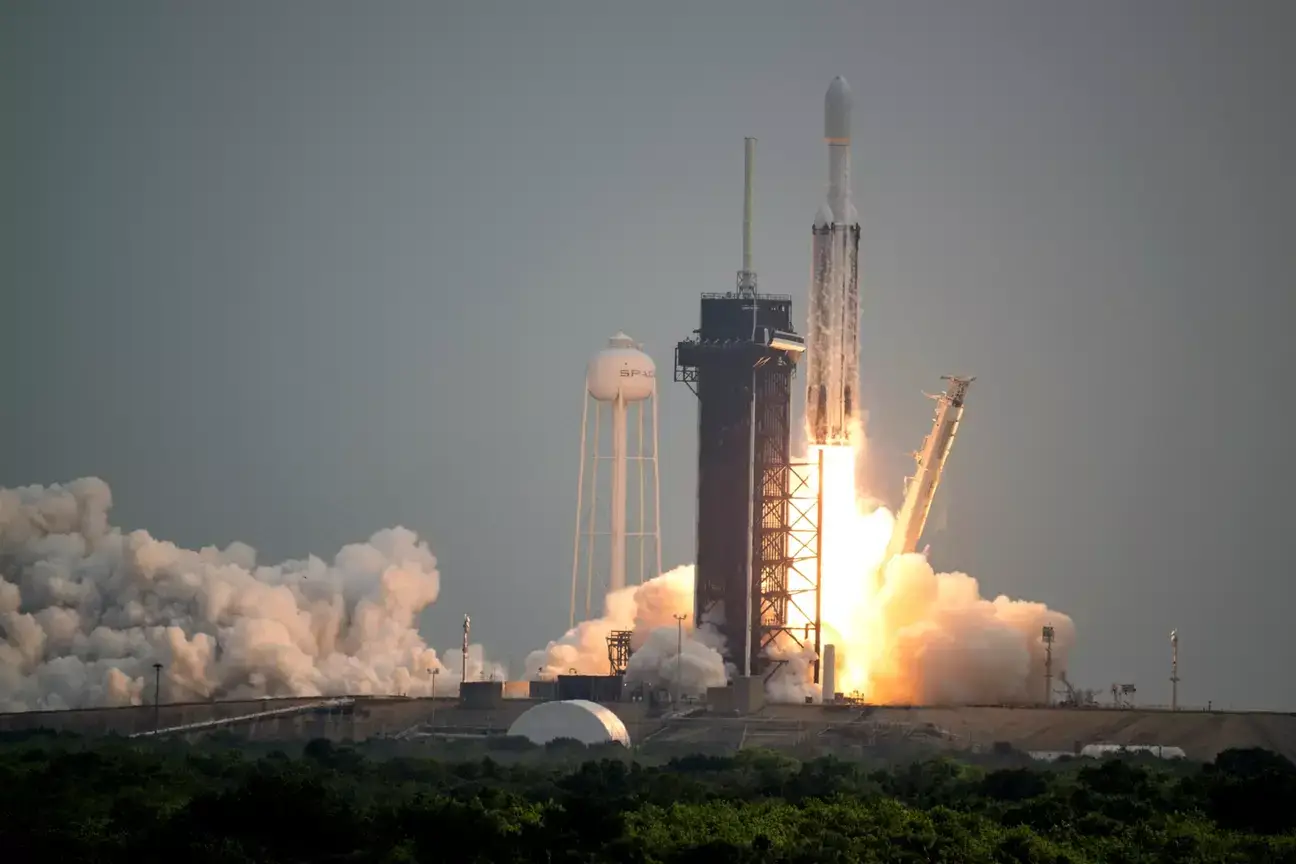
And, on 13 October, a spacecraft was launched from NASA's Kennedy Space Center in Cape Canaveral, Florida, and is now currently on its way to the asteroid.
The spacecraft - a SpaceX Falcon Heavy from Space Launch Complex 39A - was initially scheduled to launch last year but had to be pushed back due to software issues.
Now, NASA have issued a timeline of when exactly we can expect the spacecraft to return from the asteroid - which is believed by scientists to be the largest of the multiple metal-rich asteroids in our solar system.
The vessel will travel a journey of 2.2 billion miles (3.5 billion km) through space and is expected to reach the asteroid in August 2029.
Mission controllers at NASA's Jet Propulsion Laboratory (JPL) will also simultaneously spend the next 3-4 months checking over the spacecraft's system, and consistently assessing whether it is still fit to travel into deep space.
Once it reaches the asteroid in it's location in the main asteroid belt between Mars and Jupiter, the vessel will then orbit the Psyche for just over two years, all while measuring its gravity, magnetic proprieties and composition with a collection of specially selected instruments.
The spacecraft is then programmed to approach Mars in May 2026 for a small gravity assist intended to boost its momentum.
This will put the spacecraft in trajectory for its final destination - with the mission planned to reach its conclusion in November 2031.
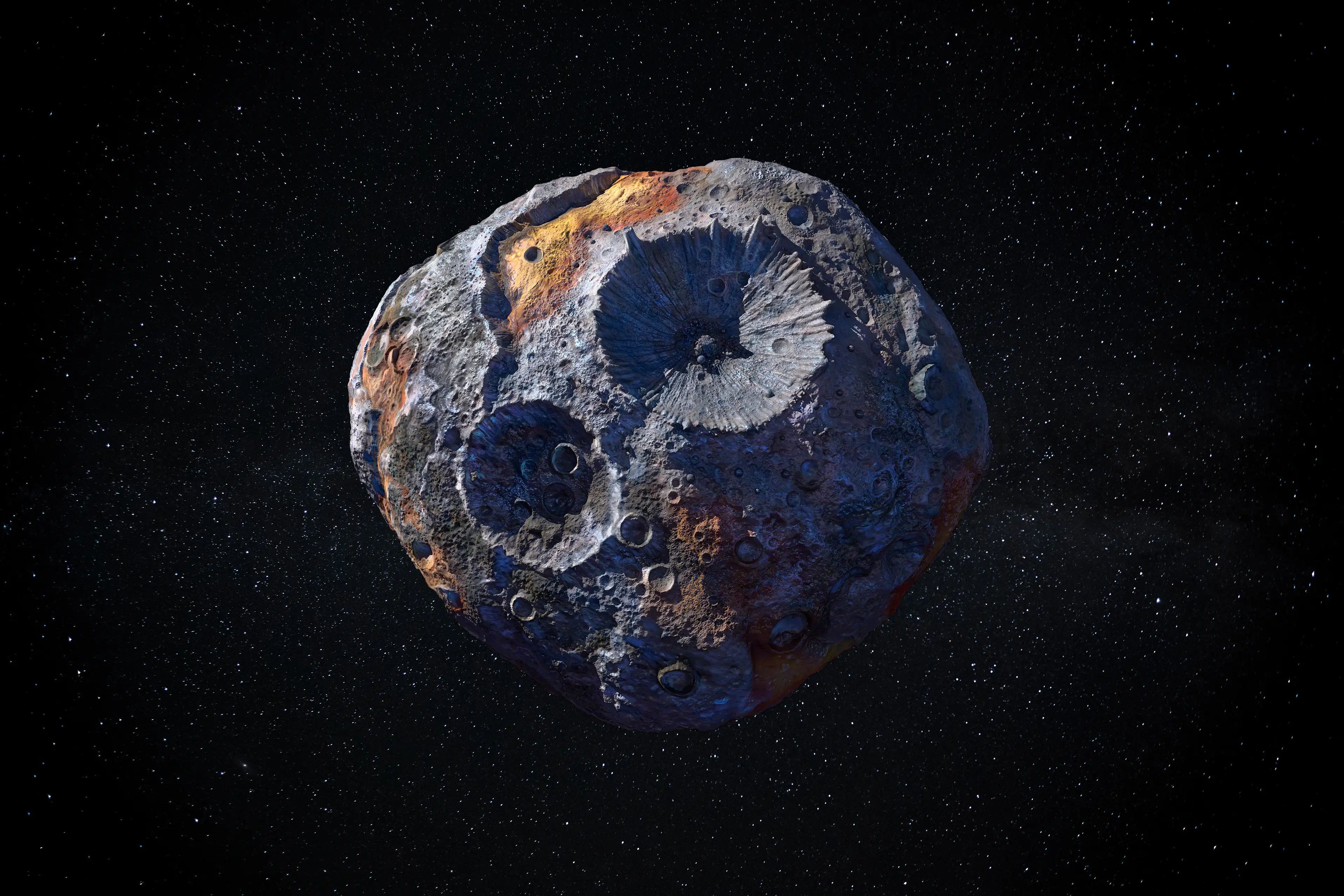
According to NASA, the asteroid measures a whopping 173 miles (280 km) across and 144 miles (232 km) long, while its surface area is 64,000 square miles (165,800 square km).
And it's the asteroid's enormous size that made NASA decide to go ahead with the mission.
Nicola Fox, associate administrator for NASA's science mission directorate, explained, as reported by Space.com: "Psyche is by far the largest, and that's why we want to go to it.
"Because the smaller ones are more likely to have been changed by things impacting them, whereas the big one, we think, is going to be completely unchanged."
Topics: Space, International Space Station, SpaceX, NASA, Technology, Science
 Rhianna Benson