unilad homepage
unilad homepage
    • News
      • UK News
      • US News
      • World News
      • Crime
      • Health
      • Money
      • Sport
      • Travel
    • Music
    • Technology
    • Film and TV
      • News
      • DC Comics
      • Disney
      • Marvel
      • Netflix
    • Celebrity
    • Politics
    • Advertise
    • Terms
    • Privacy & Cookies
    • LADbible Group
    • LADbible
    • SPORTbible
    • GAMINGbible
    • Tyla
    • UNILAD Tech
    • FOODbible
    • License Our Content
    • About Us & Contact
    • Jobs
    • Latest
    • Archive
    • Topics A-Z
    • Authors
    Facebook
    Instagram
    X
    Threads
    TikTok
    YouTube
    Submit Your Content
    Brain chip allows woman to 'speak' 11 years after being diagnosed with same disorder that killed Stephen Hawking

    Home> Technology> News

    Published 20:46 23 Aug 2023 GMT+1

    Brain chip allows woman to 'speak' 11 years after being diagnosed with same disorder that killed Stephen Hawking

    Pat Bennett lost the ability to talk due to ALS

    Jess Battison

    Jess Battison

    google discoverFollow us on Google Discover
    Featured Image Credit: Stanford Medicine / Willett, Kunz, et al.

    Topics: Health, Science, Technology, US News

    Jess Battison
    Jess Battison

    Jess is an Entertainment Journalist with a love of all things pop culture. Her main interests include keeping up with the Twitter girlies, waiting for a new series of The Traitors and losing her voice at a Beyoncé concert. She graduated with a first in Journalism from City, University of London in 2021 and has previously worked at MyLondon.

    X

    @jessbattison_

    Advert

    Advert

    Advert

    Tiny brain chips have enabled a woman to ‘speak’ again, 11 years since she started suffering from the same disorder that killed Stephen Hawking.

    Pat Bennett, 68, used to ride horses, jog daily, and work in human resources before her life was taken over in 2012.

    The woman has amyotrophic lateral sclerosis (ALS), a neurological disease that affects motor neurones in the brain and spinal cord which control voluntary muscle movement - such as talking.

    It’s the same disease that recently took the life of Sandra Bullock’s partner Bryan Randall as well as the famed physicist Hawking in 2018.

    Advert

    But a clinical trial at Stanford University has given Bennett a new light.

    Four ‘baby-aspirin-sized’ sensors have been implanted into her brain.
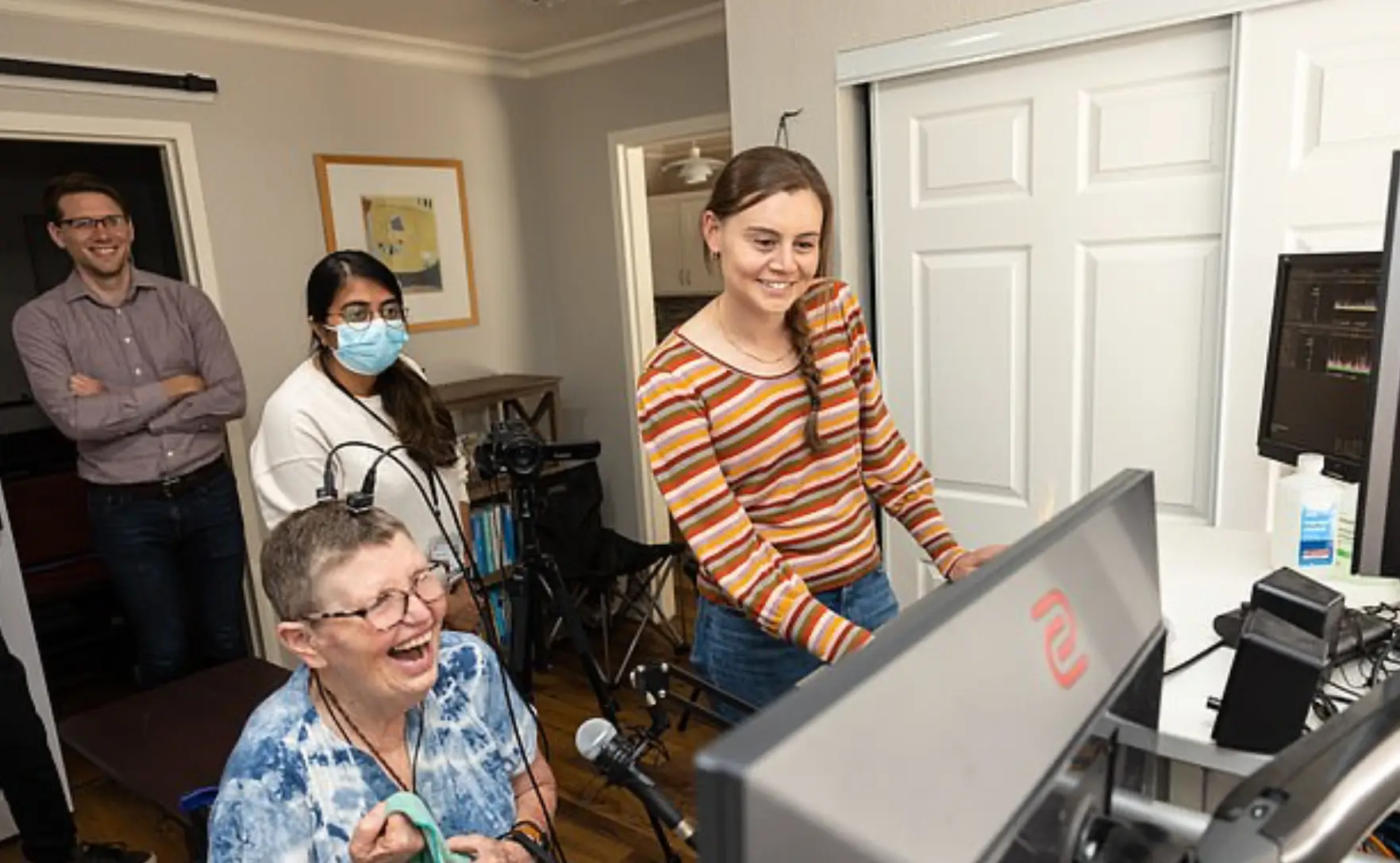
    Pat Bennett had the brain implants to help her speak again.
    Stanford Medicine/Willett, Kunz, et al

    She is now able to communicate her thoughts directly from her mind to a computer monitor at a record-breaking 62 words per minute.

    Professor Philip Sabes of the University of California, who co-founded Elon Musk’s Neuralink, described this new study as a ‘big breakthrough’.

    He previously told MIT Technology Review: “The performance in this paper is already at a level which many people who cannot speak would want, if the device were ready.

    “People are going to want this.”

    With each one lasting around four hours, Bennett went through 26 sessions working with an AI algorithm.

    She helped to train it to identify which brain activity corresponds to 39 key phonemes - that’s sounds to you and me - used in spoken English.

    Sandra Bullock's partner Bryan Randall recently lost his life to the disease.
    Jackson Lee/GC Images/ Getty

    During each training session, Bennet would try and effectively communicate roughly 260 to 480 sentences - selected randomly.

    They picked out these sentences from a collection of conversations over the phone collected by a calculator-maker company back in the 90s.

    Helping Bennett get her ability to chat back, the sentences included things like: “It’s only been that way in the last five years.”

    Despite managing an error rate, the algorithm’s speed is moving at three times faster than previous models and at 62, it’s getting closer to the natural rate of human conversation of arounf 160 words per minute.

    As reported by Daily Mail, Bennett wrote via email: “These initial results have proven the concept, and eventually technology will catch up to make it easily accessible to people who cannot speak.

    “For those who are nonverbal, this means they can stay connected to the bigger world.”

    Bennett’s experience of ALS was a rarer variety as she adds: “When you think of ALS, you think of arm and leg impact.

    “But in a group of ALS patients, it begins with speech difficulties. I am unable to speak.”

    Choose your content:

    4 days ago
    7 days ago
    9 days ago
    10 days ago
    • Justin Sullivan/Getty Images
      4 days ago

      OpenAI names 22 industries at risk of job losses as it proposes four day week

      Two new reports suggest AI might be coming for your job - but you could also get a three day weekend

      Technology
    • Kayla Bartkowski/Bloomberg via Getty Images
      7 days ago

      Congressman Tim Burchett claims he has seen UFO footage that ‘defies logic’

      Tim Burchett says he has seen UFO footage that couldn't be man made - and he wants answers from the government

      Technology
    • NASA/JPL-Caltech/MSSS
      9 days ago

      NASA's Curiosity rover makes groundbreaking discovery that suggests Mars can support life

      An expert has claimed the new reveal 'increases the prospect that Mars offered a home for life in the ancient past'

      Technology
    • John Nacion/Variety via Getty Images
      10 days ago

      Bill Nye issues stern warning to Trump over concerns he could 'end NASA'

      Bill Nye the Science Guy revealed that Donald Trump's NASA proposal is a 'huge mistake'

      Technology
    • Why experts believe cure for disease that killed Stephen Hawking could be found in space
    • Parents of four daughters diagnosed with same rare brain condition reveal 'strange symptoms'
    • Woman, 30, diagnosed with brain tumor after telling her doctor about common symptom
    • Woman diagnosed with brain tumor after dismissing symptoms as a cold that wouldn’t go away