Astronomers discover half of the universe's hydrogen gas that's been unaccounted for since the Big Bang 13,800,000,000 years ago

Astronomers think they've finally located half of the universe's hydrogen gas that's been unaccounted for since the Big Bang 13,800,000,000 years ago.
Astronomers who have been rounding up all the stars, galaxies and gas in the universe have fumbled the figures when it comes to the total matter produced in the Big Bang all those years ago.
More than half of normal matter, which accounts for half of 15 percent of the universe's matter that is not dark matter, had seemingly gone missing - until now.
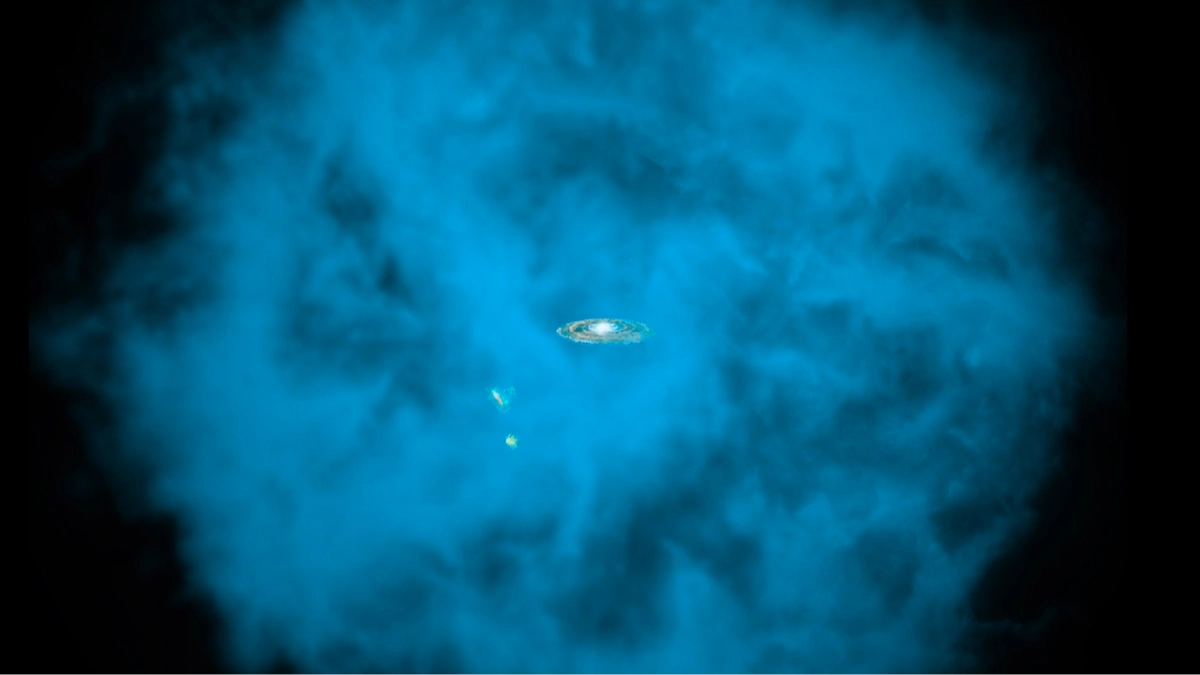
According to Phys.org, fresh measurements seem to have found it all - in the form of 'very diffuse and invisible ionized hydrogen gas' which has formed a halo around galaxies and looks a lot more 'puffed out' than astronomers initially believed.
Advert
Boryana Hadzhiyska, a Miller postdoctoral fellow at the University of California, Berkeley, explained the eureka discovery in a paper on the findings after the team found the discovery exposes a conflict around the Big Bang and that there are black holes at the centers of galaxies that are more active.
"We think that, once we go farther away from the galaxy, we recover all of the missing gas," she said. "To be more accurate, we have to do a careful analysis with simulations, which we haven't done. We want to do a careful job."
Her colleague, Simone Ferraro, a senior scientist at Lawrence Berkeley National Laboratory (Berkeley Lab) and at UC Berkeley, added: "The measurements are certainly consistent with finding all of the gas."
The study, co-authored by 75 scientists from across the globe, is yet to be peer reviewed and has been posted as a preprint on arXiv.
The researchers say their 'advances in cosmological observations have provided an unprecedented opportunity to investigate the distribution of baryons relative to the underlying matter.'
They say their work proves gas 'is much more extended than the dark matter' and has 'important implications for bridging the gap between theory and observations and understanding galaxy formation and evolution.'
The news comes as mysterious dark matter makes up about 84 percent of matter in the universe with around seven percent of normal matter in the form of stars.
The rest makes up invisible hydrogen gas in galaxies, most of which has been ionized.
The scientists estimated the distribution of ionized hydrogen in space by stacking images together within eight billion light-years of Earth and measuring the dimming or brightening of the 'cosmic microwave.'
Ferraro explained this is the 'back of everything we see in the universe'.
"It's the edge of the observable universe. So you can use that as a backlight to see where the gas is," she added.
From there, they used a 3D map to measure the effect of dark energy on the expansion of the universe which revealed the results.
Topics: Space, World News, Science
 Liv Bridge