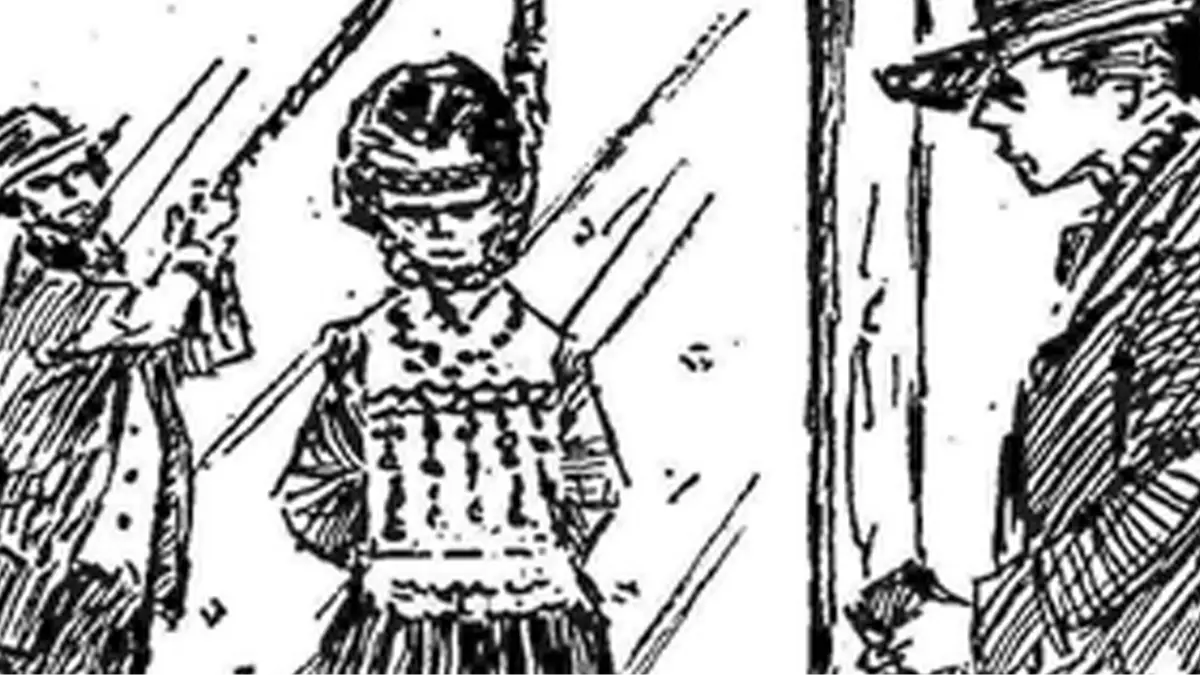
Chilling story of the youngest person ever to be executed by state in the US

The story of the youngest person to be executed in the US is a sad one.
It all began on December 20, 1786, where a crowd gathered behind New London’s old meeting house to witness the execution of a young girl accused of murder.
Hannah Ocuish stood trial and was convicted of the intentional death of 6-year-old Eunice Bolles, the daughter of a prominent New London family.
Ocuish was a Pequot Native American girl with an intellectual disability, who was accused of planning the death of the young child, in retaliation of her allegedly accusing her of stealing strawberries.
Advert
On the morning of July 21, 1786, Eunice headed to school but disappeared during the journey.
At around 10:00 am, Eunice’s body was found lying face down next to a stonewall on a road which went from New London to Norwich.

It was found that she had a fractured skull, bruises on her arms and face, and signs of strangulation, too.
Investigators said her killer attempted to stage an accident by covering her head and torso with rocks, as though the wall had collapsed on her.
But heads soon turned to Hannah, who was known to have committed a robbery which left a little girl nearly dead just six years before Eunice’s murder.
Initially, it was reported that Ocuish pointed the finger at a group of four boys who were close by.
However, when police failed to find the boys, they took her in for questioning in the presence of the dead body.
There, it was alleged that Ocuish confessed, though a 2023 opinion piece for OddFeed said the girl’s confession did not line up to what she told to local minister Henry Channing, who had visited her several times in prison.
At the time, Ocuish was an orphan as her mother had reportedly been an alcoholic who left her at a home, where she was then taken in by a series of foster families.
Sceptics also believe the allegation that Ocuish lead Eunice to the woods with a gift of calico material was fabricated, as children were wary of her due to her behaviors.
The article explained that the widow who Ocuish worked for after she was given to her as a servant, had not had any complaints over the six years of having her in her home.
The piece also called into question the motive, writing: "While Eunice may have threatened to tell on Hannah for stealing fruit, this never happened, as the girl faced no consequences for those actions ... The idea that she could have lured Eunice to a private corner with a piece of calico fabric also seems strange. Based on their previous interaction, Eunice would likely have been suspicious of Hannah and avoided being alone with her."
Because of her disability, many questioned whether she was fit to stand trial, but a judge sentenced her to hang.
Witnesses described her as seeming unconcerned by her death sentence until hours before she was due to be hanged, when she began to cry.
Ocuish was the last documented execution of a female in Connecticut.
 Britt Jones