unilad homepage
  • News
    • UK News
    • US News
    • World News
    • Crime
    • Health
    • Money
    • Sport
    • Travel
  • Film and TV
    • Netflix
  • Music
  • Tech
  • Features
  • Celebrity
  • Politics
  • Advertise
  • Terms
  • Privacy & Cookies
  • LADbible Group
  • LADbible
  • SPORTbible
  • GAMINGbible
  • Tyla
  • UNILAD Tech
  • FOODbible
  • License Our Content
  • About Us & Contact
  • Jobs
  • Latest
  • Archive
  • Topics A-Z
  • Authors
Facebook
Instagram
X
Threads
TikTok
YouTube
Submit Your Content
What happens if there is a tie in the US election between Donald Trump and Kamala Harris

Home> News> US News

Updated 20:57 5 Nov 2024 GMTPublished 20:53 5 Nov 2024 GMT

What happens if there is a tie in the US election between Donald Trump and Kamala Harris

Although the chances are rare, here's what would happen next

Yasmeen Hamadeh

Yasmeen Hamadeh

google discoverFollow us on Google Discover
Featured Image Credit: Michael M. Santiago/Getty Images / Scott Olson/Getty Images

Topics: Donald Trump, Kamala Harris, US News

Yasmeen Hamadeh
Yasmeen Hamadeh

Advert

Advert

Advert

It's a close race in this year's presidential election as polls continue to show a neck-and-neck break between candidates Donald Trump and Kamala Harris.

While the verdict will likely come down to a handful of swing states, in the historically rare chance that the Electoral College finds itself in a tie, there are measures in place to determine who will be the next president and vice president.

For a tie to occur, each candidate would have to win 269 electoral votes.

But what would happen next?

Advert

Well, the 12th Amendment rules that the president would be chosen by the House of Representatives and the vice president by the Senate.
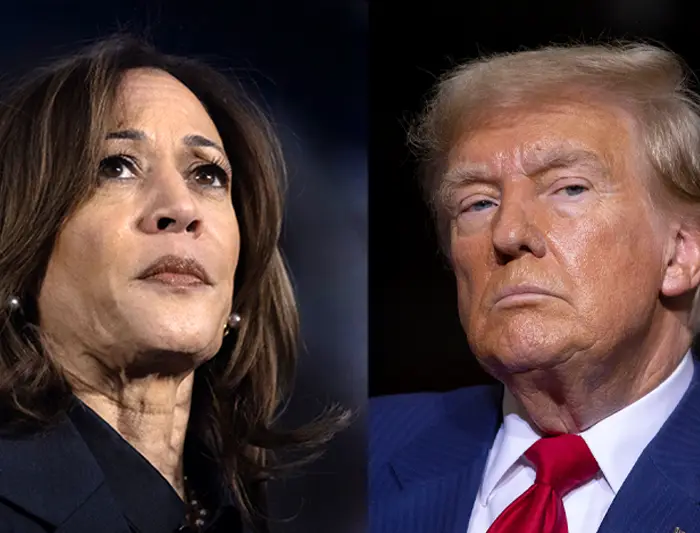
The Electoral College would be considered evenly split if votes finish at 269 for each candidate. (Bill Pugliano/Getty Images)

The newly elected House of Representatives taking office in January will meet to count the electoral votes.

Once it's been confirmed that no candidate has a majority of electoral voters, House lawmakers will then break the tie by having each state's delegation submit a single vote.

At that point, a majority of 26 states would be needed to determine who the next president is.

The Republican party has a majority in the House of Representatives with 26 state delegations, meanwhile the democratic party has 22 delegations. Two states, Minnesota and North Carolina, are tied.
The House of Representatives would select the next president. (Andrew Harnik/Getty Images)

Notably, while Washington, D.C. has three electoral votes in the presidential election, it would not have a vote in the House in the case of a tie because it is not a state.

House lawmakers would be able to list their top three candidates, but in practice, the choice will likely be a toss-up between Trump and Harris.

Meanwhile, a vice president will be selected by a simple majority vote in the Senate. All senators would have the chance to cast a single vote, and would have to choose between the two highest-scoring vice presidential candidates in the Electoral College.
The Senate would select the next vice president. (Anna Moneymaker/Getty Images)

In this case, the choice will be between Senator JD Vance or Minnesota Governor Tim Walz.

This ruling means that it's possible, although rare, that the president and vice president could be from different parties.

In the off-chance the House is also not able to select a president, then the person elected as vice president by the Senate would serve as president while representatives continue to vote.

Under the Presidential Succession Act of 1947, if both the Senate and House do not come to a decision, then a speaker of the House would serve as president. However, the aforementioned scenarios have never happened in American history.

Although an even split in the Electoral College is remarkably rare, scenarios that could lead to it include a third-party candidate winning some of the electoral votes or if there are 'faithless electors' who decide to break their pledge and vote for a candidate other than the one who won the state's popular vote.

Choose your content:

4 hours ago
5 hours ago
6 hours ago
  • Tom Williams/CQ-Roll Call, Inc via Getty Images
    4 hours ago

    Trump gathers top banking leaders to address looming crisis after terrifying AI hack

    Trump was addressing the security crisis in finance which is posed by new AI technology

    News
  • Rodin Eckenroth/Getty Images for THE WILD PODCAST/ THE WILD BOYS
    4 hours ago

    Man dating his 'dad' defends relationship after admitting he always thought he was 'attracted to women'

    The pair were both only attracted to women before they met one another

    News
  • This Morning
    5 hours ago

    Woman who is allergic to daylight reveals brutal impact it's had on her daily life

    Sonal Keay is a barrister and businesswoman who shared her struggle with the chronic health condition

    News
  • Mandel NGAN / AFP via Getty Images
    6 hours ago

    Melania's former chief of staff calls out Donald Trump for his response to her Epstein speech

    Allegedly the president didn't know about his wife's speech before it happened

    News
  • People mindblown after seeing who is more likely to win election in 2028 out of Donald Trump and Kamala Harris
  • Kamala Harris explains how election defeat was as painful as the death of her mother
  • Major update issued after Trump cancels Kamala Harris' 'undisclosed' Secret Service protection
  • Kamala Harris brands Trump a 'con man' after revealing surprising comments he made to her in private