unilad homepage
unilad homepage
    • News
      • UK News
      • US News
      • World News
      • Crime
      • Health
      • Money
      • Sport
      • Travel
    • Music
    • Technology
    • Film and TV
      • News
      • DC Comics
      • Disney
      • Marvel
      • Netflix
    • Celebrity
    • Politics
    • Advertise
    • Terms
    • Privacy & Cookies
    • LADbible Group
    • LADbible
    • SPORTbible
    • GAMINGbible
    • Tyla
    • UNILAD Tech
    • FOODbible
    • License Our Content
    • About Us & Contact
    • Jobs
    • Latest
    • Archive
    • Topics A-Z
    • Authors
    Facebook
    Instagram
    X
    Threads
    TikTok
    YouTube
    Submit Your Content
    Scientists reveal they may have discovered what's causing the unexplained rise in cancer cases
    Home>News>Health
    Published 20:00 8 Jan 2025 GMT

    Scientists reveal they may have discovered what's causing the unexplained rise in cancer cases

    The study was published earlier this month

    Callum Jones

    Callum Jones

    google discoverFollow us on Google Discover
    Featured Image Credit: Justin Sullivan/Getty Images/BEN STANSALL/AFP via Getty Images

    Topics: Health, Science, Cancer

    Callum Jones
    Callum Jones

    Advert

    Advert

    Advert

    Scientists have revealed they may have discovered what's causing the unexplained rise in cancer cases across the world.

    In 2024, it was estimated around two million people were diagnosed with cancer in the US, a figure that's increased sharply in recent years.

    Some of the possible cause of many of these cancers for which genetics, diet and lifestyle cannot explain has left scientists stumped... until now.

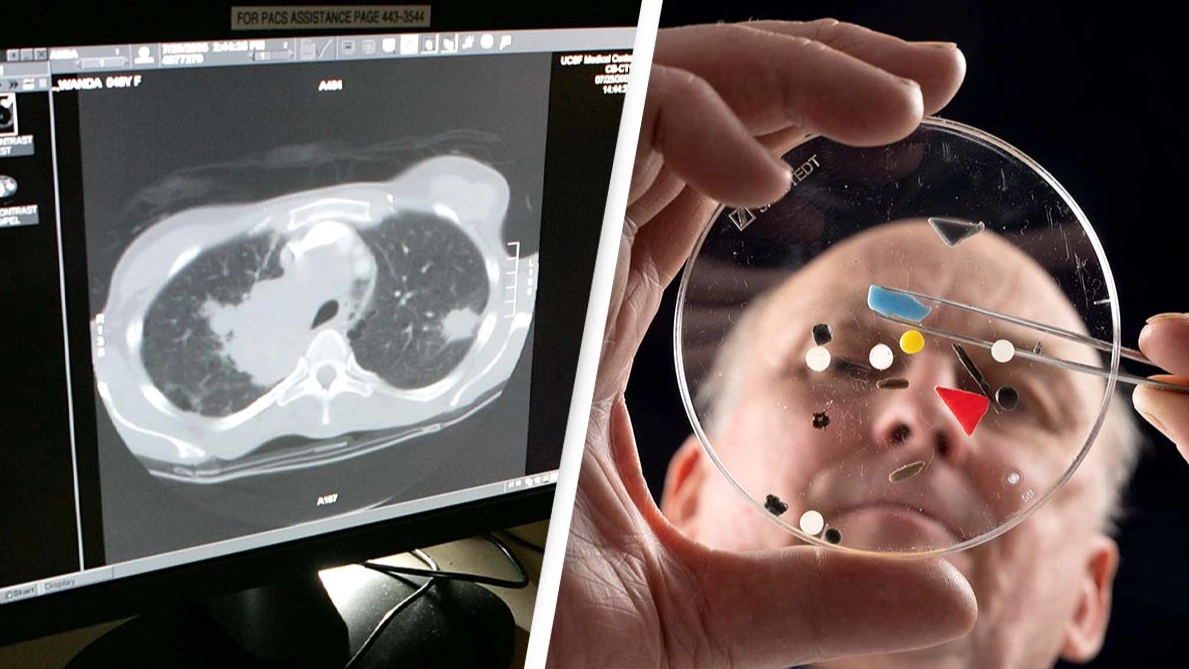
    The study has helped scientists out in terms of unexplained cancer cases (Getty Stock Photo)
    The study has helped scientists out in terms of unexplained cancer cases (Getty Stock Photo)

    Advert

    Ultimately, Californian researchers concluded that an individual being exposed to microplastics is 'suspected' to play a role with the increase in colon and even lung cancer.

    The study, which was published in ACS Publications Environmental Science & Technology, earlier this month stated: "We concluded that exposure to microplastics is 'suspected' to adversely impact the colon and small intestine in humans."

    On top of that, microplastics are 'suspected' of causing chronic inflammation and damaging the immune system.

    "Across the outcomes, we identified that exposure to microplastics is 'suspected' to be a digestive hazard to humans, including a suspected link to colon cancer, using the key characteristics of carcinogens approach," the study added.

    The study also found that microplastics can impact fertility, damage sperm count in men and impact the ovaries and placenta in women.

    Particles from these microplastics can also cause inflammation in the airways, which can increase the risk of someone developing lung cancer.

    The researchers added: "Microplastics are widespread and mobile in the environment, being detected in air, surface water, costal beaches, sediment, and food.

    "They have been discovered in remote and pristine locations, including the Antarctic, deep ocean trenches, and Arctic sea ice.
    The study has provided long-desired answers (Getty Stock Photo)
    The study has provided long-desired answers (Getty Stock Photo)

    "Due to their small size, microplastics more easily enter and are distributed in the human body in comparison to larger particles; microplastics have been measured in human placenta, breastmilk, and live."

    Tracey J. Woodruff, a professor of obstetrics, gynaecology and reproductive sciences and senior author on the study, added: "These microplastics are basically particulate matter air pollution, and we know this type of air pollution is harmful."

    Such findings will hopefully be a wake up call for many companies across the globe who produce mass amounts of plastics every single year.

    Heck, nearly 460million metric tons of plastic was produced last year, a figure that is expected to increase to 1.1 billion by 2050.

    Nicholas Chartres, the study's first author, said: "We urge regulatory agencies and policy leaders to consider the growing evidence of health harms from microplastics, including colon and lung cancer."

    Choose your content:

    5 hours ago
    6 hours ago
    • Getty Stock
      5 hours ago

      What your answer to 'the Red or blue Button' dilemma means, according to science

      The red button or blue button debate has split social media in half, but a game theory expert has broken down what it actually means

      News
    • TLC
      6 hours ago

      The horrific crimes 90 Day Fiancé Geoffrey Paschel went to prison for explained

      Geoffrey Paschel appeared on our TV screens not long before being imprisoned for 18 years over a brutal attack on his ex

      News
    • Getty Stock
      6 hours ago

      The simple way swingers spot each other on a ‘spicy’ cruise explained

      There's a simple way to tell if passengers are up for 'play'...

      News
    • Getty Stock Image
      6 hours ago

      The six stages of a relationship explained and what to expect

      Knowing if your relationship is on the right track isn't easy, but there are six stages that all couples can expect to go through

      News
    • 11 cancers on the rise in under 50s as scientists claim they may have explanation
    • Scientists reveal exact number of alcoholic drinks which could cause colon cancer as cases rise
    • Scientists discover vegetarians have significantly lower risk of 5 types of cancer
    • Global study finds alarming rise of 6 types of cancer in young adults