Scientists discover the male 'G-spot' and it's not where they thought it was

After years of looking for the elusive male G-spot, science has determined that it’s not where we thought it was.
Spanish experts have found the erogenous zone after quite some time looking, and with a surprise finding, they published it in the journal Andology.
As the male version of the commonly talked about female G-spot, for a long time, it was thought be the prostate gland two inches inside of the rectum.
But that’s not quite true.
Advert
Instead, the spot is more like a ‘zone’, which sits lower than the anus, at the frenular delta.
According to the study, they were able to find out exactly where it is for the very first time after studying slices of male sexual organs.
Ouch.
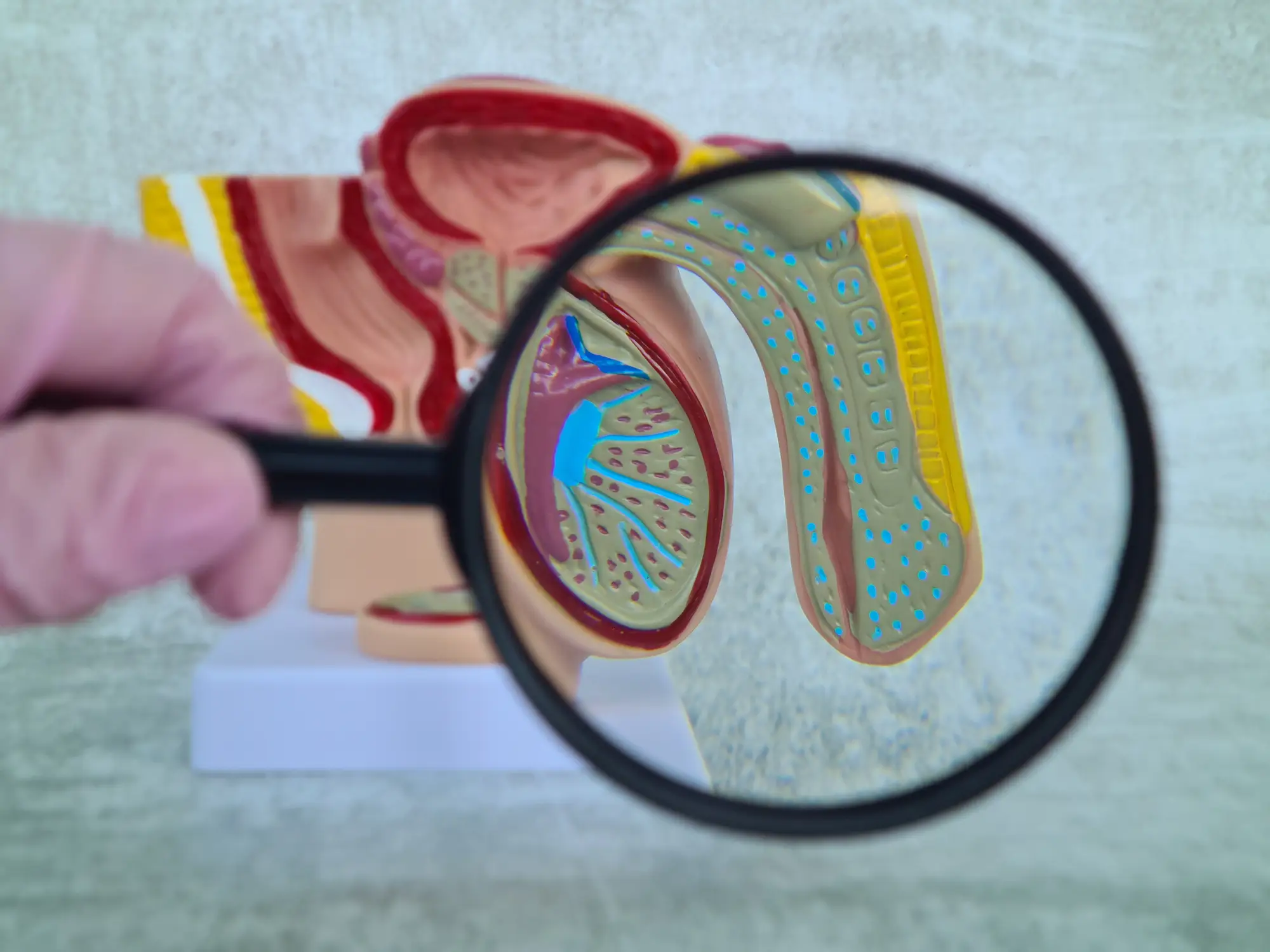
The samples, which were from 30 fetuses and 14 men who donated their bodies to science post-mortem, showed scientists the 17 nerve bundle which is located in the triangular zone on the underside of the penis, where the head meets the shaft.
The University of Santiago de Compostela in Spain, who conducted the research, says this area of the penis is ‘richly innervated by partially overlapping perineal (related to the region connecting genitals and anus) and dorsal (aft-facing) nerve branches’ and has ‘heightened concentrations of nerve bundles’ which when stimulated, induces intense pleasure and orgasms.
Now, after the prostate was seen to trigger orgasms, and scientists didn’t look further beyond that, the case has finally been solved.
Of course, if you know your penis quite intimately and are aware of what gets you off quickly, you might have known that this zone was something special. But the G-spot?
“Although this may seem self-evident to anyone attuned to the sensations of their penis during sexual activity, our work scientifically validates the existence of a ventral penile anatomical region that serves as a center of sexual sensation,” write the authors of the study, led by Alfonso Cepeda-Emiliani. “In essence, the presence of a sensory center in the penis, akin to a ‘G-spot,’ emerges as a neuroanatomical reality”.
“It is one of the most pleasurable spots for male sexual stimulation,” Eric Chung of the University of Queensland in Australia, who wasn’t involved in the study, told New Scientist.
However, the fact that it has taken until 2026 to figure this out highlights the ‘persistent blind spots in sexual medicine and urology’ that the male G-spot has been regarded as for decades.
Topics: Sex Education, Health, Science
 Britt Jones