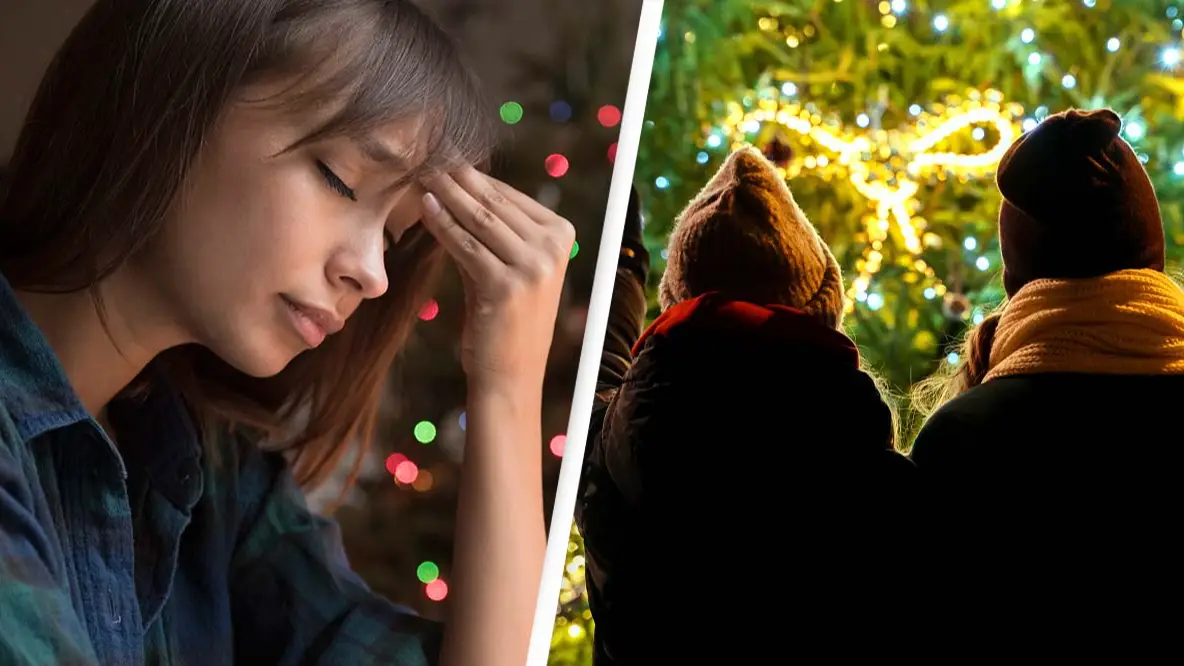
Staring at a Christmas tree can tell you if you have a health condition not everyone has

Did you know that gazing into your Christmas tree could make you aware that you’re suffering from a common eye issue?
We’re officially on the cusp of the Big Day—the halls are decked, the presents are wrapped and you’ve already lost Whamageddon after multiple re-dos.
While taking a moment to admire your handiwork, notice whether it looks like beams of light are coming out of each lightbulb on your festive display.
Advert
If it does, then you may have a common refractive error that affects about a third of the US population.
Below, we’ve outlined everything you need to know about this issue, including how experts believe it may be caused and how it can be detected.
Why am I seeing beams coming out of lights?
If you appear to see streaks through your Christmas tree lights then you may have a fairly common eye condition called astigmatism.
The American Academy of Ophthalmology (AAO) defines astigmatism as ‘an imperfection in the curvature of your eye’s cornea or lens’, stating your vision is likely to be blurry at ‘all distances’.
Instead of your eye being spherical, it’s shaped more like an American football. So instead of rays being focused sharply onto the retina, these light rays fail to bend properly as they enter the front of the eye.
“Vision is blurry at near and far because light rays either fall short of the retina or behind it,” writes the AAO.
It’s thought that around one in three people has astigmatism, according to the Cleveland Clinic.
It’s also important to note that the condition can develop at any age, while some people are born with it.

What are the main causes of astigmatism?
While doctors understand astigmatism may be caused by a different shape cornea or lens, experts have yet to discover why it varies from person to person.
However, they are aware that astigmatism can be hereditary. So if you have this common condition, then you pay pass it onto your offspring in the future.
The AAO says people can develop it after contracting an eye disease, suffering from injury, or even after undergoing surgery.
What are the symptoms of astigmatism?
According to the National Eye Institute (NEI), there are a handful of common astigmatism symptoms
These include blurry vision, needing to squint to see clearly and trouble seeing at night. Others include headaches and experiencing eye strain.
However, if you have a mild case then you may not notice any symptoms—so peering into your Christmas tree won’t be a good enough indication.
Instead, it’s suggested that you attend regular eye exams to keep on top of your health.

What astigmatism tests can I do at home?
If you’ve realised you have some (if not all) of the symptoms related to astigmatism, it’s recommended you book an eye exam with an optometrist or ophthalmologist ASAP.
These experts will put you through a series of tasks, including reading off eye charts and looking through a Phoropter - an instrument used to measure an individual’s refractive error.
But if you want to be sure before heading to see a specialist then there are some astigmatism tests you can complete at home.
One is to print off an official eye chart from a reputable source, place it on a wall with no window on it and sit around 10 feet away in a chair.
Cover one eye and read the smallest letters you can see clearly before repeating with the other eye.
But remember, these efforts are not designed to determine if you need to correct an astigmatism. Instead, it only helps you determine whether or not you have one.
 Ella Scott