Doctor shares 10 questions that could mean you have autism

A TikTok doctor has shared a test that could help give an insight into whether an individual has autism.
Of course, the test does not diagnose autism as the disorder needs to be diagnosed by a medical professional. However, those who may have concerns can always take the test to see if it's a possibility.
What is autism?
According to the National Institute of Mental Health, 'Autism spectrum disorder (ASD) is a neurological and developmental disorder that affects how people interact with others, communicate, learn, and behave.'
Symptoms of the disorder include nonverbal communication, problems with communication and repetitive behaviors.
Advert
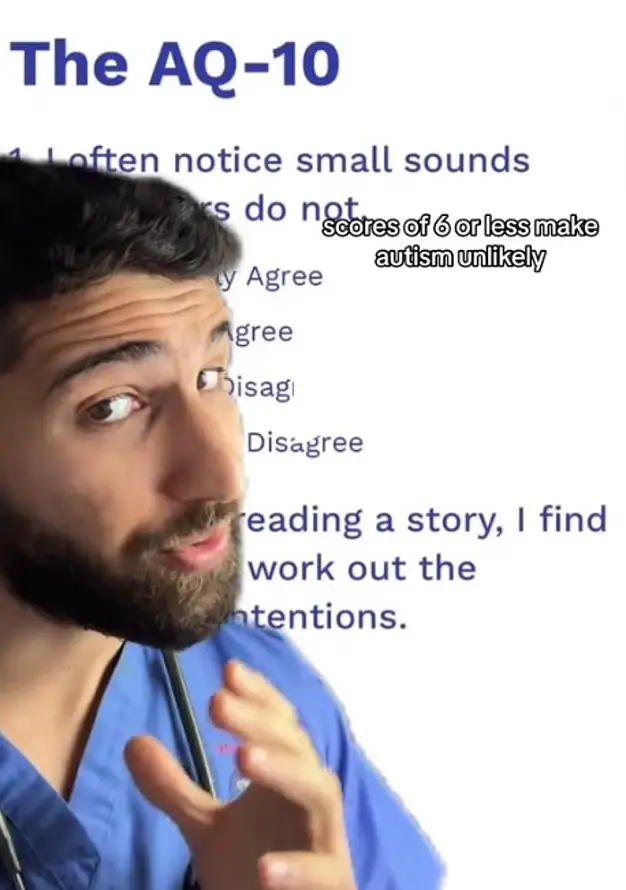
The Autism Spectrum Quotient-10 (AQ-10) explained
Doctor turned TikToker Dr Sermed Mezher discussed the Autism Spectrum Quotient-10 (AQ-10) test in a recent video that has gone viral on the video platform.
The test, which can be completed by those over the age of 16, consists of ten questions focusing on communication and social skills.
Dr Mezher said in his TikTok video: "The Autism Spectrum Quotient-10 is a brief screening tool designed to identify signs that may suggest a person could have autism.
"It consists of ten questions that focus on social communication, behaviour, and how someone processes information.
"While the AQ-10 can provide an indication of autistic traits, it is not a diagnostic tool.
"A high score on the AQ-10 suggests that further assessment might be necessary, but it cannot confirm an autism diagnosis."
The medical expert continued: "An official diagnosis requires in-depth analysis, including clinical interviews, developmental history, and observations by specialists.
"The AQ-10 can be a useful first step in recognising potential signs of autism, but it is not definitive — merely a guide to help determine if additional professional insights are needed.
"This test helps doctors to figure out if you could have autism or not. Scores of six or less make autism unlikely. Go with your first instinct."

Each question on the test can be answered with either 'definitely agree', 'slightly agree', 'slightly disagree' and 'definitely disagree'.
The questions are:
- I often notice small sounds when others do not
- I usually concentrate more on the whole picture, rather than the small details
- I find it easy to do more than one thing at once
- If there is an interruption, I can switch back to what I was doing very quickly
- I find it easy to ‘read between the lines’ when someone is talking to me
- I know how to tell if someone listening to me is getting bored
- When I’m reading a story I find it difficult to work out the characters’ intentions
- I like to collect information about categories of things (e.g. types of car, types of bird, types of train, types of plant etc)
- I find it easy to work out what someone is thinking or feeling just by looking at their face
- I find it difficult to work out people’s intentions
If you think you might have autism after taking the test, it's best to get in touch with your doctor's office who will be able to advise on next steps.
Topics: Health, Mental Health, Social Media, TikTok
 Callum Jones