
unilad homepage
unilad homepage
  • News
    • UK News
    • US News
    • World News
    • Crime
    • Health
    • Money
    • Sport
    • Travel
  • Music
  • Technology
  • Film and TV
    • News
    • DC Comics
    • Disney
    • Marvel
    • Netflix
  • Celebrity
  • Politics
  • Advertise
  • Terms
  • Privacy & Cookies
  • LADbible Group
  • LADbible
  • SPORTbible
  • GAMINGbible
  • Tyla
  • UNILAD Tech
  • FOODbible
  • License Our Content
  • About Us & Contact
  • Jobs
  • Latest
  • Archive
  • Topics A-Z
  • Authors
Facebook
Instagram
X
Threads
TikTok
YouTube
Submit Your Content
'Artificial Fish' Made of Human Heart Muscle Swims In Bizarre Footage
Home>Technology
Published 18:21 11 Feb 2022 GMT

'Artificial Fish' Made of Human Heart Muscle Swims In Bizarre Footage

The 'biohybrid' fish has been created by scientists at Harvard University, with the 'ultimate goal' to build an artificial heart

Emily Brown

Emily Brown

google discoverFollow us on Google Discover
Featured Image Credit: Alamy

Topics: Science, Health, US News

Emily Brown
Emily Brown

Emily Brown is UNILAD Editorial Lead at LADbible Group. She first began delivering news when she was just 11 years old - with a paper route - before graduating with a BA Hons in English Language in the Media from Lancaster University. Emily joined UNILAD in 2018 to cover breaking news, trending stories and longer form features. She went on to become Community Desk Lead, commissioning and writing human interest stories from across the globe, before moving to the role of Editorial Lead. Emily now works alongside the UNILAD Editor to ensure the page delivers accurate, interesting and high quality content.

Advert

Advert

Advert

Ever wondered what your heart might look like if it was a fish? Me neither, but scientists have now managed to create a fully autonomous artificial fish made out of human heart muscle.

On the off-chance you are someone who has wondered what their heart might look like as a fish, the answer is simple: it looks like a fish – albeit a toy fish.

The unusual little creature is made out of human heart muscles derived from stem cells, and scientists found it could swim continuously for up to 108 days by mimicking the contractions of a beating heart.

See the fish in action below:

Advert

The study, published this week in Science, was conducted by the Disease Biophysics Group at the Harvard John A. Paulson School of Engineering and Applied Sciences (SEAS), led by Kit Parker.

Prior to coming up with the 'biohybrid' fish, the team developed biohybrid stingrays and jellyfish from rat heart cells, as well as other bioengineering innovations.

In a news release about the fish, Parker said the team's 'ultimate goal is to build an artificial heart to replace a malformed heart in a child.'

He commented: 'Most of the work in building heart tissue or hearts, including some work we have done, is focused on replicating the anatomical features or replicating the simple beating of the heart in the engineered tissues. But here, we are drawing design inspiration from the biophysics of the heart, which is harder to do. Now, rather than using heart imaging as a blueprint, we are identifying the key biophysical principles that make the heart work, using them as design criteria, and replicating them in a system, a living, swimming fish, where it is much easier to see if we are successful.'
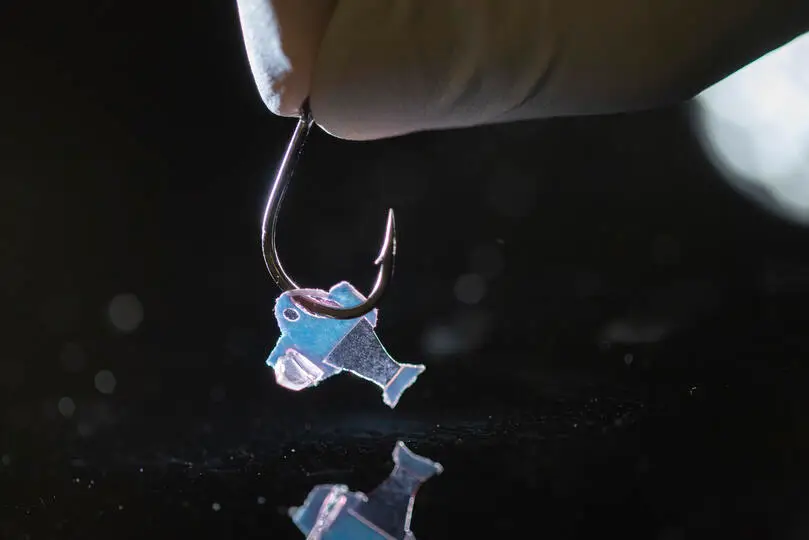
Biohybrid fish on a hook (Michael Rosnach, Keel Yong Lee, Sung-Jin Park, Kevin Kit Parker)

For their latest creation, Parker and his colleagues took into account the movements of zebrafish, which move by coordinating their body and caudal fin movements to generate propulsion.

They then sought to apply this motion to the artificial fish by layering cardiomyocytes, the muscular cells responsible for heart contractions, on two sides of the fish’s tail fin. As one side of the tail contracted, the other side stretched and stretch-activated mechanosensitive proteins launched into a constant closed-loop motion.

The scientists used an electrically autonomous pacing node, similar to a pacemaker, to allow the artificial creature to swim with the same motion as a beating heart, VICE reports.

In the study, Parker and his colleagues said: 'Our muscular bilayer construct is the first to demonstrate that the mechanoelectrical signaling of [cardiomyocytes] could induce self-sustaining muscle excitations and contractions for extended periods.'

The findings of the study shed light on cardiac disease, and could be a stepping stone in the development of artificial hearts for transplants.

If you have a story you want to tell, send it to UNILAD via [email protected]  

Choose your content:

a day ago
3 days ago
  • Getty Stock Images
    a day ago

    Security experts share key advice as Instagram DMs are no longer 'private' after huge change

    It's recommended you move 'sensitive conversations' to other platforms

    Technology
  • Justin Sullivan/Getty Images
    a day ago

    AI responds to ChatGPT CEO's warning that the tech will surpass humans by 2030

    Sam Altman said AI could become 'superintelligent' within a matter of years

    Technology
  • Brendan Smialowski - Pool/Getty Images
    a day ago

    Trump forced to ditch his trusty cellphone as he barreled into high-stakes China summit with Xi

    Donald Trump left China today (May 15) following a two-day state trip

    Technology
  • Graham Hughes/Bloomberg via Getty Images
    3 days ago

    'AI godfather' issues grim 10-year warning as he raises concerns about serious risks to humanity

    Yoshua Bengio said that giving AI's rights would be like giving citizenship to 'hostile extraterrestrials'

    Technology
  • Heart surgeon issues warning for food people eat that is 'slowly destroying your heart'
  • 'Medieval STI' nearly eradicated in the 90s is on the rise and it raises risk of heart attack
  • Trump calls for 'demonic' Barack Obama to be 'imprisoned' in bizarre late-night rant
  • Truth behind teddy bear 'made of human skin' found at gas station that sparked police investigation